
Roseville landlord tax benefits for rental costs and upgrades

A refundable rental security deposit generally isn’t income when received. If you keep part of it for unpaid rent or another taxable purpose, that amount may become income. Understanding Roseville landlord tax benefits also means distinguishing eligible rental expenses from upgrades that are generally recovered over time.
It’s easy to assume every dollar spent on a rental can be deducted right away, but the tax treatment depends on what the expense covers. Ordinary operating costs and repairs may be deductible in the year they occur, while capital improvements are generally recovered over time. According to the Internal Revenue Service, U.S. residential rental property is depreciated over 27.5 years.
This guide covers rental income, operating expenses, repairs, improvements, depreciation recapture, and construction costs. You’ll learn which costs may reduce taxable rental income, why upgrades can be treated differently from routine upkeep, and how organized records can support tax planning for your Roseville rental.
Table of Contents
1. Tax planning for property improvements and transactions
For a Roseville rental, organize tax planning around the property’s use, costs, and timing. According to the Internal Revenue Service, U.S. residential rental property is depreciated over 27.5 years. Depreciation applies to the building, not the land, and begins when the property is ready to rent. The depreciation period may depend on whether the property remains in rental use and whether its cost has been recovered. Appliances in rental properties are depreciated over 5 years.
A sale followed by another investment may raise the question of a Section 1031 exchange. According to the Internal Revenue Service, the replacement property must be identified within 45 days of selling the first property, and its purchase must be completed within 180 days. The replacement property must be of equal or greater value than the one sold. These deadlines make transaction timing and documented identification central planning steps, rather than details to leave until after a sale.
Tax treatment for short-term and long-term rentals can differ based on the average rental period, services provided, and the owner’s level of participation. These factors affect how the activity is reported and whether other reporting considerations apply. Roseville owners should assess the actual rental arrangement rather than relying on the label “short-term” or “long-term.”
Rental losses may be limited by the owner’s income and participation. Most small landlords may deduct up to $25,000 in rental-property losses each year, while a special rule permits some landlords to deduct 100% of losses every year. When income is too high for a current deduction, rental losses may carry forward. The applicable income thresholds and eligibility depend on the owner’s circumstances, so a loss on paper does not automatically mean a full current-year deduction.
To compare property tax bills across years or cities, review each parcel’s assessed value, tax rates, and listed charges separately. A higher bill may reflect a changed assessment or a different local charge, not a change in rental income. In Placer County and the City of Roseville, distinguish property-tax charges from federal rental deductions. Owning a rental does not by itself establish eligibility for an exemption or rebate.
For rental-property business driving, the standard mileage rate was $0.67 per mile in tax year 2024 and is $0.70 per mile for tax year 2025. To use the standard mileage method, a landlord must use it in the first year the vehicle serves the business activity. The method is unavailable after claiming accelerated depreciation or a Section 179 deduction for that vehicle. Keep records for rental-related travel, including overnight expenses. Residential property uses the 27.5-year depreciation period; U.S. commercial rental real estate uses 39 years.
2. Deductible rental operating expenses
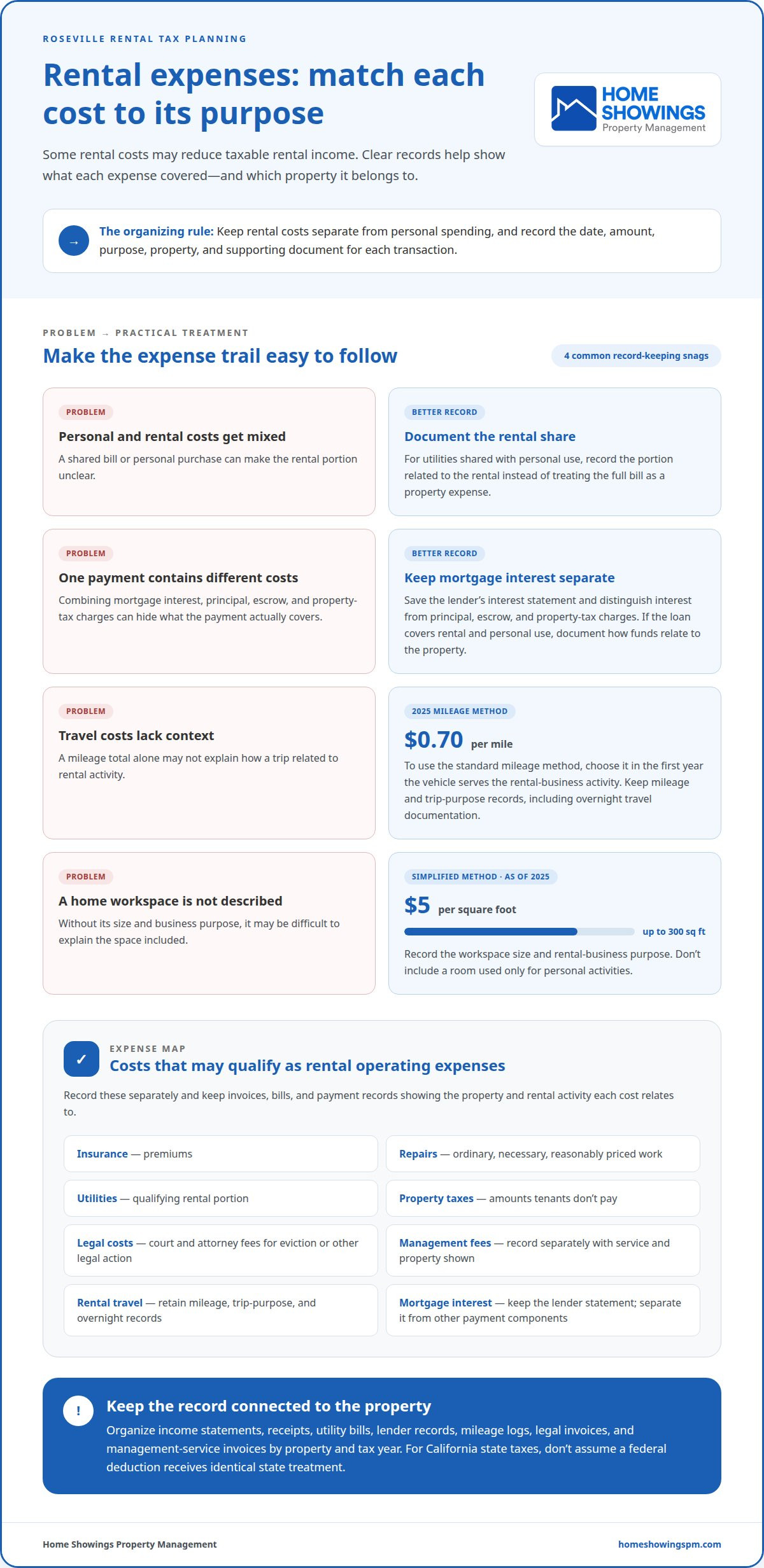
Start by recording rental income and the expenses connected to earning it. Qualifying expenses may reduce taxable rental income, but keep personal spending separate from rental costs. For each transaction, record the date, amount, purpose, property, and supporting document. This makes it easier to explain why a cost belongs to your Roseville rental. Real estate owners often look to specialized accounting practices for guidance—firms like POP Business illustrate how dedicated advisory services can help property investors maintain clear financial systems and stay organized.
Common rental operating expenses include insurance premiums, repairs, certain utilities, and property taxes that tenants don’t pay. Court and attorney fees for an eviction or other legal action may also qualify. Keep invoices, bills, and payment records together, noting the property and rental activity each expense relates to. If utilities are shared with personal use, document the rental portion instead of treating the entire bill as a property expense.
Travel, utilities, management fees, and home-office costs don’t all follow the same treatment. Rental-related utilities and qualifying travel costs may be deductible, while management fees should be recorded separately with invoices showing the service and property. For rental-business driving, the standard mileage rate is $0.70 per mile for tax year 2025; using this method requires choosing it in the first year the vehicle serves the activity. Keep mileage and trip-purpose records, including documentation for overnight travel.
Record mortgage interest separately. Keep the lender’s interest statement and distinguish interest from principal, escrow, and property-tax charges. These amounts represent different parts of a payment, so combining them can obscure the actual rental expense. If a loan covers both rental and personal use, retain records showing how the funds relate to the property.
For a home office, the simplified method uses the qualifying workspace area. According to the Internal Revenue Service, as of 2025, the simplified home office deduction is $5 per square foot and applies to a space of up to 300 square feet. Keep a record of the space’s size and its rental-business purpose; don’t include a room used only for personal activities.
For California state taxes, report rental income and apply expenses under the rules for that return. Don’t assume a federal deduction receives identical state treatment. Organize income statements, receipts, utility bills, lender records, mileage logs, legal invoices, and management-service invoices by property and tax year. This creates a clear record connecting each expense to its purpose.
A consistent system for rent and property records can make tax-time sorting easier. Explore residential property management as a way to keep rental operations organized.
3. Repairs versus capital improvements
A repair addresses wear, damage, or a specific malfunction in a rental property. Ordinary, necessary, and reasonably priced repairs to rental property are fully deductible in the year incurred. Fixing a leaking faucet or replacing a broken windowpane, for example, restores an existing feature. The work need not create something new to resolve the immediate problem.
A capital improvement generally adds value, adapts a property to a new use, or extends its useful life. Replacing an aging roof or renovating a kitchen may go beyond routine upkeep. These costs are generally recovered over time rather than deducted in full when paid. The project’s scope and effect on the property matter more than the label on the invoice.
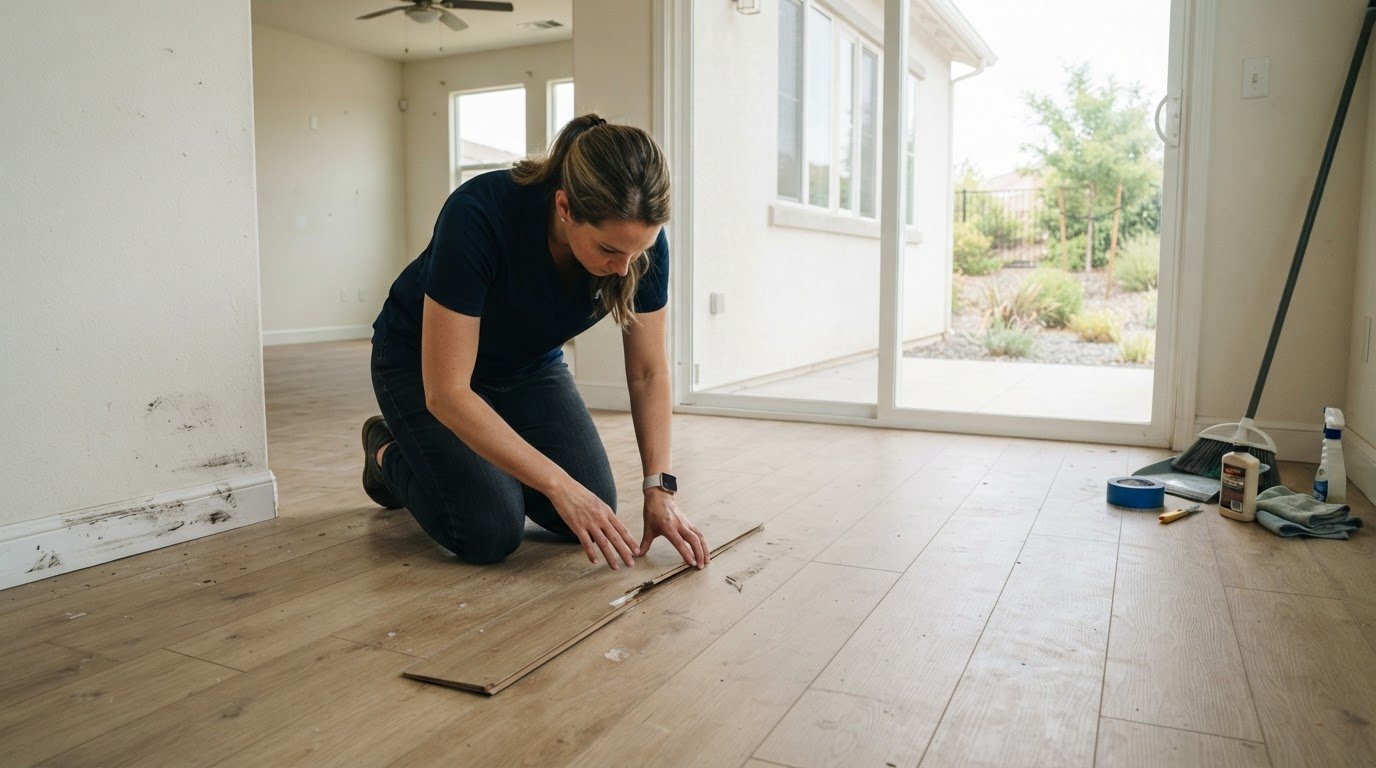
Classify the work by what it accomplishes. If a contractor repairs one damaged section of flooring, document the area and the repair. If the project replaces flooring throughout the rental and upgrades its quality, its broader scope may point to an improvement. One project can include separate repair and improvement tasks, so itemized invoices help keep descriptions accurate.
Use a consistent recordkeeping process for each job. Keep the invoice, proof of payment, work order, and relevant inspection notes together. Record the property address, date, materials, labor, and reason for the work. Before-and-after photos can help show whether the work restored an existing condition or changed the property. For owners assessing Roseville landlord tax benefits, these records support accurate expense classification.
Cost alone doesn’t determine the classification. Consider the property’s condition before work began, the area affected, and whether the result restored function or improved it. Repairing a damaged section of a fence differs from replacing the entire fence with a more durable design. Record the facts behind each decision, including separate contractor charges for different tasks.
Accurate classification matters: repairs may reduce rental income in the year incurred, while improvements are generally recovered over time. Treating an improvement as a current repair can distort expenses and the property’s investment basis. Treating a repair as an improvement can delay a deduction. Clear records of repairs and improvements support Roseville landlord tax benefits planning by showing how each cost was handled.
For ongoing upkeep, connect each repair record to the property’s maintenance history. A recurring leak, for instance, can show why a repair was necessary and what work resolved it. A later full plumbing replacement should have its own scope and documentation. This job-by-job record helps distinguish separate work and supports consistent tax treatment across years.
4. Depreciation recapture
Depreciation can lower taxable rental income while you own real estate, but it can also affect taxes when you sell. Depreciation recapture generally refers to tax treatment related to depreciation deductions claimed or allowable during ownership. The sale calculation considers the property’s adjusted basis, which reflects depreciation, alongside the sale proceeds. Keep purchase documents and depreciation records together to establish a clear starting point.
For residential rental property, depreciation recapture rates are capped at 25%. That cap is not the same as a guaranteed tax rate for every seller. The amount and treatment depend on the depreciation and sale details, along with other tax considerations. A sale may also involve capital gain, so recapture and gain should not be treated as interchangeable terms.
For example, an owner buys a rental, claims depreciation during the rental period, and later sells it. Depreciation records show the deductions that affected the property’s basis. Purchase documents establish the original investment, while sale records document proceeds and transaction details. Comparing these records helps identify amounts relevant to the final tax calculation without confusing rental income with sale proceeds.
The holding period matters, too. Rental property owned for over a year is taxed at long-term capital gains rates. That rule concerns the holding period and does not remove depreciation recapture considerations. A tenant’s occupancy or a change in rental income does not replace the owner’s purchase date, sale date, or depreciation history in the transaction records.
Keep depreciation separate from other entries that affect rental finances. Mortgage interest is an operating expense, while depreciation tracks the recovery of the property investment. A tax credit is a separate item and should not be included in the property’s depreciation total. Organize records by tax year and keep supporting statements, improvement documents, and sale paperwork together.
Before listing a rental for sale, assemble the purchase closing statement, depreciation schedules, capital-improvement records, mortgage documents, and expected sale paperwork. Match each improvement record to the property and the year the work occurred. This helps distinguish the original cost from later investments and accumulated depreciation. If ownership changed through inheritance or another transfer, preserve those documents as well, since they may affect the basis used in the sale calculation.
For a Roseville landlord, the practical takeaway is to track depreciation from the first rental year through the sale year. Don’t rely only on the latest tax return. Complete records across the ownership period can clarify how depreciation affected basis and what to consider when selling real estate. For investors aiming to turn property holdings into long-term wealth, strategic real estate consultancies like Acquire2Retire show how careful asset planning and portfolio guidance can help protect financial gains over time.
5. Eligible construction and rehabilitation costs
Construction and rehabilitation costs need clear records because a project can combine different types of work. A new rental building, a major renovation, and routine upkeep may receive different tax treatment. Start by identifying the project’s purpose, the areas involved, and whether the work creates or upgrades a lasting feature. These details help explain how the expense relates to rental real estate.
Some larger improvements are generally recovered over time instead of deducted as ordinary operating expenses in the year paid. However, some landlords may qualify to deduct certain rental-property improvement costs in one year. Eligibility depends on the specific cost and applicable tax rules. Don’t assume every construction invoice qualifies for immediate deduction or that every project follows the same method.
Separate project costs into useful categories. An invoice, for example, might include building materials, labor, permits, design work, and work on surrounding land. Keep itemized contracts and payment records so each amount is connected to its purpose. Land value itself cannot be depreciated, so keep land and building allocations distinct in your records.
Timing matters, too. Record when construction begins, when each phase is completed, and when the property is ready to rent. A renovation completed before rental use differs from work on an occupied rental, and dated invoices help establish the sequence. If a project adds an appliance, keep its purchase record separate from building costs because appliances have a different depreciation period.
Financing records matter alongside contractor invoices. If a landlord refinances and uses extra funds to improve or maintain the property, additional interest and fees may be deductible. Keep the refinance documents and evidence showing how the funds were spent. A mortgage statement alone may not show whether borrowed money went toward eligible property work or another purpose.
For a Roseville rental, build a project file with plans, contracts, permits, invoices, proof of payment, completion dates, and notes describing the work. Match each document to the property and specific improvement. If a contractor’s bill covers several tasks, request an itemized breakdown rather than recording one vague total. This creates a clearer basis for classifying construction expenses and tracking future deductions.
Property owners planning upgrades can coordinate rental property maintenance with organized project records. Keeping maintenance documentation alongside rehabilitation files helps distinguish recurring upkeep from broader investment work.
Home Showings Property Management
Home Showings Property Management helps rental owners manage day-to-day operations that generate income and expenses. Its Rental Property Management, Rental Marketing, Tenant Screening, and Rent Collection services support an organized rental process, helping owners maintain clearer leasing and rent records for their tax preparation.
If managing tenants, rent, and rental operations takes time away from planning property improvements, professional management can streamline those responsibilities. Home Showings Property Management supports Roseville owners with the ongoing work of residential rentals.
Contact Home Showings Property Management to discuss managing your rental.
Put your rental records to work
Strong tax planning starts with decisions made throughout the year, not just at filing time. Keep project documents, rental income records, and operating expenses organized as they arise. This gives you a clearer foundation for planning future work and considering how Roseville landlord tax benefits may apply to your rental.
Managing a rental also means finding tenants and keeping operations orderly. Home Showings Property Management offers Rental Property Management, Rental Marketing, and Tenant Screening to support owners with these ongoing responsibilities. Consistent management can make it easier to maintain the records and oversight that inform property decisions.
If you’re ready to discuss support for your rental, contact Home Showings Property Management. Take the next step with a steadier approach to managing your property.
Frequently Asked Questions
How are security deposits treated for tax purposes?
A refundable security deposit generally isn’t rental income when received because it is held for possible return to the tenant. If an owner keeps part to cover unpaid rent, that amount may become taxable income. Track the deposit received, any amount returned, and any portion applied to rent separately. Clear transaction records distinguish refundable funds from income reported for the property.
What federal tax deductions can landlords claim for rental property in Roseville, California?
Eligible expenses may include insurance premiums, repairs, certain utilities, property taxes tenants don’t pay, and legal fees for an eviction or other legal action. Rental income must still be reported, while qualifying expenses may reduce the taxable income it generates. Keep an invoice for a rental-related repair separate from a household expense. Whether a cost qualifies depends on its connection to the rental activity and its tax treatment.
How do mortgage interest, property taxes, insurance, and repairs affect rental income taxes?
Qualifying property taxes, insurance, and repairs can reduce rental income for tax purposes. Mortgage interest and fees on a refinance may also be deductible when extra funds are used to improve or maintain the property. Keep lender statements and records showing how refinance proceeds were spent. Record each expense by property and purpose, since personal costs or loan funds used elsewhere should not be treated as rental expenses.
How are rental property depreciation and the 2026 depreciation rules calculated?
U.S. residential rental property is depreciated over 27.5 years, while commercial rental real estate uses 39 years; appliances in rental properties are depreciated over 5 years. The depreciable amount excludes land and applies to the building and eligible depreciating items. Depreciation begins when the property is ready to rent. For 2026, use the applicable property classification, depreciable basis, and placed-in-service timing in calculating deductions.
How do California property tax assessments and Proposition 13 affect rental property owners in Roseville?
Property-tax assessments contribute to the tax bill, and local charges can differ by jurisdiction. Proposition 13 is part of California’s property-tax framework, so owners should distinguish the assessed property-tax amount from federal rental-income deductions. For a Roseville rental, keep assessment notices and tax bills with the property’s annual records. Comparing bills across years can help identify changes in assessed value or local charges without confusing them with deductible operating expenses.
What are the IRS passive activity loss limits and income thresholds for rental property owners?
Rental losses may be limited by income and participation. Most small landlords may deduct up to $25,000 in losses annually; a special rule allows some to deduct 100%, and losses that cannot be deducted because income is too high may be carried forward.


Comments