
Sacramento Landlord Guide to Rent Increases and Legal Limits

A rent increase that’s lawful for an apartment may not follow the same rules as one for a single-family home. California’s Tenant Protection Act caps annual increases for covered rentals at 5% plus the change in cost of living, up to 10% in any 12-month period, according to California Legislative Information. This Sacramento landlord guide to rent increases explains why property type and exemptions matter before you set a new rent.
If you’re weighing a lease renewal or planning a rent adjustment, you need a clear answer before sending notice. There is no single rent cap for every Sacramento rental: the property’s type, age, and applicable exemptions can affect which limits and notice rules apply.
This guide explains how California’s statewide rules work, what to consider for single-family rentals, and how timing affects a rent increase. It also covers how property management can help keep rent decisions, tenant communication, and leasing organized.
Table of Contents
When can a property manager request a rent increase?
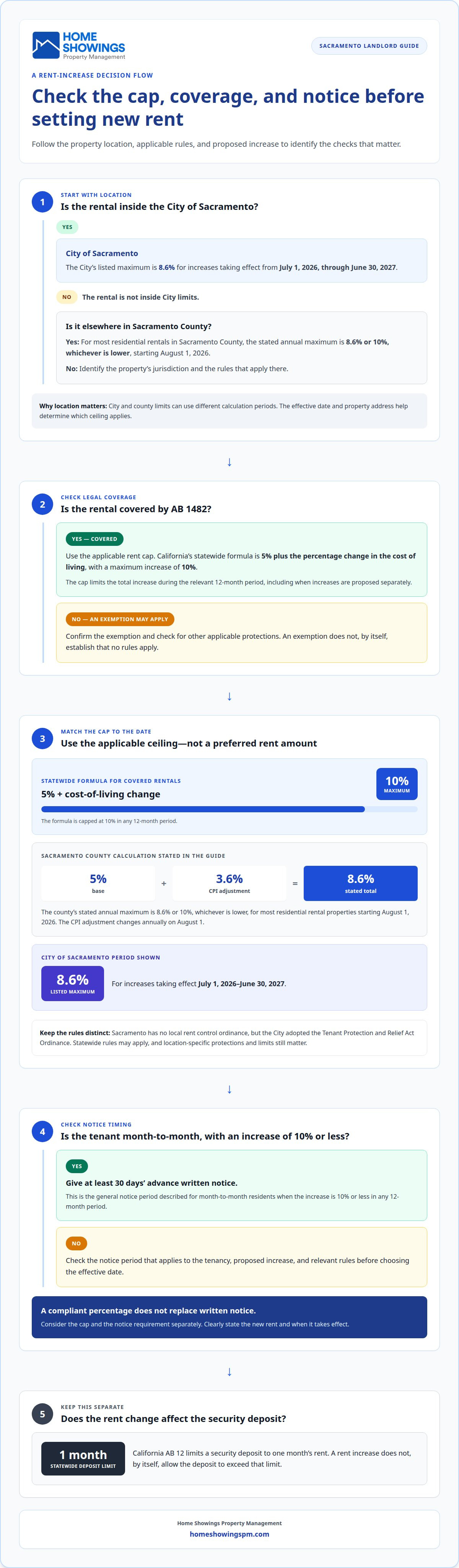
A property manager can propose a rent adjustment only after identifying the applicable cap, coverage rules, and notice period. This Sacramento landlord guide to rent increases starts with the property’s location and the date the increase would take effect, since Sacramento County limits change by period.
California Rent Cap Formula
California’s statewide formula sets a ceiling using a base increase plus a cost-of-living percentage, subject to a maximum. California Legislative Information states that the Tenant Protection Act caps annual rent increases at 5% plus the percentage change in the cost of living, with a maximum increase of 10%. This formula matters because the calculated limit, rather than the owner’s preferred payment amount, governs covered units.
AB 1482 Rent Cap
AB 1482 is the California law that limits rent increases for many residential rental properties. A property manager first determines whether the unit falls under the law and whether an exemption applies. If the unit is covered, the rent cap restricts the total increase during the relevant 12-month period. That distinction helps prevent a proposed adjustment from exceeding the limit through separate increases.
Sacramento County Rent Limits
For most residential rental properties in Sacramento County, the stated annual maximum is 8.6% or 10%, whichever is lower, starting August 1, 2026. The county calculation uses a 5% base plus a 3.6% Consumer Price Index adjustment. The CPI adjustment changes annually on August 1, so the date an increase takes effect matters. After August 1, 2026, the notice must show a new rent amount that does not exceed 8.6% of current rent.
Notice timing is separate from the cap. California Legislative Information says landlords generally must give month-to-month residents at least 30 days’ advance written notice for a rent increase of 10 percent or less in any 12-month period. A compliant percentage doesn’t replace written notice, so the manager considers both requirements before setting the effective date.
Security deposits have a separate statewide limit. California AB 12 limits a security deposit to one month’s rent. A rent increase doesn’t, by itself, allow the deposit to exceed that limit. Keeping the deposit calculation distinct from the new monthly rent helps avoid treating a higher payment as permission to collect additional security.
A Sacramento landlord guide to rent increases should distinguish property coverage, the applicable cap, the effective date, and the notice period. Together, these factors determine the permitted adjustment and when to communicate it. The new rent must stay within any applicable cap, and written notice should clearly explain the change to the tenant.
Is there a local ordinance in Sacramento?
Sacramento has a Tenant Protection and Relief Act Ordinance, but no local rent control ordinance. Tenants can keep notices and payment records, raise a suspected overcharge in writing, and consult California Legislative Information for state-law text. SHRA provides Housing Choice Voucher guidance. Unlawful rent demands can lead to disputes and unresolved payment questions.
Local CPI Cap Calculations
A local CPI cap uses a base percentage plus a cost-of-living adjustment to set the permitted increase. Sacramento’s formula allows one annual increase within a 12-month period, calculated as 5% plus CPI, up to 10%. For increases taking effect from July 1, 2026, through June 30, 2027, the City’s listed maximum is 8.6%. The effective date and local CPI figure determine which ceiling applies.
Sacramento Rent Control and Protections
Sacramento does not have a local rent control ordinance, but the City adopted the Sacramento Tenant Protection and Relief Act Ordinance. That distinction matters: the absence of a local rent control program does not mean every residential tenancy is free from limits or protections. California statewide rules may apply, and the City ordinance provides local tenant protections. A tenant reviewing a proposed increase should identify the property’s jurisdiction and applicable rules.
Local Rent Stabilization Rules
Rent stabilization rules can differ between the City of Sacramento and other parts of Sacramento County. A property manager first identifies whether the rental lies within city limits or elsewhere in the county, then matches the effective date to the relevant cap. The City’s listed 8.6% maximum applies during its stated July-to-June period. County limits and state caps can have different calculation periods, so the address and date matter.
Landlord Risks and Official Guidance
If a tenant questions an increase, keeping the written notice, rent ledger, and payment records makes it easier to raise the discrepancy in writing with the landlord or property manager. These records show the requested amount, current rent, and effective date. An unlawful demand can create a payment dispute and strain the tenancy; the stated Sacramento code-enforcement fines concern unresolved issues, not a specific rent-increase penalty.
For official guidance, California Legislative Information provides the text of state law, while SHRA handles rent-change processes for Housing Choice Voucher participants. SHRA’s role is specific to its program, so it is not a general rent-control office. A managed review of the applicable cap, notice, and rent records can help keep decisions organized; professional property management may suit owners seeking that support.
Lease renewals and timing
For a Sacramento rent increase, a property manager determines advance written notice by considering the proposed increase, tenancy type, and applicable state or local rules. California Legislative Information says month-to-month residents generally receive at least 30 days’ written notice for an increase of 10 percent or less in any 12-month period.
Renewal planning starts well before the lease ends. Reviewing comparable rents and CPI data 90-120 days ahead gives owners time to understand market conditions and the relevant rent maximum. That review is a planning step, not permission to exceed a rent control limit. The applicable cap still governs any increase for a covered rental.
With the initial analysis complete, a property manager can set a proposed rent and renewal terms 75-90 days before lease end. This timing leaves room to consider the tenant’s payment history, the property’s condition, and whether the proposed amount fits the applicable rules. A clear decision early in the process also helps avoid rushed or inconsistent communications.
Renewal discussions can begin 60-90 days before a fixed-term lease ends. The manager can share the proposed terms in writing, explain the new rent and effective date, and give the tenant time to respond. If the tenant wants to renew, the written agreement records the terms. If either party proposes changes, the manager can address them before the existing lease expires.
The notice period for a rent increase is separate from the timing of renewal discussions. First identify whether the tenancy is month-to-month or fixed-term, calculate the proposed increase, and determine which notice rule applies. Written notice should state the new rent and effective date. A renewal conversation does not replace legally required notice.
Nonrenewal has its own timing considerations. Sacramento landlords may need to provide 90 days’ notice before a lease non-renewal or eviction without cause in certain situations. That rule concerns ending a tenancy, not the ordinary notice period for raising rent. Keeping those processes distinct helps prevent a renewal decision from being confused with a rent adjustment.
Security deposits are separate from renewal rent. California’s one-month deposit limit should not be treated as an additional rent increase or as a way to change the monthly payment. Keep the rent amount, deposit, lease dates, notices, and tenant responses distinct in the renewal record. Clear documentation helps owners and tenants refer back to the terms if questions arise.
Statewide cap coverage and exemptions
California’s statewide cap applies to many residential rentals, but coverage depends in part on the property’s age and type. For Sacramento rentals, distinguish exemption from local rent stabilization from exemption under state law.
Statewide Cap Coverage
California’s Tenant Protection Act sets a rent-increase ceiling for covered housing, helping tenants and owners assess a proposed adjustment. According to California Legislative Information, the Act caps annual rent increases at 5% plus the percentage change in the cost of living, with a maximum increase of 10%. California’s statewide cap generally applies to rental housing more than 15 years old. A property’s age therefore helps determine whether this protection applies.
The cap also controls cumulative increases during the applicable period, rather than treating each rent change as unrelated. For units covered by AB 1482, a landlord may raise rent twice in a 12-month period if the cumulative increases stay within the cap. For example, two separate increases still need to fit under the same overall limit. California’s Tenant Protection Act is in effect through January 1, 2030, unless extended by the Legislature.
Exempt Properties
Some Sacramento properties may fall outside local rent stabilization rules because of their construction date or type. Local rent stabilization caps generally don’t apply to buildings with a certificate of occupancy issued after February 1, 1995, or to most single-family homes and condominiums. That distinction matters, but a local exemption alone doesn’t establish that a property is exempt from statewide tenant protections.
For a single-family home or condominium, the property manager separates the local-rule question from AB 1482 coverage. The building’s age and rental type help frame the review, while the relevant state exemption determines whether the statewide cap applies. If the property is covered, its rent changes must remain within the state limit even when local stabilization rules don’t apply.
Turnover can affect the rent calculation. Under California law, a landlord may set the initial rent when existing tenants move out and new tenants move in. This initial-rent rule differs from raising rent for a continuing tenant, where applicable protections and caps remain relevant. Identify whether the situation involves a new tenancy or an increase during an existing tenancy.
For Sacramento owners, start by identifying the property type, construction or occupancy date, and tenancy status, then determine which state and local rules apply. Treating “exempt” as a blanket label can lead to mistakes. Any applicable cap still governs increases for covered tenants, and notice requirements must be considered separately.
Rent increases for single-family homes
A single-family home may be treated differently from an apartment, but property type alone does not resolve every rent-limit question. Determine whether the home is exempt from the applicable state cap and whether separate notice rules apply.
California local rent stabilization caps generally don’t apply to most single-family homes or condominiums. They also generally don’t apply to buildings with a certificate of occupancy issued after February 1, 1995. These local-rule exemptions aren’t the same as an exemption from AB 1482. A manager needs to establish which rule governs the property before setting a new rent.
For an AB 1482-exempt single-family house, the research example uses monthly rent of $1,000 and a proposed increase of $200. That adjustment is greater than 10%. The example explains that an exempt landlord may raise rent above 10%, while still needing to provide the applicable advance notice. The practical takeaway is that an exemption from the cap doesn’t remove notice obligations.
Notice depends on the situation and the program involved. For a requested rent increase greater than 10%, the Sacramento Housing and Redevelopment Agency states a 90-day notice requirement. This is especially relevant when the rental participates in the Housing Choice Voucher program. SHRA’s stated notice requirement is 60 days for a requested increase less than 10%, so the proposed percentage affects the timeline.
Keep the proposed amount, calculation, notice date, and effective date together in the rental record. If renewing a lease, distinguish the rent change clearly from other renewal terms. A written record helps owners explain the change and gives tenants a reference for the new payment. It also keeps a rent adjustment separate from an eviction or nonrenewal decision.
Local ordinances and state protections can vary with the property’s location and exemption status. A single-family home in the City of Sacramento may have different local-rule considerations from one elsewhere in Sacramento County. Before issuing notice, identify the property’s jurisdiction, state-law coverage, and any applicable SHRA requirements.
For owners managing a single-family rental, get property management support to coordinate rent updates, notices, and tenant communication.
Home Showings Property Management: Rental Marketing
Home Showings Property Management helps owners connect rent decisions with the wider rental process. Rental Marketing and Tenant Screening support leasing, while Rent Collection and property management help organize ongoing operations. Consider professional support when coordinating rent updates, tenant communication, and leasing becomes difficult. Clear records of rent terms and notices help keep each decision connected to the tenancy.
If you’d like support with your rental property, contact Home Showings Property Management.
Build a steadier rental process
Use this Sacramento landlord guide to rent increases as a starting point for a more consistent approach to rental ownership. Make rent decisions part of an organized management process, with clear records, timely tenant communication, and attention to each property’s circumstances. This structure can make future leasing decisions easier to manage.
Home Showings Property Management brings property management together with Rental Marketing and Tenant Screening, helping owners manage key parts of the rental process through one professional relationship. This support can help when rent planning overlaps with leasing and tenant needs, rather than standing alone.
Move forward at a pace that fits your property and priorities. Contact Home Showings Property Management to discuss support for your rental, and take the next step with a clear plan.
Frequently Asked Questions
Is there a rent control in California?
California sets statewide rent-increase limits for covered rentals, but not every property is covered. Local ordinances may impose stricter limits, while Sacramento has tenant protections but no local rent control ordinance. Distinguish the statewide Tenant Protection Act cap from local protections and property-specific exemptions to determine which ceiling applies before communicating a proposed increase.
Can my landlord email or text this notice?
A rent increase notice must be in writing. California Legislative Information describes the notice period for qualifying month-to-month increases. Whether email or text meets delivery requirements depends on the applicable rules and circumstances, so don’t rely on message format alone. State the proposed rent and effective date clearly, and use a delivery method that meets the legal requirements for the tenancy.
Does AB 1482 apply to all properties?
No. AB 1482 applies to many residential rentals, but coverage depends on factors such as the property’s age and whether a legal exemption applies. California’s statewide rent cap generally covers rental housing more than 15 years old. Most single-family homes and condominiums may be exempt from local rent stabilization, but that doesn’t automatically establish a state-law exemption. Managers should assess state and local coverage separately for each property.
How does a property manager determine how much rent to charge?
When setting a proposed rent, consider comparable local listings, the home’s condition and features, and any applicable legal cap. Market rent and maximum lawful rent are different figures: the proposed amount must stay within the limit that applies to the property. Comparing area listings can help owners set a competitive rent, while the lease terms and tenant’s current rent inform the permitted adjustment.
How does a property manager calculate the maximum annual rent increase in Sacramento, including CPI?
The manager identifies the property’s jurisdiction and the cap period, then applies the relevant CPI adjustment to the permitted base. For most Sacramento County residential rentals, the limit starting August 1, 2026, is 8.6% or 10%, whichever is lower, using a 5% base plus a 3.6% CPI adjustment. City of Sacramento increases have a separate effective period, so the address and date matter.
What rules apply to rent increases for month-to-month and fixed-term leases in Sacramento?
For a month-to-month tenancy, the amount and notice period depend on the proposed increase and applicable protections. California Legislative Information says landlords generally must give at least 30 days’ advance written notice for increases of 10 percent or less in any 12-month period. For a fixed-term lease, the agreement’s end date and renewal terms shape when a new rent can take effect, alongside any applicable cap and notice rules.
Can a property manager raise rent more than once in a 12-month period?
For a unit covered by AB 1482, rent may be increased twice in a 12-month period if the cumulative increases don’t exceed the applicable cap. For example, two adjustments must be considered together, not treated as separate opportunities to apply the full cap. The manager also needs to follow notice requirements for each change. Property exemptions and other applicable rules can affect the analysis.
What notice and disclosure requirements does a property manager need to follow for Sacramento rent increases?
The manager should provide written notice with the proposed rent and effective date, then follow the notice period tied to the increase and tenancy. California Legislative Information specifies at least 30 days for qualifying month-to-month increases of 10 percent or less. For Housing Choice Voucher rent requests, Sacramento Housing and Redevelopment Agency states 60 days for increases under 10% and 90 days for increases greater than 10%. SHRA procedures apply to its program.


Comments