
Rancho Cordova Landlord Communication for Leasing and Renewals

Communication is part of managing a rental, not an extra task to squeeze in when time allows. Rancho Cordova landlord communication best practices start with clear tenant updates, timely renewal conversations, and owner reports that support decisions. Consistent, respectful follow-through keeps leasing and resident relations organized.
Owners want tenants to feel informed and to know what is happening with their property. When messages are delayed or unclear, routine questions can become harder to resolve and renewal decisions may feel rushed. A steady communication process gives residents a reliable point of contact and owners a clearer view of day-to-day management.
This article covers communication during leasing, renewals, maintenance, owner reporting, and legal compliance in Rancho Cordova. It explains what a professional manager communicates, how timely updates support resident relations, and what to consider when choosing a management partner. The aim is a practical process that keeps everyone informed without adding unnecessary complexity to ownership.
Table of Contents
Clear tenant communication and timely lease renewals
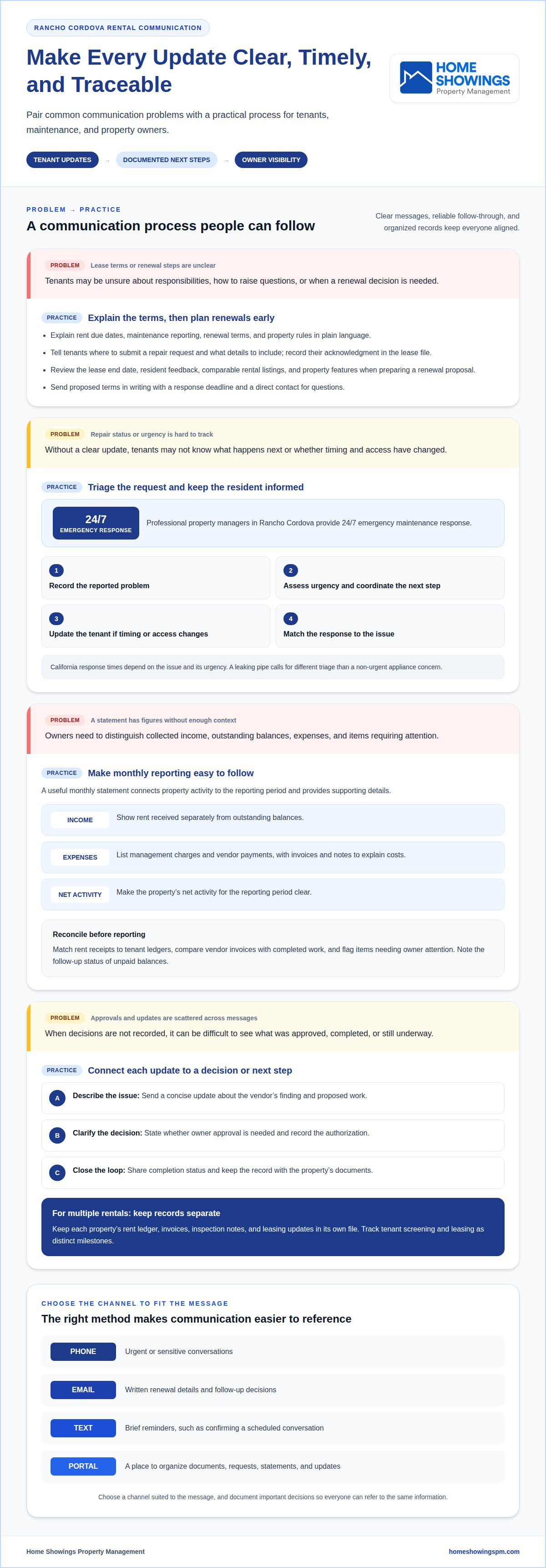
Clear updates make rental milestones easier to follow, from lease signing to renewal. In Rancho Cordova, property management communication works best when messages, decisions, and next steps are documented.
Explaining Lease Terms
Before a tenant signs, a manager can explain the lease, including rent due dates, maintenance reporting, renewal terms, and property rules. Plain language helps tenants understand their responsibilities and how to raise questions. For example, a manager can explain where to submit a repair request and what details to include, then record the tenant’s acknowledgment in the lease file.
Choosing Communication Methods
Phone calls work well for urgent or sensitive conversations, while email provides a written record of renewal details and follow-up decisions. For handling high call volumes or after-hours inquiries, automated answering services like Oscar can ensure resident calls are always picked up promptly. Texts can handle brief reminders, such as confirming a scheduled conversation, and a tenant portal can keep documents, requests, and updates organized. Professional property managers choose a channel suited to the message and record important decisions so everyone can refer to the same information.
Responding to Repairs and Emergencies
Professional property managers in Rancho Cordova provide 24/7 emergency maintenance response. For other repair requests, the manager records the reported problem, assesses its urgency, coordinates the next step, and updates the tenant if timing or access changes. California response times depend on the issue and its urgency; a leaking pipe, for example, calls for different triage than a non-urgent appliance concern. Clear status updates keep the tenant informed while work is coordinated.
Begin renewal planning early enough to review the lease end date, resident feedback, and current rental market conditions. A manager can assess comparable rental listings and property features, then explain how those factors inform proposed terms. Send the proposal in writing with a response deadline and a direct contact for questions. This gives both sides time to discuss renewal instead of leaving the decision until the lease is about to end.
Lease administration includes keeping signed agreements, notices, payment records, and tenant communications organized. If a tenant misses a lease requirement, the manager can cite the relevant clause, explain the concern in writing, and document the response. For a rent dispute or complaint, hear the tenant’s account, review the lease and payment history, explain the applicable process, and track agreed next steps. Consistent records keep the discussion focused on the issue.
Prepare leases using clear terms and review documents for consistency before presenting them to tenants. Legal requirements can affect notices and lease provisions, so compliance belongs in preparation and renewal, not as an afterthought. Across the Sacramento area, organized lease files help connect tenant communication with rental marketing, renewal decisions, and ongoing administration.
Open communication and clear owner reporting
Owner updates are most useful when they connect property activity to decisions and next steps. For a Rancho Cordova rental, a manager can report leasing progress, tenant concerns, maintenance coordination, and financial activity in one organized record. Owners can then distinguish routine updates from matters needing approval, such as a repair estimate or a change in leasing plans.
A useful monthly statement makes income and expenses easy to follow. It can show rent received, outstanding balances, management charges, vendor payments, and the property’s net activity for the reporting period. Supporting invoices and notes explain expenses. For example, a plumbing charge should identify the work completed and the property involved, rather than appear as an unexplained line item.
Monthly accounting is more useful when transactions are reconciled before reporting. Managers can match rent receipts to tenant ledgers, compare vendor invoices with completed work, and flag items needing owner attention. If a payment remains outstanding, report it separately from collected income and note the follow-up status. This gives owners a clearer view of cash flow without suggesting an unpaid balance has been resolved.
Open communication also requires agreement on how decisions are handled. When a vendor identifies an issue, a manager can send a concise update, describe the proposed work, and say whether owner approval is needed. After a decision, record the authorization and share the completion status. This creates a traceable sequence for maintenance, leasing, or tenant concerns instead of relying on scattered messages.
For owners with multiple rentals, consistent report labels make comparisons easier. Keep each property’s rent ledger, invoices, inspection notes, and leasing updates in its own file. If one rental is vacant while another has a maintenance expense, separate records prevent confusion. Report tenant screening and leasing as distinct milestones so owners can see what has happened and what is still underway.
Owner and tenant portals can centralize statements, documents, and property updates, giving owners a practical place to review records. A manager should still explain unusual entries directly, such as a vendor invoice that differs from the approved scope. Clear reporting is not just uploading documents; it means connecting each record to a decision, an event, or a next step. For owners seeking a more organized view of their property management services, a portal-based reporting process can make ongoing coordination easier to follow.
Adopting Rancho Cordova landlord communication best practices means maintaining transparent financial records; it also means explaining how records support decisions over time. Professional managers foster tenant relationships through clear communication and timely lease renewals. California generally limits residential security deposits to one month’s rent for most properties. The stated local housing mix is also relevant: 60% of residential properties in Rancho Cordova are single-family properties, making tailored owner reporting essential for individual property types.
Legal compliance
In California, tenant notices and rental records require careful handling. A property manager can connect each notice to the applicable rule, delivery record, and rental file.
Following Tenant Notice Rules
Professional managers follow California notice rules by identifying the notice type, reviewing tenancy documents, and using the applicable delivery process. They retain a copy and record when and how it was sent. This helps organize rent collection notices, lease communications, and other tenant updates. For a notice about a lease concern, document the relevant facts and subsequent communication as well.
Delivering Rent Increase Notices
For California rentals covered by the Tenant Protection Act, annual rent increases are capped at the lower of 5% plus the applicable change in cost of living or 10%, according to California Legislature. A manager should determine whether the rental is covered before preparing a notice. The notice process should follow applicable requirements, and the manager should retain the notice and delivery record with the tenant’s file.
Notifying Tenants of Entry
Before arranging access to a rental, a property manager communicates the purpose and proposed timing, then follows the notice requirements that apply. The manager records the notice and coordinates access with the tenant. For example, an inspection or maintenance visit should have a clear purpose and documented communication, not an informal, unrecorded arrangement.
Security deposit accounting also requires an organized process. California landlords generally have 21 days after a tenancy ends to return the remaining security deposit and provide an itemized statement when deductions are taken, according to California Legislature. A manager can track the tenancy end date, gather supporting records for deductions, prepare the statement, and document the return. Clear records help explain how the deposit was handled.
Rancho Cordova has local requirements alongside California rules. Residential rental properties must be registered with the city annually, and owners must maintain an active business license. A manager can track these obligations in the property file and keep related records together. If an inspection identifies violations, the city generally allows owners 30 days to make corrections before reinspection.
Compliance also affects leasing. Keep listings, screening records, lease documents, and tenant notices organized as separate parts of the rental file. For example, employment information gathered during screening belongs with the tenant’s records, not mixed with inspection notes or rent collection correspondence. A clear file structure supports accurate communication across Rancho Cordova and surrounding communities.
When a tenancy ends, document the move-out, organize inspection findings, and prepare deposit accounting within the applicable timeframe. If a tenant questions a deduction, refer to the itemized statement and supporting records. Tracking each step, from notice preparation through delivery and follow-up, makes legal communication easier to review and manage.
Resident relations and communication
Resident relations are built in ordinary moments, such as explaining a delayed repair or clarifying a shared-space concern. A manager can acknowledge the tenant’s message, summarize the issue, and explain the next step. If a resident reports repeated noise, for example, record the concern, contact the relevant parties, and follow up with the outcome. Consistent handling supports respectful residential relations and helps protect the owner’s investment.
Language needs and accessibility requests call for attentive, direct communication. A professional manager can ask which format works best, use plain language, and adapt how information is shared to the tenant’s stated needs. For example, break a lengthy explanation into short written steps and offer a call to clarify details. Record the agreed communication preference so future updates follow a consistent approach.
Maintenance requests need a clear record from the initial report through completion. Log the tenant’s description, affected area, access details, and action taken. If a resident reports a leaking sink, the record can capture when it was reported, vendor coordination, and updates shared with the tenant. This history supports later reporting and helps prevent requests from getting lost between conversations.
Handle complaints calmly, separating reported facts from assumptions. Listen to each tenant, document the specific concern, and identify a practical next step. For a common-area dispute, that could mean recording the location and timing, reviewing relevant property records, and communicating the resolution. A consistent process helps residents understand how their concern is handled without exposing another tenant’s private information.
Lease concerns, including possible violations, require measured, professional communication. Identify the lease provision involved, describe the observed issue, and keep the discussion focused on relevant facts. If a situation may lead to eviction, follow the applicable legal process for communication and records rather than relying on threats or informal promises. Clear documentation distinguishes a resolved concern from one requiring further action.
Resident relations begin during leasing. Clear communication about screening steps and application requirements helps applicants understand what information is requested, including credit details, without suggesting every application will have the same outcome. Provide the same process information to each applicant and keep applicant records separate. In Rancho Cordova, this approach helps applicants understand expectations before moving in and gives owners a clearer account of leasing activity.
rmation they need to provide and what to expect from the process. Local context can help keep those conversations grounded in the needs of the community. About 85% of Rancho Cordova residents aged 25 or older have completed high school, while about 22% of Rancho Cordova residents aged 25 or older have completed some form of post-secondary education. Sacramento County residents can contact the Sacramento Housing and Redevelopment Agency at 916.440.1390 about applying for public housing or housing vouchers. Providing this contact gives residents a clear point of reference for those questions.
What landlord-tenant communication best practices can a professional property manager provide in Rancho Cordova, California?
A professional manager can create a consistent communication process for each rental, from move-in coordination to maintenance follow-up. In Rancho Cordova, keep tenant messages, property decisions, and owner updates connected. Establish preferred contact channels, record important conversations, and direct each request to the person responsible for the next step.
Set clear expectations before a tenant takes possession. Explain how to submit requests, where to direct questions, and how updates will arrive. For example, a move-in message can describe how to report a maintenance concern and which details are useful. This gives residents a clear route for routine issues without confusing them with urgent situations.
Professional communication distinguishes acknowledgment from resolution. After receiving a concern, confirm it was received, identify any information needed, and explain the next action. If a vendor needs access, coordinate the visit and update the tenant about changes. Once the request is complete, close it with a concise summary that leaves a useful property management record.
For maintenance: Record the issue, location, access details, and status updates.
For complaints: Document the concern, review relevant records, and share the appropriate next step.
For owner decisions: Explain the choice required and record the owner’s direction.
For leasing: Keep applicant communications consistent and separate from resident records.
When a conversation becomes tense, keep it factual and focused. If a tenant questions a charge, review the account entry and lease documents, then explain the basis for the amount. If a resident reports a recurring issue, check prior records before deciding on follow-up. A written summary helps prevent misunderstandings from carrying into later conversations.
Useful owner communication also respects decision boundaries. Identify matters needing owner input, present the relevant details, and record the decision before coordinating action. For example, explain a proposed maintenance expense with its purpose and supporting information. This helps owners understand the choice without receiving disconnected updates about every operational step.
In practice, strong Rancho Cordova landlord communication best practices combine a dependable record, clear responsibility, and respectful follow-through. If you want professional support coordinating rental communication and property management, connect with a property manager to discuss the next step.
Home Showings Property Management
Home Showings Property Management coordinates communication across leasing and ongoing rental management. If tenant updates, renewals, and owner reporting take time away from other responsibilities, a professional manager can organize these processes alongside Rental Marketing, Tenant Screening, and Rent Collection.
This support is useful when you want one management process to connect applicant communication with tenancy operations. Owners have a clear point of coordination for rental activity, while resident communication stays respectful and records organized.
For help managing rental communication in Rancho Cordova, contact Home Showings Property Management.
Make communication part of your rental plan
Your next step is to decide how you want rental communication handled as ownership continues. Consider which tenant matters need your direct involvement and which updates a professional manager can coordinate. Applying Rancho Cordova landlord communication best practices means building a process that adapts as residents, leasing needs, and property decisions change.
Home Showings Property Management provides Property Management, Rental Marketing, and Tenant Screening to support owners through key parts of the rental process. Contact Home Showings Property Management to discuss your priorities, your property, and the communication you want tenants to receive.
Ready to discuss a more organized approach to managing your rental? Contact Home Showings Property Management to talk about your property management needs. A clear next step can help you move forward with greater confidence and a steadier plan for the months ahead.
Frequently Asked Questions
Are there Rancho Cordova or Sacramento County rental housing rules affecting landlord communications?
Yes. California requirements and City of Rancho Cordova procedures can affect what landlords communicate and document. For example, local rental inspections may check working plumbing and carbon monoxide detectors, so managers can clearly explain inspection access, findings, and follow-up. Requirements depend on the property and issue involved. A manager should distinguish city procedures from state rules and keep related notices and inspection records with the rental file.
Comments