
Sacramento Rental Property Operating Expenses: A 2026 Landlord’s Guide

A clear picture of rental costs starts with records organized by property. Sacramento rental property operating expenses can include recurring bills, maintenance, and other costs, but it may not be obvious what belongs in an operating budget or how a cost should be treated for tax purposes. Scattered receipts and invoices make that harder to sort out.
To understand how costs affect a rental’s performance, track them consistently and keep the supporting documents. This guide covers common expense categories, how to distinguish routine operating costs from potential capital improvements, and what to organize for a tax professional. It doesn’t replace professional tax advice, but it can help you prepare useful records and questions.
We’ll also cover a practical recordkeeping routine and how rent, maintenance, and inspection records support property oversight. With an orderly system, you can review operations throughout the year and make tax-time preparation more manageable.
Table of Contents
Sacramento Rental Property Operating Expenses: What Owners Should Track
Operating expenses are the costs of running and maintaining a rental property. For a Sacramento rental, examples might include a routine plumbing repair, an insurance payment, or a utility bill paid by the owner. A high-level overview of Operating expense (OpEx) also describes how the term applies in real estate. For practical bookkeeping, record each transaction clearly without assuming that every cost has the same tax treatment.
Operating expenses help owners understand the costs of running a rental, but they are not automatically tax deductions.
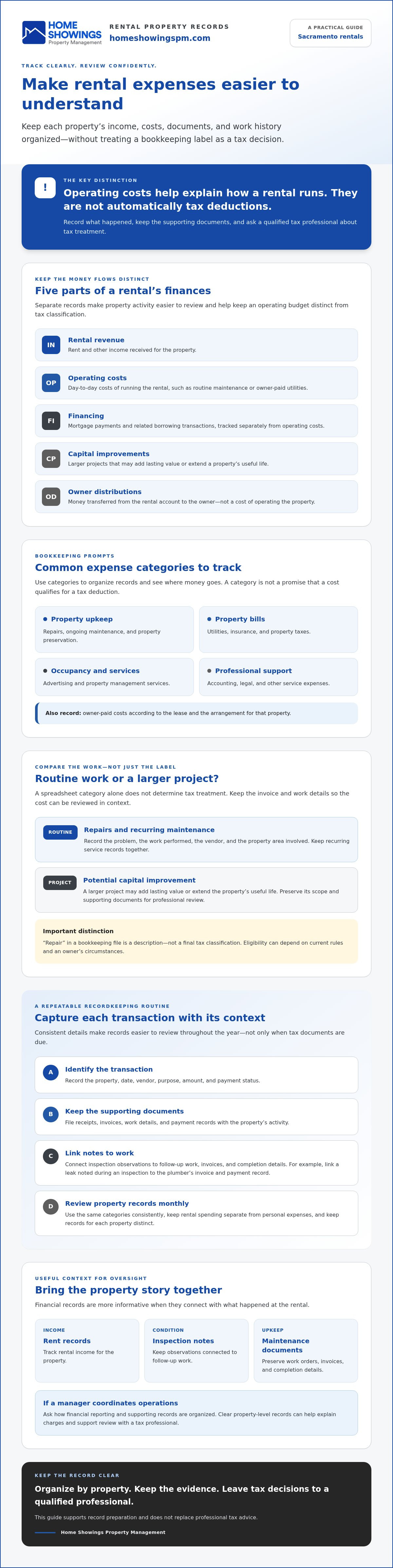
Keep these parts of the property’s finances distinct:
Rental revenue: Rent and other income received for the property.
Operating costs: Day-to-day costs of running the rental, such as routine maintenance or owner-paid utilities.
Financing: Mortgage payments and related borrowing transactions, tracked separately from operating costs.
Capital improvements: Larger projects that may add lasting value or extend a property’s useful life.
Owner distributions: Money transferred from the rental account to the owner, rather than a cost of operating the property.
Separating these items makes it easier to review cash flow and prepare records for professional review. It also prevents an operating budget from being mistaken for a tax determination.
Operating expenses versus rental property tax deductions
Bookkeeping categories organize what happened; tax classifications determine how a cost is treated under applicable rules. The two are related, but labeling an item “repair” in a spreadsheet doesn’t settle whether it is deductible. Eligibility can depend on current rules and an owner’s circumstances. Keep the invoice and work details, then confirm the classification with a qualified tax professional.
Why Sacramento landlords benefit from property-level records
For each transaction, record the property, date, vendor, purpose, amount, and payment status. Note which rental a contractor visited and what the work addressed, rather than filing the invoice under a general “home repair” label. Keep Sacramento-area rental records separate from personal spending and records for any other properties. Using the same categories each year also makes it easier to compare operations consistently.
This approach makes Sacramento rental property operating expenses easier to review throughout the year, not just when tax documents are due. Rent, maintenance, and inspection records provide context: a charge linked to a specific repair or inspection note is easier to understand later. If a manager coordinates property operations, ask how financial reporting and supporting records are organized. Leave tax decisions to your tax professional.
Common Sacramento Rental Property Operating Expense Categories
Use expense categories as bookkeeping prompts, not as a promise that each cost qualifies for a tax deduction. Actual spending depends on the property’s condition, lease terms, and which responsibilities you handle rather than the tenant. A consistent category list helps you see where money goes and identify records to review with a tax professional.
Checklist: Track repairs, utilities, insurance, property taxes, advertising, and management services for each rental.
Maintenance, repairs, and property preservation
For each service call or project, record the date, issue, vendor, invoice, payment status, and part of the property involved. Keep inspection notes with related work orders, invoices, and completion details. For example, if an inspection identifies a leak, connect the finding to the plumber’s invoice and payment record. This creates a useful history of the property’s condition and upkeep. Owners seeking help coordinating this work can learn about property maintenance management.
Repairs: Document the problem and the work performed, not just the amount paid.
Ongoing maintenance: Keep service records together so recurring work is easy to review.
Property preservation: Link inspection observations to follow-up work and supporting documents.
Administrative, occupancy, and professional costs
Record advertising, property management, accounting, legal, and other service expenses in separate categories. Track utilities and other owner-paid costs according to the lease and the arrangement for that property. For tax questions, consult current IRS Publication 527 and ask a qualified tax professional how current rules apply to your circumstances. A bookkeeping category can make a cost easier to find, but it doesn’t determine its tax treatment.
Insurance and property taxes: Save policy statements, bills, and proof of payment.
Utilities: Note the service period and whether the owner or tenant paid the bill.
Advertising and management: Keep invoices and statements that explain the service and identify the property.
For Sacramento rental property operating expenses, tie each record to the specific rental and the reason for the charge. That context makes category totals more useful for budgeting and gives your tax professional clearer documentation to review.
Repairs, Improvements, and Other Costs: How to Compare Them
A payment connected to a rental property isn’t automatically a deductible expense. Some costs relate to routine operations, while others may involve larger projects or financing. When tracking Sacramento rental property operating expenses, record what the work involved and flag ambiguous items for professional review instead of deciding based on a bookkeeping label.
Routine repair or larger improvement?
Routine maintenance generally aims to keep a property operating as expected. A substantial project may upgrade the property or affect it beyond ordinary upkeep, which can require different accounting or tax treatment. The work’s scope and circumstances matter, so use examples as prompts, not final classifications.
A repair following damage may differ in context from a planned renovation, even if both involve the same part of the property. The IRS Publication 527 discusses federal rental-property tax topics, but owners should confirm how current rules apply to a specific project with a qualified tax professional. Don’t assume a cost is deductible simply because it was necessary, paid during the year, or entered under “repairs.”
How to document an expense that needs review
Build a record that lets someone else understand what happened without having to reconstruct it from memory. Save the invoice, contract, payment evidence, and photographs when relevant. Add a concise description of the work and note whether it followed damage, ordinary wear, an inspection finding, or a planned renovation.
If a vendor invoice says only “property work,” ask for an itemized explanation while the details are fresh. Keep unclear items in a review category rather than forcing them into repairs or improvements. This gives your tax preparer the facts needed to assess the expense and helps preserve a reliable property history for budgeting and oversight.
A Practical System for Tracking Sacramento Rental Expenses
A manageable recordkeeping routine doesn’t require complicated software. It does require a consistent place for each transaction and regular checks that your records agree. Use the same workflow for every property so Sacramento rental property operating expenses don’t get mixed with personal spending or lost among unrelated paperwork.
1. Separate rental finances. Where practical, use a dedicated account or payment method for rental transactions. Keep personal purchases out of the property’s records, and identify each rental separately if you own more than one.
2. Capture transactions promptly. Record the date, amount, vendor, property, category, purpose, and payment status. Save the receipt or invoice as soon as it’s available.
3. Match records to each transaction. Bank statements show that money moved; invoices and receipts explain what it paid for. Maintenance notes add context, such as the reported issue, work completed, and any related inspection finding.
4. Review monthly. Compare your transaction log with bank statements and invoices. Check unusual changes, recurring bills, missing receipts, and maintenance items that remain open.
5. Prepare records for year-end review. Group income and expense records by property, category, and tax year. Include vendor details and note questions about unclear classifications for your tax professional.
Monthly expense tracking and reconciliation
Set a recurring time each month to reconcile records instead of waiting until tax documents are due. If a statement shows a payment with no matching invoice, follow up while the transaction is easy to identify. Store digital copies in a consistently named, access-controlled folder for each property. A simple structure might group files by year, then by category, with maintenance notes and inspection records alongside relevant invoices.
For rent, compare collection records with deposits and statements so income entries are supported, too. Home Showings Property Management provides rent collection and secure owner portals with financial reporting. Owners who want to see how those records can support property oversight can explore rent collection and financial reporting.
Preparing a clean year-end record package
Before sending records for tax review, check that each transaction belongs to the correct property and has supporting documentation where available. Include income records, expense invoices or receipts, vendor information, and a short list of unresolved questions. Keep unclear items flagged rather than assigning a tax treatment yourself. Ask your tax professional what records to retain and which filing requirements apply under current guidance.
This routine creates a clearer handoff: statements confirm payments, receipts explain charges, and maintenance notes show the work’s context. Together, they help you review operations and provide a qualified professional with a more useful set of records.
How Property Management Can Improve Expense Visibility
Managing a rental yourself gives you direct control over vendor choices, spending decisions, and recordkeeping. It also means you’re responsible for collecting rent, coordinating work, organizing documents, and reviewing the numbers. Delegating some operations can shift that workload, but it’s important to understand what information and decision-making authority you’ll retain.
When self-management may fit, and when support may help
Self-management may suit owners who are comfortable coordinating vendors, tracking transactions, and reconciling records. If those tasks compete with other responsibilities, delegated support may help organize recurring operations. Regular inspections can document property condition, while maintenance records show what work followed. Either approach can support oversight when records are consistent; neither guarantees lower expenses, a particular tax result, or a specific return.
These details matter when reviewing Sacramento rental property operating expenses. Rent collection records connect receipts to deposits, inspection notes can explain why work was requested, and invoices show the service performed. Together, they offer more context than a list of charges alone. Property management supports operations and reporting, not tax advice. Confirm expense classifications and tax questions with a qualified tax professional.
What to ask about reporting before choosing a manager
Ask how you’ll access statements, invoices, maintenance updates, inspection notes, and other property records. Clarify which operational tasks are included, how expenses are documented, and when your approval is needed before work proceeds. Ask how rent collection and reporting are presented so you can review activity by property. For additional context, see this Sacramento owner's guide to professional property management.
The right arrangement depends on how much coordination you want to handle and how you prefer to stay informed. If you’d like to discuss your Sacramento-area residential management needs, connect with Home Showings Property Management to learn about its property management, rent collection, maintenance, and inspection services.
Build a Clearer View of Your Rental’s Operations
A reliable expense picture starts with consistent records: track costs by property, keep receipts and maintenance details together, and review unclear tax classifications with a qualified professional. An operating budget helps you understand how a rental runs, but it doesn’t determine which expenses are deductible.
When Sacramento rental property operating expenses are organized, it’s easier to review activity and make property decisions using useful information. If coordinating the details takes more time than you’d like, professional management may offer another way to stay informed. Home Showings Property Management provides residential rent collection, coordinated maintenance, secure owner portal access with financial reporting, and regular inspections to support property oversight and preservation.
Discuss your Sacramento rental property management needs and explore whether operational support fits your goals. Home Showings Property Management serves residential property owners in Sacramento, Folsom, Roseville, Elk Grove, Rancho Cordova, Natomas, North Lake Sacramento, El Dorado Hills, Citrus Heights, and Carmichael. With a steady recordkeeping process and the right support, you can approach rental ownership with greater clarity.
Frequently Asked Questions
What are operating expenses for a rental property?
Operating expenses are recurring costs associated with running a rental property. Examples may include routine repairs, maintenance, insurance, owner-paid utilities, property taxes, and services used to operate the rental. Track these separately from rental income, financing transactions, major property projects, and money transferred to the owner. This gives you a clearer view of property operations, but an expense category alone doesn’t establish how a cost should be treated for tax purposes.
Which rental property expenses should Sacramento landlords track?
Sacramento landlords can track repairs, maintenance, insurance, property taxes, owner-paid utilities, advertising, and property management services. Keep vendor invoices and payment records, too, and note which property each charge relates to. Lease terms and owner responsibilities affect which costs the owner pays, so review those details before assigning a bill. A complete record of Sacramento rental property operating expenses can help with budgeting and give a tax professional useful information to review.
Are rental property operating expenses tax deductible in California?
Some rental costs may qualify for tax deductions, but not every payment connected to a property is automatically deductible. Treatment can depend on the type of expense, current federal and California rules, and the owner’s circumstances. Keep receipts, invoices, and payment records even when you’re unsure how to classify a cost. For guidance on your situation, review current IRS and California Franchise Tax Board information with a qualified tax professional.
Are rental property repairs and improvements treated the same for taxes?
No. Repairs and improvements may receive different tax treatment, so don’t assume they’re interchangeable. Routine work intended to keep a property operating as expected can differ from an extensive project that upgrades the property or affects it over time. The work’s scope and circumstances matter. Save the invoice, contract, payment evidence, and a description of what prompted the work, then ask a qualified tax professional to review uncertain classifications.
How should I organize rental property expense records?
Organize records by property, tax year, and expense category, and keep rental transactions separate from personal spending. For each charge, retain the date, vendor, purpose, amount, and payment status alongside its receipt or invoice. Bank statements help confirm that money moved, while maintenance notes explain the work and its context. Review records regularly, follow up on missing documentation, and ask your tax professional about current retention and filing requirements.
Can property management fees count as rental operating expenses?
Property management fees are costs owners can record when tracking rental operations, but recording a fee doesn’t determine its tax treatment. Keep the management agreement, statements, invoices, and payment records with the property’s other financial documents. Ask a qualified tax professional whether and how the fee should be reported under current rules and in light of your circumstances. Don’t rely on a bookkeeping label as a tax determination.
How can a Sacramento property manager help track rental expenses?
A property manager can support operational recordkeeping through rent collection, coordinated maintenance, inspection notes, and financial reporting. Home Showings Property Management provides residential management and secure owner portal access. Owners in Sacramento, Folsom, Roseville, Elk Grove, Rancho Cordova, Natomas, North Lake Sacramento, El Dorado Hills, Citrus Heights, and Carmichael can ask how statements, invoices, and property records are shared. Management supports operations and reporting, not tax preparation or tax advice.



Comments