
Rental Property Legal Compliance California: The 2026 Landlord Guide
- Steven Lunetta
- Jul 14
- 12 min read

Updated: Jul 16
Could a single overlooked detail in your tenant screening process lead to a costly Fair Housing lawsuit? For many Sacramento property owners, maintaining rental property legal compliance california feels like trying to hit a moving target while the rules of the game constantly shift. You've worked hard to build your local portfolio, and it's frustrating when new regulations like the 2026 security deposit limits make your established systems feel obsolete overnight. We know the weight of that responsibility, and we believe that staying compliant shouldn't have to be a source of constant anxiety.
This guide provides a definitive roadmap for your 2026 operations, breaking down the complexities of AB 1482 rent control limits and specific local requirements for the Sacramento area. By the end of this article, you'll have the tools to replace legal uncertainty with a systematic approach that protects your investment from litigation and heavy fines. We'll explore how to move forward with the confidence that every detail of your property management is being handled with professional precision, giving you the peace of mind you deserve as a local investor.
Table of Contents
Navigating the 2026 California Rental Compliance Landscape
The regulatory climate for property owners in the Golden State has moved far beyond simple lease agreements and handshake deals. As we move through 2026, rental property legal compliance california has become a high-stakes environment where even minor procedural errors can lead to major financial setbacks. If you've been managing your Sacramento or Elk Grove properties on your own, you've likely noticed that the margin for error is shrinking. Passive "DIY" management was once a viable strategy, but today's legal framework requires a proactive, systematic approach to protect your equity and your reputation.
The complexity often stems from the interaction between state-wide mandates and local rules. While the broad strokes of Landlord-tenant law provide a foundation, Sacramento County adds its own layers of oversight that can trip up even experienced investors. Professional oversight acts as a form of insurance for your investment. By implementing rigorous systems for property preservation and legal documentation, you ensure that your assets remain protected before a dispute ever reaches a courtroom.
The Evolution of the Tenant Protection Act
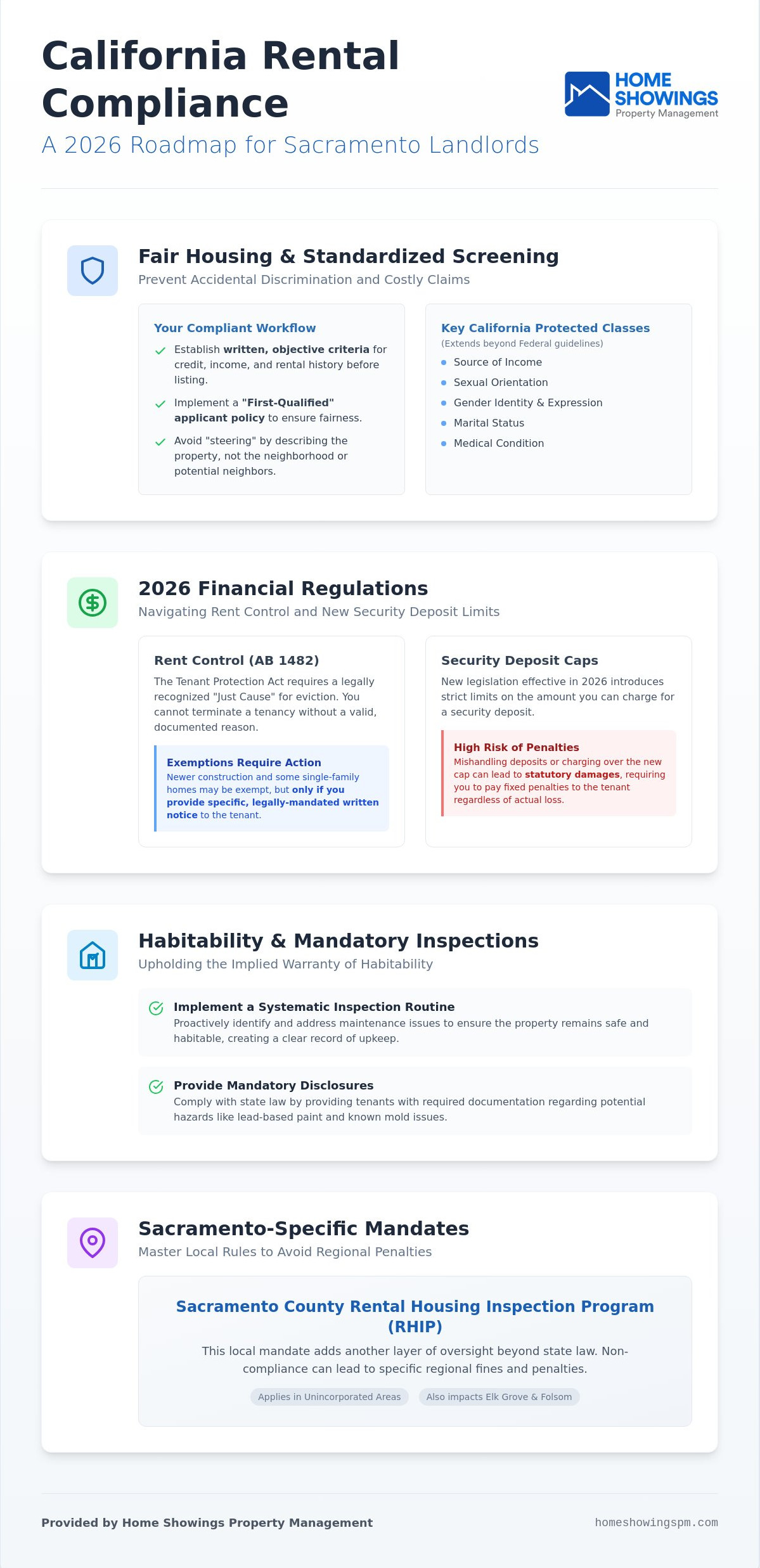
The Tenant Protection Act (AB 1482) continues to define the landscape with its "Just Cause" eviction requirements. In 2026, you can't simply terminate a tenancy because you'd like a change; you must have a legally recognized reason, such as a material breach of the lease or a documented "no-fault" reason like a primary residence move-in. Identifying which properties are exempt is equally critical. Generally, newer construction and certain single-family homes qualify for exemptions, but only if you've provided the tenant with very specific, legally-mandated written notice. For a deeper look at how these rules have matured over the last few years, you can review our California Landlord Tenant Laws 2024 guide.
Financial Risks of Non-Compliance
The cost of a mistake isn't just a minor inconvenience. If a court finds that you've implemented an illegal rent increase or mishandled a security deposit under the strict 2026 rules, you could be liable for statutory damages. In the context of CA rental law, statutory damages are fixed monetary penalties set by law that a landlord must pay to a tenant for specific violations, regardless of the actual financial loss the tenant suffered.
We believe in a tech-savvy approach to mitigate these risks. By using digital portals to track legal notices and maintenance requests, you create an airtight paper trail. This level of transparency doesn't just help with rental property legal compliance california; it builds trust with your tenants and provides a clear defense if a legal challenge ever arises. When every notice is timestamped and every inspection is documented, you can manage your Sacramento area investment with total confidence.
Fair Housing and Tenant Screening: Avoiding Discrimination Claims
Fair housing compliance is often the most anxiety-inducing aspect of property ownership. In California, the list of protected classes extends well beyond federal guidelines to include traits like sexual orientation, gender identity, and source of income. Maintaining rental property legal compliance california requires more than just a fair heart; it requires a rigid, documented process that eliminates the possibility of unconscious bias. If your screening criteria change from one applicant to the next, you're inadvertently opening the door to a discrimination claim.
One of the most common pitfalls involves "steering," which is the practice of influencing a tenant's choice of where to live based on their protected characteristics. Even a well-meaning comment about a neighborhood being "great for families" can be interpreted as steering. To avoid these risks, we recommend a "first-qualified" applicant policy. This means you set clear, written standards for credit scores, income ratios, and rental history before you ever list the property. The first person who meets those exact standards gets the lease, ensuring your selection process is entirely objective. For more detailed guidance on state-level protections, the Department of Justice provides an overview of California Landlord-Tenant Issues that every owner should review.
Compliant Screening Workflows
State law strictly limits the amount you can charge for an application fee, and this number is adjusted annually for inflation. If you're overcharging or failing to provide a receipt and a copy of the background check, you're out of compliance. Our team at Home Showings Property Management utilizes automated Tenant Screening workflows to remove human error from the equation. By centralizing the data, we ensure every applicant is vetted against the same legal benchmarks, providing you with a clear paper trail of your due diligence. If you're feeling overwhelmed by these requirements, our professional tenant screening services can help streamline your entire placement process.
Reasonable Accommodations and Modifications
The rules regarding service animals and emotional support animals (ESAs) are a frequent source of confusion. Under California law, these are not considered "pets," so you cannot charge pet rent or a pet deposit for them. If a tenant requests a reasonable accommodation, you must engage in what's known as the "interactive process." This is a good-faith dialogue to determine how to meet the tenant's needs without causing an undue financial or administrative burden. When it comes to physical modifications, such as installing a grab bar, the tenant generally pays for the installation and removal, but the landlord must allow the change if it is reasonable. Documenting every step of this interactive process is your best defense against potential litigation.
Rent Control and Security Deposit Regulations in 2026
The financial aspects of rental property legal compliance california have undergone a massive shift as we enter 2026. One of the most significant changes involves how you collect and hold security deposits. While previous years allowed for a two-month or even three-month cushion, legislation like SB 611 and SB 567 has effectively capped security deposits at one month’s rent for the vast majority of residential properties. This change requires a fundamental adjustment in how you assess risk during the screening phase, as you no longer have that extra financial buffer to cover potential damages or unpaid rent.
Calculating rent increases has also become more data-dependent. Under the Tenant Protection Act, annual increases are capped at 5% plus the local Consumer Price Index (CPI), or 10%, whichever is lower. For owners in Sacramento County, this means you must verify the specific CPI for our region before issuing any notice. If you miscalculate even by a few dollars, your entire notice could be deemed invalid, forcing you to restart the process and potentially face legal challenges. We use our digital owner portals to maintain a clear record of these calculations, ensuring every financial move is transparent and legally defensible.
Managing Security Deposit Itemization
When a tenant moves out, the 21-day clock begins. You must return the deposit or provide an itemized statement with receipts for any deductions. A common area of friction is the distinction between "normal wear and tear" and actual damage. Faded paint or minor carpet indentations from furniture are typically wear and tear; large holes in the drywall or deep pet stains are damages you can deduct for. To protect yourself, we recommend high-resolution photos and professional invoices for all repairs. This level of detail is a cornerstone of Online Rent Collection and financial management, as it prevents disputes from escalating into litigation.
Notice Requirements for Rent Changes
If you plan to adjust the rent, the timing of your notice is just as important as the amount. In California, a 30-day notice is standard for increases of 10% or less, while a 90-day notice is required for anything higher. Since most properties are now capped below 10%, the 30-day window is common, but the notice must still contain specific legal language regarding the tenant’s rights under the Tenant Protection Act. If your property is in Folsom or Roseville, it is vital to check for any hyper-local ordinances that might impose stricter caps than the state-wide average. Professional oversight ensures these deadlines and local nuances are never overlooked.
Habitability Standards and Mandatory Property Inspections
The concept of the "Implied Warranty of Habitability" is a foundational element of rental property legal compliance california. It's a non-waivable legal promise that every rental home meets basic health and safety standards. If a unit lacks essential services like heat, clean water, or adequate weather protection, it isn't just a maintenance headache; it's a significant legal breach. As a local investor, you're also responsible for mandatory disclosures regarding lead-based paint (for homes built before 1978), bed bugs, and mold. Failing to provide these documents at the start of a tenancy can jeopardize your standing in future legal proceedings and potentially lead to heavy fines.
One area where many owners inadvertently cross the line involves landlord entry rights. You can't enter a tenant's home whenever you please, even for a quick check-up. California law is very specific: you generally must provide a 24-hour written notice for repairs or inspections, and the entry must occur during normal business hours. Respecting this boundary is crucial for maintaining a positive tenant relationship and staying within the law. Our guide on Property Maintenance Management in Sacramento explains how we balance these rights with the need for rigorous asset preservation.
The 2026 Inspection Framework
We've found that the best way to manage these requirements is through a structured, three-step framework. First, always provide the required 24-hour written notice of entry, even if you have a friendly relationship with the tenant. Second, utilize a standardized California rental property inspection checklist to ensure you don't miss hidden issues like slow leaks under a sink or faulty smoke detectors. Third, document every finding with date-stamped digital photography. This creates a transparent record that protects both you and the tenant, ensuring there is no confusion regarding the property's condition at any given time.
Maintenance Response Times and Legal Remedies
If a landlord fails to address a significant habitability issue in a timely manner, the tenant may exercise the "Repair and Deduct" remedy. This allows them to pay for a repair themselves and deduct the cost from their rent, provided they followed specific legal steps first. To avoid this, you need clear response timelines. Emergency issues, like a burst pipe or a broken heater during a winter cold snap, require action within 24 to 48 hours. Non-emergency items should still be handled promptly to prevent small problems from spiraling into larger legal liabilities. If you want to ensure your property remains in top condition without the stress of managing vendors yourself, our professional property maintenance services provide the proactive oversight you need.
Mastering Local Compliance with Sacramento Property Management
While state-level mandates provide the framework, mastering rental property legal compliance california often comes down to the specific ordinances of your local municipality. In Sacramento County, the Rental Housing Inspection Program (RHIP) is a prime example of local oversight that requires a meticulous, proactive approach. This program ensures that rental properties meet basic safety and habitability standards through periodic, mandatory inspections. If you're managing a property in Rancho Cordova or Elk Grove, you aren't just following state-wide rent caps; you're also navigating local registration requirements and code enforcement standards that can result in significant penalties if they're ignored. We understand the nuances of these local codes because we live and work in these neighborhoods every day.
We believe the most effective way to manage these risks is by blending modern technology with "boots-on-the-ground" oversight. Transitioning from high-risk self-management to professional stability isn't just about offloading daily tasks; it's about installing a defensive system around your investment equity. Our approach ensures that you're always several steps ahead of potential issues, from shifting local mandates to changing tenant protection rules. By utilizing a systematic property management model, we turn compliance from a source of anxiety into a routine part of your investment's long-term success.
Boots-on-the-Ground Oversight in Folsom and Roseville
There is no substitute for a manager who physically visits the property. In cities like Folsom and Roseville, understanding local nuisance ordinances or specific trash and recycling regulations is essential for preventing neighborhood friction and city-level citations. A neighbor's complaint about overgrown landscaping or improper waste disposal can quickly escalate into a code enforcement visit that stays on your property's record. By maintaining a regular presence and conducting routine inspections, we catch these minor issues before they ever become legal liabilities. Our team acts as your local eyes and ears, ensuring that every asset reflects the high standards of Professional Property Management in Sacramento.
The Future of Your Investment
As you look to scale your portfolio in 2026, the complexity of legal reporting and financial tracking only grows. Maintaining 100% rental property legal compliance california across multiple units requires a centralized system that doesn't rely on paper files or manual spreadsheets. Our dedicated owner portals simplify this process by providing real-time access to digital inspection reports, maintenance logs, and year-end financial statements. This level of transparency makes tax season a breeze and ensures you always have a clear, timestamped paper trail for every property in your portfolio. Additionally, for investors interested in the senior housing sector, the Assisted Living Real Estate Group provides specialized brokerage services to help you acquire and lease facilities while meeting California's strict regulatory standards.
Investing in the Sacramento area should be a path to long-term stability, not a source of constant legal stress. We're here to provide the steady hand and local expertise you need to grow your assets with total confidence. Protect your investment with Home Showings today and experience the peace of mind that comes with professional, systematic property management.
Securing Your Investment for a Compliant 2026
Mastering rental property legal compliance california is no longer just about knowing the rules; it's about building a proactive system that anticipates change. We've explored the critical shift toward one-month security deposit limits, the precision required for Sacramento rent cap calculations, and the necessity of documented habitability inspections. These regulations aren't just hurdles. They are essential components of a professional management strategy that protects your long-term equity and keeps your tenants satisfied.
If you're feeling the weight of these new 2026 mandates, you don't have to navigate them alone. Our team provides expert oversight across Elk Grove, Folsom, and Roseville, ensuring strict adherence to the latest California Landlord-Tenant laws. Through our comprehensive digital owner and tenant portals, we provide the transparency and paper trail needed to keep your portfolio secure and your reporting accurate. We believe that with the right systems in place, property ownership can be a source of stability rather than stress.
Ready to see where your property stands in the current legal landscape? Get a Professional Compliance Audit for Your Sacramento Rental and take the first step toward a worry-free 2026. We're here to help you turn legal complexity into operational excellence.
Frequently Asked Questions
What is the maximum security deposit a landlord can charge in California in 2026?
The maximum security deposit for most residential properties in 2026 is limited to one month's rent. This rule applies whether the unit is furnished or unfurnished. While there are narrow exceptions for small landlords who own only two properties with no more than four total units, the vast majority of owners must adhere to this one-month cap to stay within the law.
Do I need to provide a reason to evict a tenant under the Just Cause laws?
Yes, you must provide a legally recognized "just cause" reason to terminate a tenancy for any tenant who has lived in the property for 12 months or more. These reasons are categorized as "at-fault," such as non-payment of rent, or "no-fault," such as an owner move-in. If you use a no-fault reason, you're typically required to provide the tenant with relocation assistance equal to one month's rent.
How much can I increase the rent for a property in Sacramento this year?
For properties covered by state law, the maximum rent increase is 5% plus the local Consumer Price Index (CPI), or 10%, whichever is lower. Since the CPI for Sacramento County changes annually, it's essential to verify the current percentage before sending a notice. If your property is exempt from these caps, you may have more flexibility, but you must still provide proper written notice.
Are single-family homes exempt from California rent control laws?
Single-family homes are generally exempt from state rent caps and just cause rules, provided they aren't owned by a corporation or REIT. However, this exemption isn't automatic. You must provide your tenant with a specific, legally mandated notice in the lease agreement stating that the property is exempt. If you fail to include this disclosure, the home may still be subject to state-wide rent control.
What happens if I fail to return a security deposit within 21 days?
Failing to return the deposit or an itemized statement within 21 days can result in you losing the right to keep any portion of the funds. In a legal dispute, a judge may order you to return the full amount plus "bad faith" damages of up to twice the original deposit. Meeting this strict deadline is a non-negotiable part of maintaining rental property legal compliance california and avoiding costly small claims court cases.
Can a California landlord refuse a tenant with a Section 8 voucher?
No, you cannot refuse an applicant solely because they use a Section 8 voucher or other housing assistance. California's Fair Housing laws protect "source of income," meaning you must treat voucher holders the same as any other prospective tenant. You're allowed to use your standard screening criteria for credit and rental history, but you must apply those standards consistently to every person who applies.
What are the mandatory disclosures I must include in a 2026 lease agreement?
Your lease must include disclosures for lead-based paint (for pre-1978 homes), bed bugs, mold, and information regarding the Megan’s Law sex offender database. You're also required to notify tenants if the property is in a potential flood zone or if you have knowledge of any military ordnance nearby. Providing these documents is a core requirement for rental property legal compliance california and protects you from future liability.
How often can I legally inspect my rental property in California?
There is no specific number of inspections allowed per year, but entries must be for a "reasonable" purpose and occur during normal business hours. Common reasons include performing necessary repairs, conducting an annual safety check, or showing the unit to prospective buyers. You must always provide a 24-hour written notice of entry, as frequent or unannounced visits can be considered a breach of the tenant's right to quiet enjoyment.


Comments