
California Security Deposit Law: 2026 Compliance Guide
- Steven Lunetta
- 11 minutes ago
- 13 min read

What if a single day’s delay or a simple math error could cost you triple the security deposit you worked so hard to protect? For many property owners, the fear of legal penalties for overcharging or missing the strict 21-day return deadline is a constant source of anxiety. You likely understand that keeping your property in top shape is essential, but the shifting legislative landscape can make it feel like the goalposts are always moving. It's exhausting to balance your daily responsibilities while trying to decipher new mandates like AB 12 and the electronic payment requirements of AB 414.
This guide will help you master the 2026 california security deposit law for landlords, providing you with the tools to stay compliant and protect your rental income. We’ll provide a clear breakdown of the new one-month deposit limits and the specific exceptions available for small-scale owners. You'll also learn a repeatable system for move-out inspections that takes the guesswork out of distinguishing normal wear and tear from actual tenant damage. By the end of this article, you’ll have a structured plan to manage deposits through digital portals and meticulous documentation; this ensures you stay several steps ahead of potential disputes and avoid the headache of small claims court.
Table of Contents
Navigating California’s Security Deposit Limits in 2026
Under California Civil Code 1950.5, a security deposit is defined as any payment or fee that a tenant provides to a landlord to ensure they fulfill their lease obligations. It's a refundable payment that acts as a financial safety net for your investment. The primary purpose of these funds is to cover specific, allowable costs: unpaid rent, necessary cleaning after a tenant vacates, and repairs for damages that exceed normal wear and tear. Understanding these limits is a vital part of professional property management in Sacramento, as it helps you build a stable relationship with your tenants from day one while staying on the right side of the law.
A major shift in the california security deposit law for landlords occurred with the passage of AB 12. Effective July 1, 2024, this law significantly restricted the amount of financial security you can request at the start of a lease. If you haven't updated your lease agreements since this change, you might be accidentally overcharging and opening yourself up to legal liability.
The One-Month Rent Rule (AB 12)
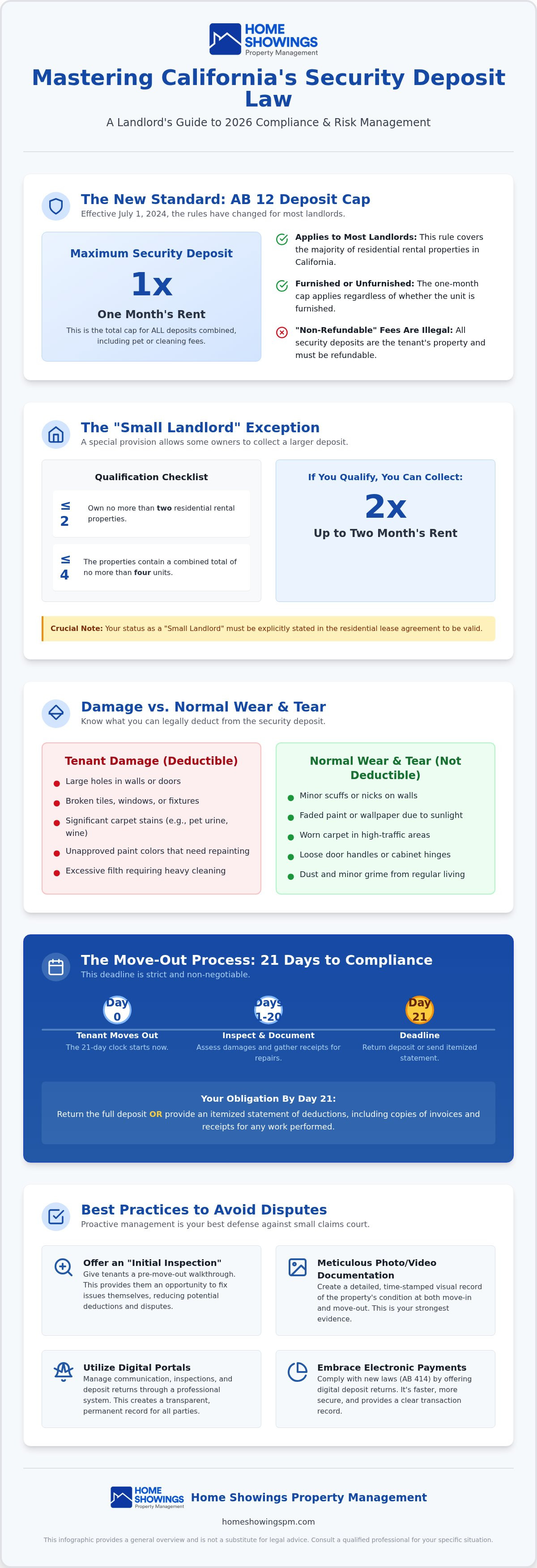
If you're managing a residential rental in California today, you're likely limited to a security deposit cap of exactly one month's rent. This rule applies across the board to most residential landlords, regardless of whether the unit is furnished or unfurnished. In the past, you could charge up to three months' rent for furnished units, but those days are over for the majority of owners. You cannot circumvent this limit by splitting the deposit into different categories. If you try to charge one month's rent plus an additional "pet deposit" or "cleaning fee," you're likely violating the law. The total of all deposits and fees (excluding the first month's rent) must stay under that one-month ceiling.
This cap has a direct impact on how you mitigate risk. Since you have a smaller financial buffer to cover potential damages, your "boots-on-the-ground" inspection process becomes your most important tool. You need to be proactive and meticulous in your documentation to ensure every dollar of that one-month deposit is protected. When you have less money held in reserve, the quality of your move-in and move-out records determines whether you can successfully claim for repairs later.
Non-Refundable Fees: A Legal Warning
You must be extremely careful with how you label the money you collect at move-in. In California, "non-refundable" security deposits are completely illegal. Whether you call it a "redecoration fee" or a "move-out cleaning charge," if it’s money held to secure the performance of the lease, it must be refundable. The only exception is the application screening fee, which is a separate transaction used to cover the actual cost of background and credit checks. Even then, you're limited to the state-mandated maximum for those fees, which adjusts annually.
It's helpful to remember that all security deposit funds remain the legal property of the tenant throughout the duration of the lease. You only "earn" the right to keep these funds after the tenant moves out and you provide an itemized list of legitimate deductions. If you don't have the receipts or photos to back up a claim, the law assumes the money belongs to the tenant. Following the california security deposit law for landlords means treating that money with the respect it deserves while it sits in your trust account.
The Small Landlord Exception: Do You Qualify for Higher Deposits?
While the one-month cap is the standard under the 2026 california security deposit law for landlords, some owners still qualify to collect up to two months' rent. This "Small Landlord" exception is very specific. To qualify, you must own no more than two residential rental properties that contain a combined total of no more than four units. If you own three single-family homes or a single four-plex, you don't qualify and must stick to the one-month limit. This rule aims to provide a bit of flexibility for mom-and-pop owners while protecting tenants from high move-in costs in larger complexes.
It's vital to document your "Small Landlord" status directly in your California residential lease agreement. We recommend including a specific disclosure that confirms you meet the unit count and ownership requirements. This transparency protects you if a dispute ever reaches a courtroom. If you're unsure where you stand, reaching out to a Sacramento property management professional can help you verify your portfolio's compliance before you sign a new lease.
Ownership Structures and Eligibility
Your ownership structure is just as important as the number of doors you own. Standard corporations (C-Corps) are strictly excluded from the small landlord exception. If your property is held by a large scale investment group or a traditional corporation, the one-month cap applies regardless of your portfolio size. However, the exception does apply if the property is held by a "natural person," a family trust, or an LLC where all members are natural persons.
You should verify your portfolio size every time you consider a new acquisition. Adding a third property could instantly change your legal requirements for all future leases. Staying organized with your titles and trust documents ensures you don't accidentally overcharge a tenant and face the "bad faith" penalties outlined in California's rules on security deposits.
Military Tenant Protections
There is one critical scenario where your portfolio size doesn't matter. If your applicant is an active-duty military service member, you cannot charge more than one month's rent for a security deposit. This is a hard limit under California law that overrides the small landlord exception. These protections are designed to ease the financial burden on service members who frequently relocate due to orders.
During your tenant screening in California, it's best practice to verify military status through official orders or the Servicemembers Civil Relief Act (SCRA) database. Handling this step with care shows you're a proactive, compliant owner who respects the unique challenges military families face. If you identify a service member during screening, adjust your lease terms immediately to stay within the one-month cap.
Damage vs. Normal Wear and Tear: Protecting Your Investment
Distinguishing between expected aging and actual destruction is often where the most friction occurs between owners and tenants. Under the california security deposit law for landlords, you cannot deduct for "normal wear and tear." This is defined as the natural, unavoidable deterioration that happens simply because someone lives in the space. For instance, paint naturally fades over several years, and carpets will eventually show slight wear in hallways. Conversely, "tenant damage" results from negligence, abuse, or accidents. Think of a large hole punched in drywall, broken windows, or deep gouges in hardwood floors caused by dragging heavy furniture. Using a detailed rental property inspection checklist for California during both move-in and move-out is the only way to objectively track these changes and protect your bottom line.
Common Deduction Categories
If a tenant defaults on their final payment, you can use the deposit to cover unpaid rent. Cleaning is another major category where landlords frequently encounter confusion. You're legally allowed to deduct costs to restore the unit to the same level of cleanliness it had when the tenant first arrived. If the home was professionally cleaned at move-in, it should be professionally cleaned at move-out. If you manage furnished rentals in Elk Grove or Folsom, the california security deposit law for landlords also permits deductions to repair or replace damaged personal property, such as broken furniture or missing kitchenware, provided you have a clear inventory documented at the start of the tenancy.
The Burden of Proof for Landlords
When a dispute lands in front of a judge, the burden of proof falls squarely on the landlord. High-resolution "before and after" photos are your most powerful defense in any legal setting. If you can show a pristine wall at the start of the lease and a spray-painted wall at the end, your deduction is much harder to challenge. Always keep third-party vendor invoices to justify the exact dollar amount of the repairs. You shouldn't just guess what a repair costs; you need a receipt from a professional to back it up.
Relying on consistent property maintenance management in Sacramento helps you build a professional paper trail that proves you've maintained the asset properly over time. This systematic approach transforms a potential legal headache into a simple, documented business transaction. When your records are organized and your inspections are thorough, you significantly reduce the risk of a tenant successfully contesting your deductions in small claims court.
The Move-Out Process: 21 Days to Compliance
Once a tenant hands over the keys, a high-stakes countdown begins. Under the california security deposit law for landlords, you have exactly 21 calendar days to either return the full deposit or provide a detailed itemized statement of deductions. Missing this deadline by even one day can result in the forfeiture of your right to keep any portion of the funds. In the worst-case scenario, if a court finds you acted in "bad faith," you could be ordered to pay the tenant up to twice the amount of the security deposit in addition to their actual damages.
The Initial Inspection Right
The process actually starts before the tenant leaves. You're legally required to notify the tenant in writing that they have the right to request an "initial inspection" during the final two weeks of their tenancy. If they request it, you must walk through the property and provide a list of specific repairs or cleaning tasks needed to avoid deductions. This gives the tenant a fair chance to cure these issues before they vacate. It's a proactive step that significantly reduces friction. When everyone is on the same page about expectations, you're much less likely to end up in small claims court.
The Itemized Statement and Documentation
If you find that deductions are necessary and they exceed $125, your itemized statement must be incredibly thorough to stay within the california security deposit law for landlords. You can't just list a flat fee for "cleaning." Instead, you must include a description of the work performed, the time spent, and the hourly rate if you or your employees did the work. You also need to attach copies of receipts or invoices for any materials or professional services used. Sending this package via a digital portal or certified mail provides the proof of delivery you need to protect yourself.
If the work can't be finished within the 21-day window, you can provide a good-faith estimate and then send the final documentation within 14 days of completion. If managing this tight window feels overwhelming, our team can help you automate the entire process through professional property inspections that ensure you never miss a compliance deadline.
How Professional Management Mitigates Security Deposit Risks
Staying compliant with the california security deposit law for landlords requires more than just good intentions; it demands a rigorous, repeatable system. If you're managing a property on your own, the 21-day window to return a deposit can quickly become a source of intense pressure. Home Showings Property Management alleviates this anxiety by automating the entire move-in and move-out inspection cycle. We ensure that every deadline is met and every deduction is backed by ironclad evidence, turning a potential legal minefield into a transparent business process.
Professional managers act as an essential buffer between you and your tenants during the high-stress period of a move-out. When emotions run high, having a neutral third party to handle negotiations prevents personal friction from escalating into a legal dispute. We also maintain relationships with licensed, insured vendors who provide the detailed, professional invoices required by law for any deduction exceeding $125. This level of documentation is often the deciding factor if a case ever reaches a small claims judge.
The Home Showings Systematic Inspection
Our "boots-on-the-ground" approach in Sacramento and Roseville is designed to capture the exact condition of your property at every stage. We don't just walk through the unit; we perform a meticulous, room-by-room assessment using high-resolution photo documentation. This creates an indisputable digital record that serves as your best defense against claims of overcharging. If a tenant contests a deduction, we have the "before and after" visual proof ready to resolve the issue immediately.
By using our dedicated digital portals, both owners and tenants have permanent access to these property condition reports. This transparency builds trust and ensures that every itemized statement we deliver is legally compliant and fully justified. We take pride in our operational efficiency, ensuring that the final accounting package is sent well before the 21-day limit expires. This proactive management style keeps you ahead of shifting regulations and protects your reputation as a fair, professional landlord.
Protecting Your Time and Reputation
The financial risks of a mismanaged security deposit go far beyond the deposit amount itself. If a court determines you've withheld funds in bad faith, you could face treble damages, which effectively triples your financial liability. Our systematic oversight virtually eliminates the risk of these "bad faith" claims. We provide you with peace of mind through transparent financial reporting and a commitment to property preservation that maintains your asset's value over the long term.
You don't have to manage these complex legal requirements alone. By partnering with a local expert who understands the nuances of the california security deposit law for landlords, you can focus on growing your portfolio while we handle the meticulous details of compliance. Protect your rental investment with professional management from Home Showings and experience the stability that comes with expert oversight.
Protecting Your Rental Income in an Evolving Market
Mastering the california security deposit law for landlords is about more than just knowing the numbers; it's about building a bulletproof system of documentation and communication. By understanding the new one-month rent caps and strictly adhering to the 21-day return deadline, you safeguard your portfolio against unnecessary legal disputes and "bad faith" penalties. Whether you're navigating the small landlord exception or distinguishing between wear and tear and tenant damage, meticulous records are your greatest asset.
You don't have to manage these shifting regulations alone. As local experts in Sacramento and Elk Grove rental laws, we provide the "boots-on-the-ground" oversight you need. From comprehensive move-in/move-out inspection services to secure digital portals that ensure 100% compliance transparency, we handle the details so you can enjoy the rewards of ownership. Our proactive approach ensures that every detail is managed with a steady, capable hand.
Get a Professional Rental Property Assessment from Home Showings Property Management today. With a proactive strategy and a dedicated partner guiding your operations, you can maintain a worry-free and profitable rental experience for years to come.
Frequently Asked Questions
How much can a California landlord charge for a security deposit in 2026?
Most owners are limited to one month's rent for the total security deposit. This cap applies to both furnished and unfurnished units under the current california security deposit law for landlords. If you're a small landlord, you might qualify for a two-month limit, but this exception is very narrow. You should always calculate this based on the monthly rent amount listed in your signed lease agreement to ensure you stay within legal bounds.
What is the "Small Landlord" exception to AB 12?
To qualify for the small landlord exception, you must own no more than two residential properties with a combined total of four or fewer units. These properties must be held by a natural person, a family trust, or an LLC composed entirely of natural persons. If you meet these criteria, you can charge up to two months' rent as a deposit. However, this exception never applies if your tenant is an active-duty military member.
How long does a landlord have to return a security deposit in California?
You have exactly 21 calendar days from the date the tenant vacates the property to return the deposit. This timeline includes weekends and holidays. As of January 1, 2026, if you collect rent electronically, you must also offer to return the deposit electronically. If you miss this deadline, you forfeit your right to keep any portion of the funds for damages. Using digital portals ensures these documents and payments are delivered and recorded on time.
What can a landlord deduct from a security deposit in California?
Landlords can legally deduct for four specific reasons: unpaid rent, cleaning to restore the unit to its original move-in condition, repairs for damages caused by the tenant, and the restoration of personal property in furnished rentals. You can't deduct for items that are considered normal wear and tear. Every deduction must be documented with receipts or invoices if the total amount exceeds $125. Clear "before and after" photos are your best defense here.
Can a landlord charge a non-refundable pet deposit in California?
No, you can't charge a non-refundable pet deposit. In California, all funds collected at the start of a tenancy are considered part of the security deposit and are legally refundable. While you can charge a "pet deposit," it must be included in your total deposit calculation, which is usually capped at one month's rent. Any fee labeled "non-refundable" is a violation of state law. If the pet causes no damage, the full amount must be returned.
What happens if a landlord misses the 21-day deadline?
Missing the 21-day deadline means you lose the legal right to withhold any part of the security deposit for repairs or cleaning. You must return the full amount to the tenant immediately. If the tenant sues in small claims court and a judge determines you acted in "bad faith," you could be ordered to pay twice the amount of the deposit as a penalty. Staying organized with a professional management system prevents these costly errors.
Do I have to provide receipts for security deposit deductions?
Yes, if your total deductions exceed $125, you must provide copies of receipts or invoices. These documents should show the cost of materials and the labor charges involved. If you or your employees performed the work, you must describe the task, the time spent, and the hourly rate. Providing this level of transparency is a requirement of the california security deposit law for landlords. It helps prove that your charges are reasonable and based on actual costs.
What is considered normal wear and tear in California?
Unavoidable deterioration from daily life, such as faded paint or thin carpet in hallways, is considered normal wear and tear. This is the natural aging process that occurs even when a tenant takes excellent care of the property. It stands in contrast to damage caused by negligence or abuse, like deep gouges in hardwood floors or broken fixtures. You cannot legally deduct from a security deposit to cover these routine maintenance costs or general property aging.


Comments