
Navigating the Eviction Process for California Landlords: A 2026 Guide

In the California rental market, a single clerical error can cost you months of rental income and thousands in legal fees. It's completely understandable if you feel overwhelmed by the shifting landscape of the Tenant Protection Act or the recent changes to court response timelines. Dealing with a difficult tenancy is stressful enough without the constant worry that a "self-help" mistake might lead to expensive punitive damages. You deserve a clear path forward that protects your property and your peace of mind.
By understanding the modern eviction process california landlord requirements, you can navigate these challenges with the confidence of a local expert. This 2026 guide is designed to help you master the legal procedures necessary to protect your investment while staying fully compliant with state law. We will walk through the critical differences between at-fault and no-fault just cause, explain the 10-day tenant response window under AB 2347, and provide a structured look at the Unlawful Detainer process. Our goal is to help you minimize vacancy time and handle every detail with meticulous precision.
Key Takeaways
Identify whether a lease violation qualifies as an "At-Fault" or "No-Fault" just cause to ensure your filing complies with the Tenant Protection Act.
Navigate the step-by-step eviction process california landlord timeline to avoid common procedural errors that could dismiss your case.
Protect yourself from costly lawsuits and daily fines by strictly avoiding "self-help" measures like changing locks or turning off utilities.
Organize a comprehensive evidence locker with time-stamped communication and detailed ledgers to strengthen your position in the Superior Court.
Discover how proactive tenant screening and routine maintenance inspections act as your first line of defense against future legal disputes.
Table of Contents
Understanding "Just Cause" Under the California Tenant Protection Act
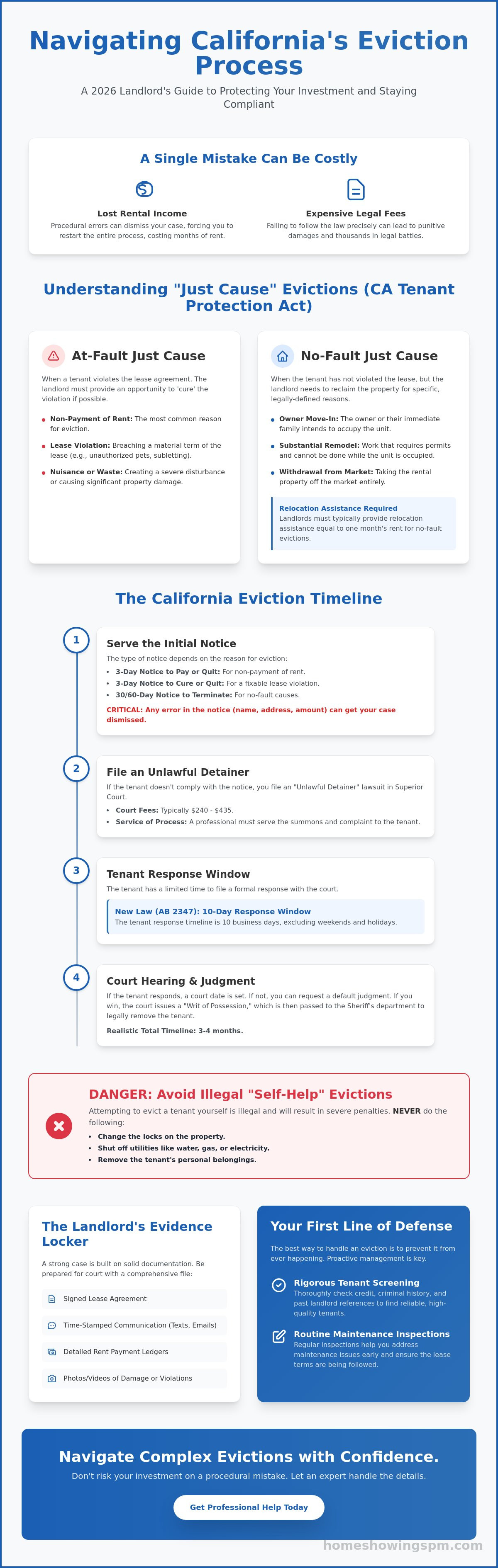
In California, the days of "no-cause" lease terminations are largely behind us. Since the Tenant Protection Act of 2019 (AB 1482) took effect, most residential tenancies are protected by "just cause" requirements once a tenant has occupied the unit for at least 12 months. This legal framework ensures that property owners have a valid, documented reason before they can initiate the eviction process california landlord must navigate. It’s helpful to view this not as a barrier, but as a checklist for maintaining a compliant and stable rental business. Understanding this Landlord-Tenant Law Overview is the first step toward protecting your investment.
At-Fault vs. No-Fault Evictions
If a tenant violates the terms of their lease, you're likely looking at an "at-fault" scenario. Non-payment of rent remains the most frequent reason for these filings. However, you can also pursue an at-fault eviction for "nuisance," which involves severe interference with neighbors, or "waste," which refers to significant damage to the property. On the other hand, "no-fault" evictions occur when the tenant hasn't done anything wrong, but you need the unit for a specific reason like an owner move-in or a substantial remodel. It's vital to remember that no-fault evictions usually require you to provide relocation assistance, often equal to one month’s rent, to help the tenant transition. As of 2024, amendments under SB 567 also require landlords to include very specific language about tenant rights in these notices to remain compliant.
Exemptions and Local Ordinances
Not every property falls under the strict umbrella of AB 1482. For example, many single-family homes and condos are exempt if they aren't owned by a corporation or REIT, provided the owner has given the tenant a specific legal disclosure. Newer constructions built within the last 15 years also typically sit outside these "just cause" requirements. Whether your property is in Sacramento or Elk Grove, you must verify your specific status before serving any notices. One of the most effective ways to avoid these legal headaches is through rigorous adherence to California tenant screening laws. By selecting high-quality tenants from the start, you significantly reduce the likelihood of ever needing to document an at-fault breach. Even if a lease has expired and transitioned to a month-to-month agreement, these just cause protections still apply. Identifying the correct legal cause is the foundation of your case; if you start with the wrong notice, the court will likely dismiss your filing, forcing you to restart the timeline from scratch.
The Step-by-Step Legal Timeline for California Landlords
The legal timeline in California is meticulous, and even a minor oversight can reset your progress to zero. While some online resources suggest an eviction might only take 30 days, a more realistic window for the eviction process california landlord must follow is often 3 to 4 months. This process begins with the service of a specific notice. As of February 1, 2025, judicial holidays and weekends are excluded from the 3-day notice period, meaning your "three days" could easily stretch into a full week depending on the calendar. If you find yourself facing a lease violation, the clock is already ticking, and precision is your best ally.
Serving the Initial Notice Correcty
If a tenant fails to pay rent, you must serve a 3-Day Notice to Pay Rent or Quit. If the issue is a lease violation that can be fixed, such as an unauthorized pet, you'll use a "Cure or Quit" notice instead. For tenancies longer than one year, a 60-day notice is generally required for no-fault terminations. You can deliver these notices personally, via sub-service to another adult at the residence, or through "nail and mail" if other methods fail. Because California courts are highly protective of tenant rights, a single typo in the address or a miscalculation of the expiration date can lead a judge to dismiss your case entirely.
The Unlawful Detainer Court Process
Once the notice period expires without a resolution, you move to the Superior Court to file an Unlawful Detainer complaint. Filing fees typically range from $240 to $435, depending on the county and the amount of rent owed. After filing, you must have a professional process server deliver the summons and complaint to the tenant. A significant change as of January 1, 2025, under AB 2347, gives tenants 10 court days to file an "Answer" to your complaint, which is an increase from the previous 5-day window. This change alone adds roughly a week to the California's Legal Eviction Timeline. If the tenant files an answer, the court will schedule a trial, usually within 20 days.
If the judge rules in your favor, they will issue a Judgment for Possession and a Writ of Possession. You then take this writ to the local Sheriff, who will post a 5-day Notice to Vacate on the property. If the tenant remains after those five days, the sheriff will perform a physical lockout, which typically involves a fee of $150 to $200. If you'd rather avoid the stress of courtrooms and process servers, having an expert handle your property management can keep your investment on track while ensuring every legal deadline is met with professional oversight.
Common Pitfalls and the Danger of "Self-Help" Evictions
The emotional toll of a difficult tenant is heavy, but reacting with a "self-help" eviction is a mistake you can't afford. In California, taking matters into your own hands by changing locks, shutting off utilities, or removing a tenant's belongings is strictly illegal under Civil Code section 789.3. Even if rent hasn't been paid in months, bypassing the eviction process california landlord must follow will likely result in a judge ruling against you. The court's priority is the legal procedure, not the landlord's frustration. It's helpful to review the Understanding 'Just Cause' Eviction guidelines from the California Department of Justice to see how the state prioritizes procedural compliance over personal grievances. When emotions run high, a steady hand is required to keep your investment safe.
Constructive Eviction and Retaliation
If you allow a property to fall into disrepair or cut off essential services like water or heat to encourage a tenant to leave, you're engaging in constructive eviction. This is a dangerous legal trap that can lead to significant lawsuits. Tenants can also claim retaliation if you begin an eviction shortly after they've exercised a legal right, such as reporting a legitimate maintenance issue to a local building inspector. It's a delicate balance to maintain, especially when you feel the tenant is taking advantage of the system. For more context on how these lease obligations and tenant behaviors interact, see our guide on what happens if you break a lease. Staying legally compliant is the only way to ensure your property remains a profitable asset.
The Cost of a Misstep
The financial consequences of a procedural misstep are staggering. A single technical error in your initial notice, such as a misspelled name or an incorrect date, can cause your entire case to be dismissed at the first hearing. When this happens, you're forced to restart the timeline from day one, which often means losing several more months of rental income while the mortgage still needs to be paid. Beyond lost rent, "self-help" violations carry statutory penalties of up to $100 per day, plus actual damages and the tenant's attorney fees. Professional oversight through a meticulous management system isn't just a convenience; it's often the most cost-effective way to ensure your eviction process california landlord journey stays on the right side of the law. Staying "boots-on-the-ground" means documenting every interaction, taking photos during inspections, and keeping a detailed communication log rather than engaging in heated confrontations that only serve to sabotage your legal standing.
The Landlord’s Evidence Locker: Preparing for Court
Winning an Unlawful Detainer case isn't about who has the better story; it's about who has the better documentation. If you enter a California courtroom without an organized evidence locker, you're leaving your investment to chance. A judge requires cold, hard facts to rule in your favor, and any ambiguity often results in the court siding with the tenant. To master the eviction process california landlord journey, you must maintain the original signed lease agreement and all subsequent written addendums. If you're dealing with "waste" or "nuisance" violations, high-quality, time-stamped photographs are your most persuasive tools for proving property damage or lease breaches.
Documenting Communication and Notices
If you rely on verbal agreements or casual text messages, you're building your case on sand. In the eyes of the court, verbal promises are generally unenforceable. It's much more effective to utilize digital portals to track every tenant interaction and maintenance request. This creates a transparent, time-stamped log that's difficult to dispute. You must also meticulously save every "Proof of Service" document from the initial notice phase. If a tenant claims they weren't properly served under the 2025 AB 2347 rules, your process server’s affidavit is the only shield that prevents your timeline from being reset. Every interaction should be recorded with the assumption that a judge will eventually read it.
Financial Transparency and Reporting
A "clean" rent ledger is the heartbeat of a successful non-payment case. This ledger should clearly display the date rent was due, the date it was paid, and any remaining balance. If you're managing the eviction process california landlord timeline, be extremely cautious with partial payments. Accepting even a small portion of the rent after serving a notice can legally waive your right to continue the eviction, forcing you to start the entire process over. This is a common trap that costs owners thousands in lost time.
Many owners find that utilizing professional property management sacramento ca is the most reliable way to ensure these financial records remain audit-ready and legally sound. If you're feeling the weight of managing these meticulous details alone, our comprehensive property management services can provide the steady hand and professional oversight you need to protect your rental income and maintain total compliance.
Mitigating Risk: How Professional Management Prevents Evictions
The most effective way to handle the eviction process california landlord requirements is to ensure you never have to initiate it in the first place. At Home Showings, we operate under an "ounce of prevention" philosophy. By focusing on the front end of the tenancy, we eliminate the friction that often leads to costly legal disputes. While the California court system is built to resolve conflicts, our management systems are designed to prevent them. Shifting from a reactive stance to a proactive strategy transforms property ownership from a source of constant anxiety into a stable, predictable financial asset.
Superior Tenant Screening
Your first and most reliable defense against a future eviction is a rigorous screening process. We don't just glance at a credit score; we perform a comprehensive deep dive into income verification, employment stability, and prior eviction histories. High-quality tenants are the bedrock of a successful rental experience. Our rental marketing services sacramento are specifically tailored to attract candidates who value their rental history and respect the terms of their lease. This meticulous placement standard significantly reduces the "anxiety of ownership" by ensuring that the person residing in your investment is both qualified and reliable.
The Home Showings Advantage
When you partner with a "Tech-Savvy Local Guide," you're gaining more than just a service provider. You're gaining a meticulous organizer who stays several steps ahead of potential issues. Our systematic approach handles the legal heavy lifting so you don't have to. We maintain a "boots-on-the-ground" presence that keeps us deeply familiar with the local landscape and shifting state regulations. Our proactive management includes several key layers of protection:
Regular Property Inspections: Routine walk-throughs allow us to catch minor lease violations before they escalate into serious "waste" or "nuisance" legal grounds.
Automated Rent Collection: Our owner and tenant portals ensure every payment is tracked with precision, providing the audit-ready ledgers required for any legal filing.
Professional Notice Delivery: If a payment is missed, we handle the delivery of late notices with legal exactness, ensuring every timeline is strictly followed.
If a situation does become unavoidable, we leverage our established network of legal experts and professional process servers to manage the eviction process california landlord journey. This ensures every document is filed correctly, avoiding the technical errors that lead to expensive delays or case dismissals. You deserve a property management partner that offers calm reliability and a steady hand. Protect your investment today with Home Showings Property Management and experience the confidence that comes with professional oversight.
Secure Your Property’s Future with Professional Oversight
If you find yourself navigating the complexities of the eviction process california landlord requirements, remember that meticulous preparation is your greatest asset. Success in the courtroom is built on the foundation of "just cause" documentation and a strict adherence to the judicial timeline. By maintaining a clean evidence locker and avoiding the legal traps of self-help measures, you protect both your reputation and your bottom line. Transitioning from a reactive state of worry to a proactive state of stability is the most effective way to ensure your rental business thrives in 2026.
You don't have to manage these challenges alone. As local experts in Sacramento and Elk Grove, Home Showings Property Management provides the steady hand you need. We utilize a rigorous tenant screening process to find high-quality residents from the start, and our dedicated owner and tenant portals keep your financial records audit-ready. Let Home Showings Handle the Stress—Explore Our Management Services to gain the peace of mind that comes with professional oversight. Your investment deserves the protection of a tech-savvy local guide who is always several steps ahead of potential issues.
Frequently Asked Questions
How long does the eviction process take in California in 2026?
The entire eviction process california landlord must navigate typically takes between 3 and 4 months from the initial notice to the final lockout. Recent changes under AB 2347 have extended the tenant's response time to 10 court days, which adds about a week to the timeline. In busy metropolitan areas, court backlogs can occasionally push this window closer to 120 days, so starting with a precise legal notice is essential.
Can I evict a tenant for no reason if the lease has ended?
Generally, you cannot evict a tenant without a "just cause" even if the lease has expired. Under the Tenant Protection Act (AB 1482), most California tenancies are protected once the tenant has lived in the unit for 12 months. Unless your property is specifically exempt, such as certain single-family homes or newer builds, you must provide a valid at-fault or no-fault reason to terminate the residency legally.
How much does it cost to evict a tenant in Sacramento County?
Direct court costs include a filing fee that ranges from $240 to $435, depending on the amount of back rent you are seeking. Once you win the case, the Sacramento County Sheriff charges a fee of approximately $150 to $200 to perform the physical lockout. These figures don't include the cost of lost rent during the 30 to 90 days the case is moving through the Superior Court system.
Do I have to provide relocation assistance for a no-fault eviction?
Yes, if your property is covered by AB 1482 and you are performing a no-fault eviction, you must provide relocation assistance. This payment is typically equal to one month of the tenant's current rent. You can either pay this amount directly to the tenant within 15 days of serving the notice or waive their final month of rent in writing. Failure to provide this assistance makes the eviction notice void.
What happens if the tenant pays the rent after I serve a 3-day notice?
If the tenant pays the full amount owed within the 3-day window, you must accept it and the eviction process california landlord proceedings must stop. However, if they offer a partial payment or try to pay after the notice period has expired, you aren't legally required to accept it. Be careful; accepting any money after the notice expires can sometimes waive your right to proceed with the unlawful detainer.
Can I evict a tenant for having an unauthorized pet or guest?
Yes, if your lease agreement specifically prohibits pets or long-term guests, this is considered a breach of contract. You would serve a "3-Day Notice to Cure or Quit," which gives the tenant three days to remove the pet or guest. If they don't comply within that timeframe, you can proceed with an at-fault eviction. Meticulous documentation of the violation, including photos or witness statements, is vital for your court case.
What should I do if a tenant refuses to leave after the sheriff arrives?
You should let the sheriff handle the situation entirely. When the sheriff arrives to execute the Writ of Possession, they have the legal authority to physically remove the tenant and their belongings. For your safety and to avoid claims of harassment, you should stay back and wait for the officer to give you the "all clear." Once the sheriff completes the lockout, you can immediately change the locks to secure the property.
Is a verbal eviction notice legal in California?
No, a verbal notice is never legally sufficient to start an eviction in California. State law requires all termination notices to be in writing and served using specific legal methods, such as personal delivery or "nail and mail." If you attempt to evict based on a conversation or a casual text message, the court will dismiss your case. Every step of the process must be documented on paper to stand up in front of a judge.



Comments