
Landlord Right of Entry in California: A Guide for 2026
- Steven Lunetta
- 2 days ago
- 12 min read

Imagine you've just received a report of a slow leak in your Sacramento rental, but your tenant is suddenly unresponsive to your messages. You know you need to protect your investment, but the fear of a $10,000 small claims lawsuit for a privacy violation keeps your hand off the spare key. It's a stressful dilemma for property owners who want to be proactive without being perceived as intrusive. Truly mastering the landlord right of entry california laws is the only way to bridge that gap between asset protection and tenant privacy.
We understand that managing access to a home you own, but don't live in, often feels like walking a legal tightrope. This guide is designed to help you master the complexities of California Civil Code Section 1954 so you can ensure total compliance while maintaining a positive relationship with your renters. We'll break down the 24-hour notice requirements, define what "normal business hours" look like in 2026, and provide a repeatable process for your next inspection or repair. By the end, you'll have the peace of mind that your investment is being protected legally and professionally.
Table of Contents
Understanding California Civil Code 1954: The Legal Framework
Owning a rental property in Sacramento or Elk Grove doesn't grant you an all-access pass to the front door. While you hold the deed, the tenant holds the legal right to possession. California Civil Code Section 1954 is the primary statute governing a landlord's right to enter a rental unit, and it's designed to protect the tenant's privacy above all else. If you've ever felt the urge to "just drop by" to see how the yard is looking, you're likely stepping toward a legal boundary that could cost you significantly in court.
The role of a Landlord in California comes with a heavy responsibility to respect the "Quiet Enjoyment" doctrine. This isn't just about noise levels; it's a legal promise that the tenant can live in the home without unreasonable interference from the owner. When you enter without a valid, legally recognized reason, you aren't just being intrusive. You're technically violating the terms of the rental agreement and state law. If this happens repeatedly, a tenant might even have grounds to withhold rent or terminate their lease early.
The Balance of Rights and Privacy
California law is very clear about its priorities: in non-emergency situations, a tenant's right to privacy almost always outweighs a landlord's ownership rights. A common misconception among some owners is that their "ownership privileges" allow for routine check-ins at their own discretion. However, Civil Code 1954 acts as a "closed list," meaning if your reason for entry isn't explicitly mentioned in the statute, it's likely illegal. If you don't follow these specific rules, you could face consequences ranging from court-ordered rent offsets to full-blown harassment lawsuits.
Quiet Enjoyment and Harassment Laws
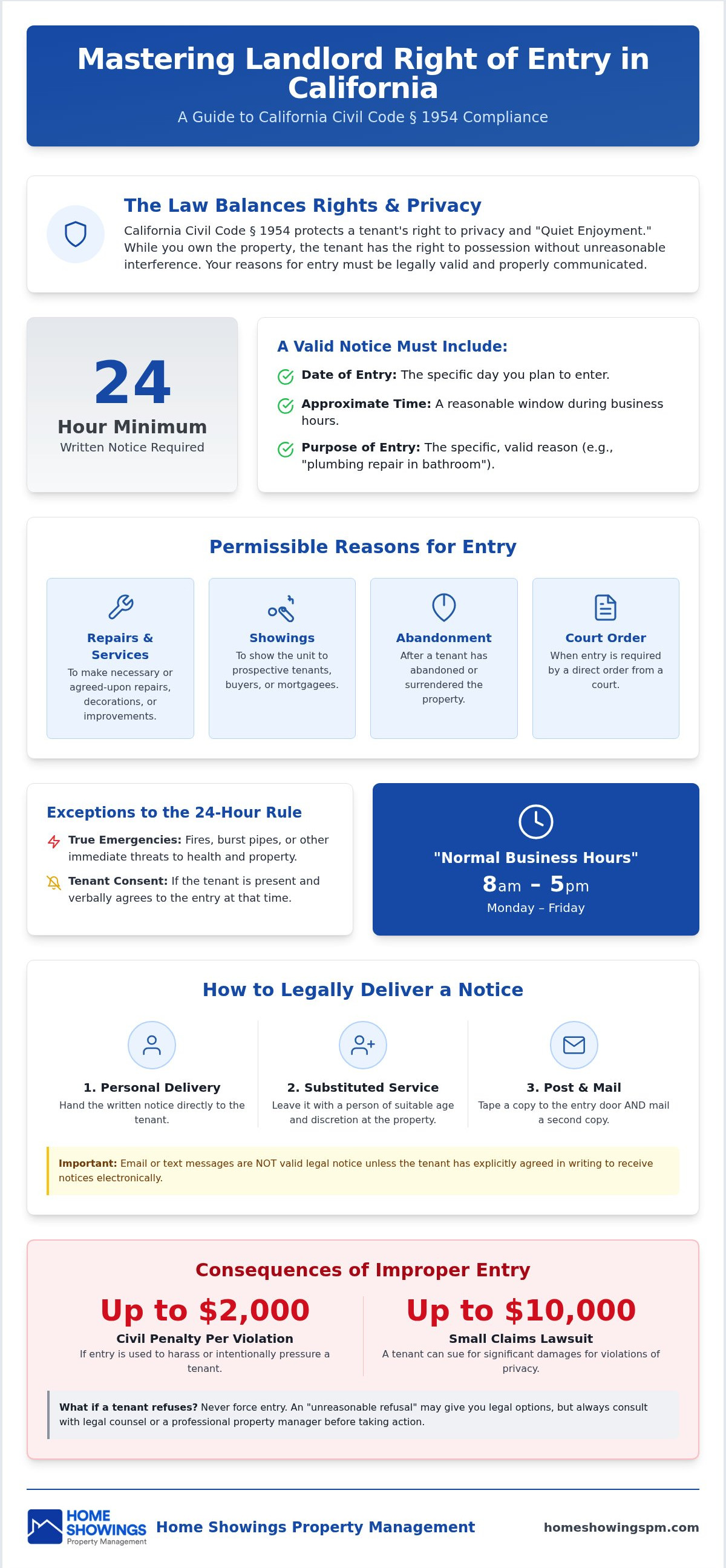
What starts as a "routine check" can quickly be interpreted as harassment if it happens too frequently or without proper notice. Under California's strict protections, intentional harassment or using the right of entry to pressure a tenant into vacating can lead to a civil penalty of up to $2,000 per violation. Additionally, tenants in 2026 can sue for up to $10,000 in small claims court for privacy violations related to the landlord right of entry california standards. This is where professional property management becomes a vital asset. At Home Showings Property Management, we act as the legal buffer between you and your tenant, ensuring every inspection is documented and compliant so you don't have to worry about expensive legal disputes.
The 24-Hour Notice Rule and Delivery Requirements
Timing is everything when you're managing a rental property. While the law generally requires at least 24 hours of written notice for a landlord right of entry california, the reality of delivery can be much more complex. You can't simply slide a note under the door at 11:00 PM on a Friday and expect to walk in on Saturday morning. Getting the clock started correctly is the first step in avoiding a costly misunderstanding.
There are two main exceptions where you don't need to wait the full 24 hours. If there's a true emergency, like a burst pipe or a fire, you can enter immediately to prevent further damage. Similarly, if the property has been abandoned and you've followed the legal steps to establish that fact, the notice requirement is waived. For all other routine matters, you must stick to "normal business hours," which California courts in 2026 define as 8:00 AM to 5:00 PM, Monday through Friday.
To stay compliant with California Civil Code 1954, you must ensure your notice includes the date, the approximate time window, and the specific purpose of the entry. If you're entering to show the unit to prospective tenants or buyers, special rules apply that may allow for oral notice after an initial written notification, but for repairs and inspections, written notice is mandatory every time.
Methods of Delivering a Legal Notice
Delivering your notice correctly is just as vital as the timing itself. You can hand it directly to the tenant or leave it with someone of suitable age and discretion at the home. For many Sacramento landlords, the "Post and Mail" method is the safest route; this involves taping a copy to the front door and mailing a second copy simultaneously. Don't rely on a quick text or email. Unless your tenant has explicitly agreed in writing to receive legal notices electronically, these methods might not hold up if a dispute reaches a judge.
The 6-Day Mailing Rule
If you choose to send your notice via the U.S. Postal Service, the timeline changes dramatically. California law requires you to add five days to the notice period for mailing. This means your 24-hour notice effectively becomes a six-day notice. The 24-hour clock only starts once the notice is 'received' or legally presumed received. To avoid "he-said-she-said" arguments, always document the exact time and method of delivery. Using professional property management portals allows you to track these notices digitally, creating a clear paper trail that protects your reputation and your investment.
Valid Reasons for Entry Under California Law
While you might feel that owning the property gives you a general right to check on its condition, the landlord right of entry california is strictly limited to specific scenarios. According to California Civil Code 1954, you can only enter for emergencies, necessary repairs, showings, or inspections required by law. If you attempt to enter for a reason outside this "closed list," you risk a legal claim of trespassing or harassment. Understanding these boundaries is the first step toward a worry-free ownership experience.
The "Emergency" clause is your only path to bypassing the notice requirement entirely. This applies to immediate threats to life or property, such as a gas leak, a structural collapse, or a fire. A tenant's refusal to answer the door for a routine repair doesn't constitute an emergency. If you enter under the guise of an emergency when one doesn't exist, you could face significant penalties in small claims court.
Maintenance and Necessary Repairs
The law distinguishes between "cosmetic" updates and "necessary" repairs. You have a clear right to enter for repairs that maintain habitability, such as fixing a broken water heater or a leaking roof. However, if you want to perform purely cosmetic upgrades, like installing new kitchen backsplashes, you generally need the tenant's agreement. When coordinating contractor access, it's best to have a professional representative present to ensure the work is done correctly and the tenant's belongings are respected. For a deeper look at how to manage these tasks, see our guide on Property Maintenance Management in Sacramento.
Inspections and Showings
Periodic inspections are essential for asset preservation, but they must be scheduled properly. In Sacramento, the Rental Housing Inspection Program was expanded in June 2026 to include all properties with four or more units, making compliance even more critical for local owners. You can legally enter for these government-mandated inspections or for your own bi-annual safety checks. If you're selling the property or re-leasing it, you can show the unit to prospective buyers or tenants, typically during the final 30 days of a lease. Using a Rental Property Inspection Checklist helps you stay organized and ensures you don't miss critical habitability items while remaining legally compliant. We handle these walkthroughs for our clients in Folsom and Roseville, acting as a professional buffer to keep the process objective and efficient.
Handling Tenant Refusals and Entry Disputes
It's a frustrating scenario: you've followed the 24-hour notice rule to the letter, but when you arrive at the property, the tenant physically blocks the door or refuses to answer. Your first instinct might be to use your spare key or demand immediate access, but this is exactly where many owners fall into a legal trap. Under the landlord right of entry california statutes, you must avoid "self-help" remedies. Forcing your way into the home, even for a valid repair, can quickly escalate into a harassment claim or a lawsuit for up to $10,000 in small claims court for privacy violations.
California law protects landlords through the "Unreasonable Refusal" clause, but it doesn't give you the right to use force. If a tenant blocks a lawful entry, your best path forward is a combination of clear communication and formal legal documentation. This approach preserves your rights while keeping you out of a courtroom. A professional manager often acts as the essential buffer here, resolving the conflict before it requires expensive legal intervention.
De-escalation Strategies for Landlords
If a tenant seems hesitant, a simple conversation often resolves the tension. Most refusals stem from a fear of privacy violation or simple inconvenience. We recommend the following steps to lower the temperature:
Explain the "why" behind the entry, focusing on how the repair or inspection benefits the tenant's safety or comfort.
Offer a specific four-hour window instead of a rigid time to accommodate their work or childcare schedule.
Suggest that the tenant can be present or have a friend there if they feel uncomfortable with someone entering while they are away.
By treating the tenant as a partner in property care rather than an obstacle, you build the trust necessary for a long-term, positive relationship.
Legal Recourse for Continued Denied Access
When neighborly communication fails, you must pivot to a more formal process. If a tenant continues to deny access for legitimate reasons after you've provided proper notice, they are in violation of state law. Repeated unreasonable refusal of entry is a breach of the standard California lease. At this point, the proper legal remedy is to serve a "Cure or Quit" notice, which formally demands that the tenant allow access or face potential eviction proceedings.
Documentation is your strongest shield during these disputes. Keep a detailed log of every notice delivered, every conversation held, and every instance where entry was denied. If the situation ever reaches a judge, having a meticulous paper trail from a professional property management team can make the difference between a quick resolution and a protracted legal battle.
Why Sacramento Landlords Trust Professional Management for Compliance
Staying current with evolving rental regulations can feel like a full-time job. In a state where tenant protections are constantly strengthening, even a well-intentioned owner can find themselves on the wrong side of a legal dispute. Navigating the landlord right of entry california standards isn't just about reading a statute; it's about executing a process that stands up in court. Professional property management provides a "legal buffer" between you and your tenant, ensuring that every interaction is conducted with professional distance and strict adherence to the law.
When you partner with a local expert, you're shifting the burden of liability from your shoulders to a team that handles these sensitive interactions daily. We understand that your property is a significant investment, and our goal is to protect it through meticulous oversight and proactive maintenance. By letting a professional handle the scheduling and notice delivery, you remove the emotional friction that often leads to entry disputes, allowing you to maintain a positive, business-like relationship with your renters.
Automated Compliance and Documentation
In California's litigious rental market, a digital paper trail is your best defense. If a tenant ever claims a privacy violation, having time-stamped proof of notice delivery is invaluable. At Home Showings Property Management, we simplify the inspection process by using advanced digital portals. These systems automate notice delivery and track receipt, ensuring that every entry is documented and legally defensible. This meticulous approach ensures all entries align with the California Landlord Tenant Laws 2024 and the updated 2026 requirements.
Protecting Your Investment in the Sacramento Region
Local expertise is essential when laws vary by city and county. For example, the June 2026 expansion of the Sacramento Rental Housing Inspection Program now requires all properties with four or more units to undergo regular inspections. Owners in Folsom, Roseville, and Elk Grove face different market dynamics and local ordinances that require a "boots-on-the-ground" perspective. We know the local landscape and the specific expectations of local courts, which is the best defense against "accidental" legal violations. If you want to ensure your investment is being managed with total regulatory compliance, contact Home Showings Property Management for a free consultation. We'll help you secure your property's future while giving you the peace of mind you deserve.
Securing Your Investment Through Legal Compliance
Understanding the precise boundaries of the landlord right of entry california is the most effective way to avoid expensive privacy claims while keeping your property in peak condition. By strictly following Civil Code 1954 and documenting every interaction through digital portals, you create a professional environment that respects tenant rights. Whether you're handling a routine inspection in Folsom, a repair in Elk Grove, or a showing in Sacramento, consistency is your greatest asset. It's the difference between a thriving rental business and a series of stressful legal hurdles.
If you're ready to step back from the stress of tenant disputes and complex legal paperwork, our team is here to manage the details for you. We provide the expert knowledge and local presence needed to navigate the evolving regulations of 2026 with total confidence. You don't have to walk the legal tightrope alone. Protect your investment with professional Sacramento property management. With the right systems and a proactive approach, property ownership can be the rewarding, worry-free experience you originally intended it to be.
Frequently Asked Questions
Can a California landlord enter without notice in an emergency?
Yes, you can enter without notice if there's a true emergency that threatens life or property. Immediate hazards like a gas leak, fire, or major structural damage qualify under state law. You should only use this right when the threat is immediate and requires instant action. If you enter for a non-emergency under this pretense, you risk violating the tenant's privacy rights. Always document the specific emergency that necessitated the entry for your records.
What happens if my tenant refuses to let me in after a 24-hour notice?
If a tenant blocks access despite proper notice, don't use force or your spare key to enter. Instead, remind them of their lease obligations and the legal requirements for entry. If they continue to refuse, you can serve a "Cure or Quit" notice for a lease violation. Documenting these refusals is essential if the situation escalates to a legal dispute. Professional management can often mediate these conflicts before they require a formal legal filing.
Is an email or text message considered 'written notice' for entry in California?
Digital messages like text or email aren't automatically considered valid written notice unless the tenant has explicitly agreed to this method in the lease. To stay safe, Sacramento landlords should stick to traditional methods like personal delivery or the "post and mail" strategy. If you choose digital notice, ensure you have a signed agreement on file. This prevents the tenant from claiming they never received the notification in a court of law.
Can I enter the property to perform an inspection if the tenant isn't home?
Yes, you can enter the property while the tenant is away as long as you've provided the required 24-hour written notice. You don't need the tenant's physical presence to exercise your landlord right of entry california. It's a best practice to leave a note inside the unit confirming the time of your visit and the work performed. This transparency builds trust and provides clear evidence of your professionalism during the inspection process.
What are 'normal business hours' for landlord entry in California?
As of 2026, California courts define "normal business hours" as 8:00 AM to 5:00 PM, Monday through Friday. Unless the tenant gives express consent for a different time, you must schedule your entry within this specific window. Weekend or evening entries are generally prohibited for routine maintenance or inspections. Following these specific hours is a simple way to demonstrate that you respect the tenant's right to quiet enjoyment and privacy.
Can I enter my rental property to show it to a new buyer?
Yes, you have a legal right to show the property to prospective buyers or mortgagees. You must provide 24 hours' written notice before the first showing. Once that initial notice is given, you can provide oral notice for subsequent showings within 120 days, provided you've informed the tenant in writing that the property is for sale. Keep these interactions brief and professional to minimize the impact on your tenant's daily life and schedule.
Do I need to give notice if the tenant requested a repair?
Even if a tenant requests a repair, you still need to provide notice unless you both agree on a specific date and time for the work. This agreement is only valid for one week after it's made. If the repair takes longer or requires multiple visits, you'll need to issue a new notice for subsequent entries. Clear communication about the landlord right of entry california helps ensure that maintenance tasks don't lead to privacy complaints.
Can a tenant sue me for entering without proper notice in California?
Yes, a tenant can sue you for unauthorized entry. In 2026, privacy violations can lead to small claims court awards of up to $10,000. If the entry is deemed intentional harassment, you could also face civil penalties of up to $2,000 per violation. These high stakes are why many Sacramento owners choose professional management. It ensures every entry is legally compliant and fully documented, protecting your equity from avoidable legal risks and disputes.


Comments