
Landlord Right of Entry in California: A Guide for 2026
- Steven Lunetta
- 2 days ago
- 12 min read

A single unannounced visit to your rental property could cost you $2,000 in civil penalties or a $10,000 trip to small claims court. It's a high price to pay for a simple misunderstanding about privacy. You likely see your property as a vital investment that requires hands-on oversight, but your tenant sees it as their private sanctuary. This fundamental difference often turns a routine maintenance check into a source of anxiety or even a legal dispute. If you've ever hesitated to schedule a repair because you feared a 'harassment' claim, you aren't alone.
By mastering the landlord right of entry california, you can protect your asset while staying fully compliant with the latest 2026 regulations. We'll guide you through the complexities of Civil Code Section 1954 to ensure your inspections are legal and your tenant relationships remain positive. This guide provides a clear, repeatable process for giving notice, explains how to handle tenants who refuse entry, and breaks down exactly what counts as a legitimate reason to enter under current state law. You'll gain the confidence to manage your property with the steady hand of a local expert.
Table of Contents
Understanding California Civil Code 1954: The Legal Framework
California law is incredibly specific about when and how you can cross the threshold of your rental property. It's a common trap for owners to believe that their name on the deed grants them unrestricted access at any time. However, once a lease is signed, you've essentially traded the right of possession for a monthly rent check. California Civil Code Section 1954 is the primary statute governing rental access, and it strictly limits a landlord right of entry california to specific scenarios like emergencies, agreed-upon repairs, or scheduled inspections. If you decide to drop by just to check on the kitchen counters without following these rules, you aren't just being thorough; you're likely breaking the law.
The Balance of Rights and Privacy
State statutes prioritize tenant privacy over ownership rights in almost every non-emergency situation. Many landlords operate under the misconception that they can enter for "routine maintenance" whenever they feel like it. In reality, the law defines the landlord right of entry california as a restricted privilege rather than an absolute right. This legal structure ensures that owners can protect their investment while preventing them from intruding on a tenant's daily life. If you enter without a valid reason or fail to provide proper notice, you risk a lawsuit for trespass or a breach of the lease agreement. It's a delicate balance that requires a meticulous approach to scheduling.
Quiet Enjoyment and Harassment Laws
The cornerstone of Landlord-tenant law is the doctrine of "Quiet Enjoyment." This isn't just about noise levels; it's a legal promise that the tenant can live in the property without interference from the landlord. When an owner enters too frequently or without a specific, legally recognized purpose, it can be classified as harassment under Civil Code Section 1940.2.
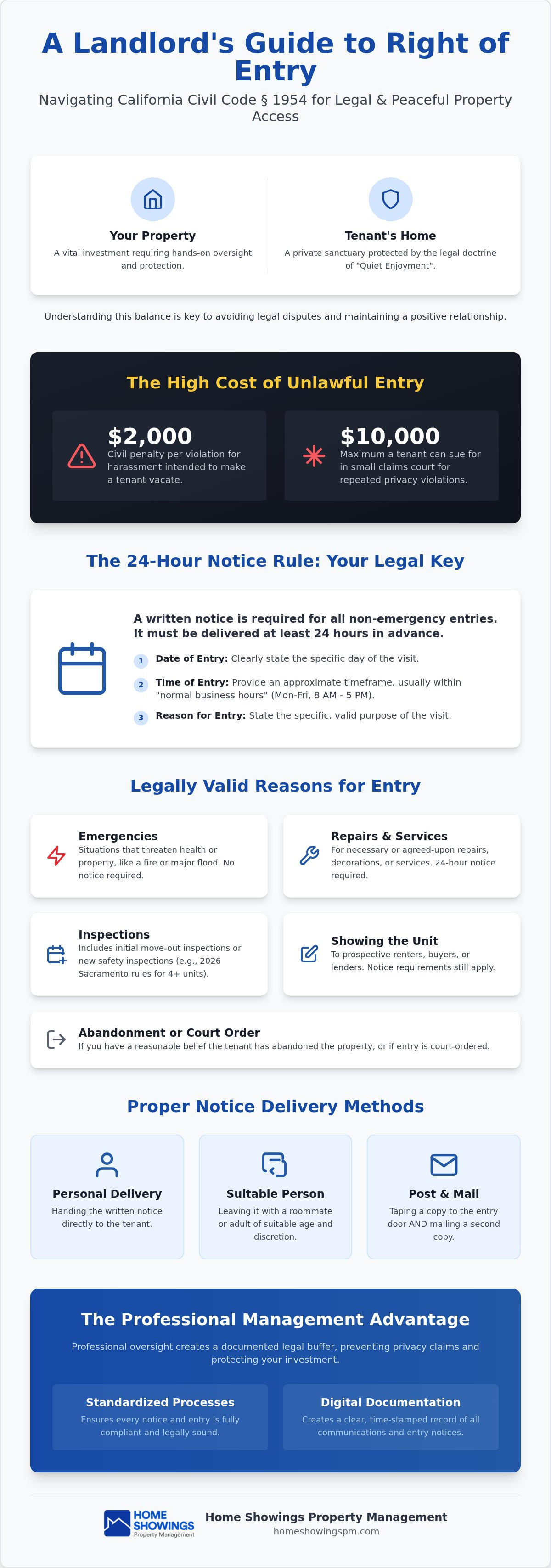
Significant violations intended to influence a tenant to vacate can lead to a civil penalty of up to $2,000 per violation. Additionally, tenants in 2026 can sue in small claims court for up to $10,000 if their privacy rights are repeatedly ignored. Professional management acts as a vital legal buffer here. By using standardized processes and digital portals, we ensure that every entry is documented and justified. This proactive oversight removes the friction that often leads to litigation, allowing you to maintain your property's value while respecting your tenant's boundaries.
The 24-Hour Notice Rule and Delivery Requirements
Providing a 24-hour written notice is the standard requirement for a landlord right of entry california, but the timing is more nuanced than a simple countdown. This rule serves as the legal threshold for non-emergency access. You must provide a written document that specifies the date, the approximate time of entry, and a valid reason for the visit. While the clock starts once the tenant receives the notice, the law also restricts when that entry can occur. Most courts interpret "normal business hours" as 8 AM to 5 PM, Monday through Friday. Unless your tenant specifically agrees to a weekend visit, routine maintenance should stay within these weekday bounds.
Exceptions to the 24-hour rule are rare and strictly defined. If a pipe bursts or a fire breaks out, you have the right to enter immediately to prevent property damage or ensure safety. Similarly, if a tenant has completely abandoned the premises, the notice requirement no longer applies. Outside of these crises, failing to provide the full 24-hour window can lead to claims of trespassing or harassment. It is a protocol built on documentation, not just a verbal heads-up.
Methods of Delivering a Legal Notice
Personal delivery is the most direct way to serve notice, but it isn't always feasible. If the tenant isn't home, you may leave the notice with a person of "suitable age and discretion," such as a roommate or an adult family member. Many Sacramento landlords rely on the "Post and Mail" method. This involves taping a copy of the notice to the front door and simultaneously mailing a second copy. This creates a strong evidence trail if the tenant later claims they never saw the notice. While digital communication is efficient, email and text messages may not be legally sufficient unless your lease agreement explicitly permits them for entry notices. For more context on tenant protections, the California Attorney General on Landlord-Tenant Issues provides a comprehensive overview of state standards.
The 6-Day Mailing Rule
Calculations change significantly when you use the postal service. If you choose to mail the notice rather than delivering it in person, California law requires you to add five days to the notice period. This turns a simple 24-hour notice into a six-day wait. The 24-hour clock only starts once the notice is 'received' or legally presumed received. To prevent "he-said-she-said" disputes, always document the exact time of delivery or keep your mailing receipts. If managing these timelines feels like a logistical burden, our team at Home Showings Property Management can automate these notices through our digital portals, ensuring you stay 100% compliant without the guesswork.
Valid Reasons for Entry Under California Law
While the law heavily weights tenant privacy, it also recognizes your fundamental need to protect and maintain your investment. Under California Civil Code 1954, access is restricted to four primary categories: emergencies, necessary or agreed-upon repairs, showings to prospective residents or buyers, and cases of abandonment. An emergency is defined as an immediate threat to life or property, such as a gas leak or a burst water main. If the situation doesn't pose an instant risk, you must revert to the standard notice protocols discussed earlier. Understanding these boundaries ensures you don't accidentally overstep into a harassment claim while trying to be a proactive owner.
Maintenance and Necessary Repairs
Distinguishing between cosmetic upgrades and necessary repairs is critical for a legal landlord right of entry california. Necessary repairs include anything that impacts the habitability of the unit. For instance, as of January 1, 2026, California Assembly Bill 628 requires landlords to provide and maintain a working stove and refrigerator. Entering to repair these essential appliances is a clear legal right. If you're coordinating with external contractors, you aren't required to be physically present, but you must still provide the tenant with the date and approximate time window for the work. For a comprehensive strategy on keeping your property in peak condition, explore our guide on Property Maintenance Management in Sacramento.
Inspections and Showings
Periodic inspections are the most effective way to catch small issues before they become expensive disasters. In Sacramento, the regulatory landscape shifted on June 1, 2026, when the Rental Housing Inspection Program expanded to include all properties with four or more units. This means more owners are now subject to annual safety checks by the city. Beyond city mandates, you have the right to conduct your own inspections to ensure the property is being preserved.
When a tenant gives notice to vacate, you can legally show the unit to prospective renters, typically during the final 30 days of the lease. This allows for a seamless transition between tenancies and minimizes vacancy loss. To ensure every walkthrough is thorough and legally sound, we recommend using a standardized Rental Property Inspection Checklist. This meticulous approach provides a clear paper trail, protecting you if a tenant later disputes the purpose of your entry. Our "boots-on-the-ground" expertise in Elk Grove and Folsom ensures these visits are handled with the professional authority and human touch your residents expect.
Handling Tenant Refusals and Entry Disputes
Even with a perfect paper trail, you might encounter a tenant who refuses to open the door. This situation is one of the most stressful aspects of managing a landlord right of entry california. While it's tempting to use your spare key and walk in, you must avoid "self-help" remedies like forcing the door open. Doing so can escalate the situation and potentially lead to a harassment claim or even a police report. Instead, rely on the "unreasonable refusal" clause within California law. This clause protects you when a tenant blocks access for a valid, documented reason after receiving proper notice. If the entry is for a necessary repair, the tenant doesn't have a legal right to stop you, but forcing your way in is rarely the right tactical move.
De-escalation Strategies for Landlords
Most entry disputes stem from a lack of communication or a fear of privacy intrusion. Start by explaining the why behind the visit. If the entry is for a mandatory safety check under the 2026 Sacramento inspection program, let them know it's a city requirement designed to keep their home safe. Offer a specific window of time, such as between 10 AM and 12 PM, rather than a vague day-long window. This shows respect for their schedule and reduces the feeling of being "invaded." If the relationship has already become strained, involving a professional property manager can lower the temperature. We act as a neutral third party, using our "boots-on-the-ground" presence in Elk Grove and Sacramento to resolve conflicts before they reach a courtroom.
Legal Recourse for Continued Denied Access
If de-escalation fails and the tenant continues to block access, you have formal legal options. You can serve a "Cure or Quit" notice, as repeated unreasonable refusal of entry is a breach of the standard California lease. Document every refusal meticulously, including the dates of the original notice and the specific interactions where access was denied. This documentation is essential if the situation moves toward an eviction proceeding or a small claims case. In 2026, where tenant protections are stronger than ever, having a clear record of your compliance is your best defense. If you're struggling with a difficult tenant, our residential leasing experts can step in to manage the communication and ensure your property remains accessible and protected.
Why Sacramento Landlords Trust Professional Management for Compliance
Managing the legalities of a landlord right of entry california isn't just a part-time task; it's a high-stakes compliance requirement that demands constant attention. For owners in the Sacramento valley, the pressure to get it right is mounting as local safety inspection programs expand to cover more properties. Professional management provides a steady, expert hand that removes the guesswork from property oversight. We act as your representative, ensuring that every interaction is conducted with a focus on stability and mutual respect between you and your residents. By letting a professional handle these sensitive touchpoints, you reduce your personal liability and maintain a healthy distance that prevents emotional disputes from turning into legal ones.
Automated Compliance and Documentation
In California's litigious rental market, a verbal agreement or a casual text message isn't enough to protect you in court. Home Showings Property Management utilizes advanced digital portals to automate and track every entry notice we serve. This creates an unshakeable digital paper trail that documents exactly when a notice was sent, what it contained, and when it was delivered. If a tenant ever disputes the legality of a visit, you have the concrete data to prove you followed the law to the letter. We ensure all entries align with the California Landlord Tenant Laws 2024, which remains the definitive compliance guide for the 2026 market. This systematic approach transforms a complex legal burden into a seamless, worry-free process.
Protecting Your Investment in the Sacramento Region
Our local expertise in Folsom, Roseville, and Elk Grove allows us to anticipate regional challenges before they become expensive legal problems. Whether it's coordinating the mandatory 2026 safety inspections for multi-unit buildings in Sacramento or handling a sensitive repair request in a suburban Folsom home, we serve as the professional buffer that protects your reputation. Professional oversight is your best defense against "accidental" legal violations that could lead to the $10,000 small claims penalties discussed earlier. If you want the peace of mind that comes with knowing your investment is being managed with meticulous care, contact Home Showings Property Management for a free consultation. We'll help you navigate every aspect of the landlord right of entry california with the confidence and reliability your investment deserves.
Securing Your Investment with Legal Precision
Protecting your real estate investment in 2026 requires more than just property maintenance; it demands a meticulous adherence to shifting legal standards. By mastering the landlord right of entry california, you transform potential points of conflict into opportunities for asset preservation and tenant retention. Whether you're navigating the 24-hour notice rule or handling a difficult entry dispute, remember that transparency and documentation are your strongest allies. These processes protect your reputation as much as your property.
If the logistical burden of tracking notices and city inspections feels overwhelming, you don't have to manage it alone. Our team provides a confident, local presence in Sacramento, Elk Grove, and Folsom to act as your legal buffer. With dedicated owner and tenant portals and an expert knowledge of Civil Code 1954, we ensure every inspection is conducted with total compliance and professional care. You can rest easy knowing every detail of your property's oversight is being handled by a proactive local guide who is always several steps ahead.
Protect your investment with professional Sacramento property management.
Stay proactive, stay compliant, and watch your rental business thrive in a stable, well-managed environment.
Frequently Asked Questions
Can a California landlord enter without notice in an emergency?
Yes, you can enter without any prior notice if there is a true emergency that poses an immediate threat to life or property. Common examples include a gas leak, a fire, or a major water pipe burst that is currently flooding the unit. In these high-stakes moments, the law recognizes that immediate action is necessary to protect the asset and the residents. You should still document the incident and the reason for entry afterward to maintain a clear record for your tenant.
What happens if my tenant refuses to let me in after a 24-hour notice?
If a tenant denies access after you've provided a legal 24-hour notice, you should not force your way in or use a key to enter against their will. Instead, calmly remind them that unreasonable refusal is a breach of their lease agreement. If they continue to block a valid landlord right of entry california, you may need to serve a formal "Cure or Quit" notice. Documenting these refusals is essential if the dispute eventually requires legal intervention or eviction proceedings.
Is an email or text message considered 'written notice' for entry in California?
Email and text messages are generally not considered sufficient "written notice" under state law unless your lease agreement explicitly allows for digital service. To stay fully compliant, it's safer to use personal delivery or the "Post and Mail" method, where a notice is taped to the door and also sent via first-class mail. Using a digital portal to track these communications provides an extra layer of protection, but the physical copy remains the gold standard for legal documentation.
Can I enter the property to perform an inspection if the tenant isn't home?
You can legally enter the property for an inspection even if the tenant is not present, provided you have served the required written notice. While you don't need their permission to be home, it's often helpful to coordinate a time that works for them to maintain a positive relationship. If you're entering an empty home, always leave a note or send a digital confirmation once the visit is complete. This transparency prevents the tenant from feeling their privacy was violated.
What are 'normal business hours' for landlord entry in California?
As of 2026, local California courts continue to view 8 AM to 5 PM, Monday through Friday, as the standard for "normal business hours." Unless your tenant specifically agrees to an evening or weekend visit, you should schedule all routine inspections and repairs within this window. Keeping your visits to these standard times respects the tenant's right to quiet enjoyment and helps you avoid claims of harassment or intrusive behavior that can lead to costly legal disputes.
Can I enter my rental property to show it to a new buyer?
Yes, showing the property to prospective buyers or mortgagees is a valid reason for entry under Civil Code 1954. You must still provide the standard 24-hour written notice for these walkthroughs. If you're in the process of selling the home, it's often beneficial to work closely with the tenant to find a schedule that minimizes disruption to their daily life. This neighborly approach often leads to better cooperation and a smoother sale process for everyone involved.
Do I need to give notice if the tenant requested a repair?
Technically, the 24-hour notice is still required even if the tenant requested the repair, unless they specifically agree to waive that notice period. Many tenants are happy to grant immediate access to get a broken stove or leaky faucet fixed quickly. If you plan to enter sooner than 24 hours, always get their consent in writing through a text or email. This protects you from any future claims that you entered the premises without proper legal authorization.
Can a tenant sue me for entering without proper notice in California?
Yes, tenants can sue for violations of the landlord right of entry california and seek significant financial penalties. In 2026, a tenant can sue in small claims court for damages up to $10,000 for privacy violations. If the entry is found to be intentional harassment meant to force a tenant to vacate, a civil penalty of up to $2,000 per violation can be imposed. Following strict notice requirements is your best defense against these expensive and stressful legal actions.


Comments