
Landlord Property Inspection Laws California: A 2026 Compliance Guide

In California, the phrase "routine inspection" is actually a legal myth that could cost you thousands in a harassment lawsuit if you aren't careful. You want to protect your investment and ensure your tenants are maintaining the home, but the state's strict privacy protections often make you feel like your hands are tied. It's completely natural to worry about hidden property damage or the risk of being sued for an invasion of privacy just for trying to look after your own asset. Staying on top of landlord property inspection laws california has never been more critical, especially with the 2026 updates and expanded local safety ordinances in areas like Sacramento.
We're here to help you master these complex entry laws so you can protect your investment while staying fully compliant with Civil Code §1954. By following a structured approach, you can replace that sense of anxiety with the steady confidence of a professional who has everything under control. This guide provides a clear, legally compliant inspection schedule and a reliable template for your mandatory 24-hour notice. We will walk through the specific reasons you're allowed to enter, how to document your visits properly, and the best ways to maintain a positive relationship with your tenants while preserving your property's long-term value.
Table of Contents
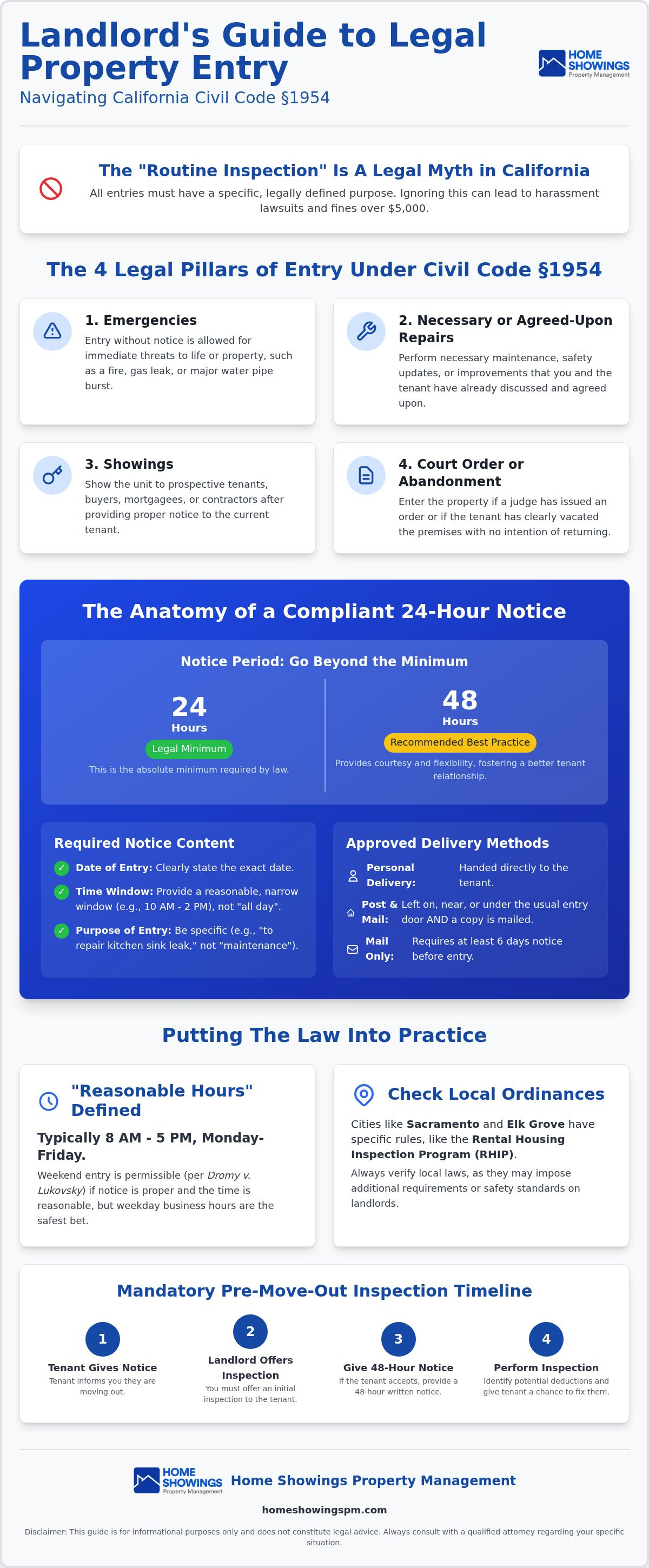
Understanding California Civil Code §1954: The Landlord’s Right to Entry
Civil Code §1954 is the definitive boundary between property rights and tenant privacy. If you own rental property in the Golden State, this statute is your primary rulebook for access. It exists to balance your need to protect your investment with the tenant's right to "quiet enjoyment," a concept rooted in the idea that a tenant should be able to live in their home without unreasonable interference from the owner. Understanding the broader Landlord-Tenant Law Overview helps put these specific California statutes into context, as they are among the most protective in the country.
If you ignore these boundaries, the consequences are steep. In 2026, a single violation of landlord property inspection laws california can result in fines exceeding $5,000 or costly harassment lawsuits in small claims court. Professional property management acts as a shield in these scenarios, ensuring every entry is documented and legally justified. Disclaimer: This guide is for informational purposes only and does not constitute specific legal advice; always consult with a qualified attorney regarding your specific situation.
The Four Legal Pillars of Entry
You cannot enter a tenant's home whenever you feel like it. California law limits your entry to four specific scenarios:
Emergencies: You may enter without notice if there is an immediate threat to life or property, such as a burst pipe or a fire.
Necessary or Agreed-Upon Repairs: This includes fixing broken appliances, performing safety updates, or making improvements you and the tenant have discussed.
Showings: You have the right to show the unit to prospective tenants, buyers, or contractors, provided you give the correct notice.
Court Orders or Abandonment: If a judge issues an order or if the tenant has clearly vacated the premises, you may legally enter.
What Constitutes 'Reasonable Hours'?
Even with a valid reason, you must generally enter during "reasonable hours." This is typically defined as standard business hours, often 8 AM to 5 PM, Monday through Friday. However, life doesn't always fit into a weekday schedule. Following the Dromy v. Lukovsky court decision, landlords may perform weekend showings if the timing is reasonable and the tenant receives proper notice. If you have an oral agreement with a tenant for a specific repair appointment, you aren't strictly bound by the 24-hour written rule, but meticulous documentation is still your best friend. Keeping entry windows narrow and predictable helps maintain a neighborly relationship while you fulfill your oversight duties.
The 24-Hour Notice Rule: Delivery and Documentation
Staying compliant with landlord property inspection laws california requires more than just a quick phone call. While state law mandates a minimum of 24 hours' notice, providing 48 hours is often the neighborly best practice that keeps tenant relationships smooth. This extra day allows residents to secure pets or tidy up, making the process less intrusive for everyone involved. For a broader look at how these rules fit into your overall strategy, our California Landlord Tenant Laws 2024 guide offers deep compliance context for the current year.
Documentation is your best defense against claims of illegal entry. According to California Civil Code § 1954, your written notice must include the date, an approximate time window, and the specific purpose for the visit. Avoid vague windows like "sometime Wednesday." Instead, aim for a four-hour block, such as 10:00 AM to 2:00 PM, to show respect for the tenant's schedule. Notice must be delivered in a way the tenant is reasonably expected to receive it.
Approved Delivery Methods in 2026
You have three primary ways to legally serve notice in California. Personal delivery is the most direct; you simply hand the document to the tenant or a person of suitable age at the property. If they aren't home, you can "post and mail," which involves leaving the notice on or under the front door and then mailing a second copy the same day. If you choose to rely solely on the mail, you've got to plan ahead. Mailing requires 6 days' notice instead of the standard 24 hours to ensure the tenant has time to receive the letter before you arrive.
Digital Notice: Can You Email or Text?
Relying on a quick text message for entry notice is a common mistake that carries high legal risks. If a tenant later claims they never saw the message, you're left without a solid paper trail in court. To solve this, Home Showings Property Management utilizes secure tenant portals to document all communication. These systems provide a time-stamped record that proves exactly when a notice was sent and viewed. If you prefer email, ensure you've established digital consent in the initial lease agreement. It's a proactive way to manage landlord property inspection laws california while keeping your operations efficient. If you're finding it difficult to keep up with these shifting requirements, professional property management can act as your shield against liability.
The 'Routine Inspection' Paradox: How to Inspect Legally
California law presents a frustrating riddle for property owners. While you have a vested interest in ensuring your asset isn't being damaged, Civil Code §1954 doesn't actually include "routine inspection" or "annual walkthrough" in its list of legal reasons for entry. If you serve a notice simply to "check the condition of the home," you're technically stepping outside the bounds of landlord property inspection laws california. This legal gap often leaves owners feeling powerless, but there's a professional way to bridge this divide without risking a harassment claim.
The solution lies in shifting your focus from "inspecting" to "maintaining." By tying your visit to specific maintenance obligations, you fulfill your duty to provide a habitable home while gaining the oversight you need. It's helpful to review a Rental Property Inspection Checklist to understand exactly what you should be looking for once you've legally crossed the threshold. This proactive approach ensures your property stays in top shape while keeping your legal standing secure.
Tying Entry to Maintenance Obligations
To enter legally, frame your notice around "necessary or agreed-upon repairs." Every home requires preventative care that falls under this category. Common legal anchors for entry include:
Testing smoke and carbon monoxide detectors (a mandatory safety requirement).
Replacing HVAC filters to ensure system longevity and air quality.
Checking for plumbing leaks under sinks or around water heaters.
Inspecting weather stripping or balcony railings for safety compliance.
When you focus the notice on tenant safety and property preservation, the visit feels like a service rather than an intrusion. At Home Showings Property Management, we normalize these visits as part of a standard care schedule, which reduces tenant anxiety and keeps owners informed through our digital reporting portals.
Handling Tenant Refusal
What happens if a tenant simply says "no"? Even with a perfect 24-hour notice, you should never use a key to force your way in against a tenant's verbal or physical objection. This is a high-risk move that can lead to "self-help" lawsuits, where damages for emotional distress or invasion of privacy can easily exceed $10,000. If a tenant denies entry, the correct path is to issue a formal "Notice of Covenant Violation." This documents their breach of the lease agreement, which typically includes a "Maintenance Inspection" clause requiring them to allow access for repairs. By following this steady, methodical process, you protect your legal rights without escalating a sensitive situation into a courtroom battle.
The Pre-Move-Out Inspection: Protecting Your Security Deposit
When a tenant decides to move on, the security deposit often becomes a major point of friction. Under Civil Code §1950.5, you're legally required to offer an initial inspection before the tenant vacates. This isn't just a courtesy; it's a mandatory part of landlord property inspection laws california that protects both parties. This walkthrough must be performed within the final two weeks of the tenancy. It provides the tenant with a "Right to Remedy," which is a chance to fix identified cleaning or repair issues before they leave. Failing to offer this inspection can forfeit your right to deduct for certain damages, leaving you to cover the costs of repairs that should've been the tenant's responsibility.
The 48-Hour Notice Requirement
Unlike the standard 24-hour window for repairs or showings, this specific pre-move-out inspection requires 48 hours' written notice. This longer lead time ensures the tenant has a fair opportunity to prepare and be present during the walkthrough. If they choose to attend, you're obligated to provide them with a "Statement of Deficiencies" before you leave the premises. This document acts as a checklist of specific tasks needed to return the property to its move-in condition. It's a transparent process that prevents "surprise" charges after the keys are handed over, fostering a sense of fairness that often prevents future legal disputes in small claims court.
Professional Documentation vs. DIY
A blurry cell phone photo rarely holds up in a Sacramento courtroom when a deposit is on the line. If you're dealing with a security deposit dispute, high-resolution, time-stamped evidence is your strongest asset. Meticulous reporting is the only way to clearly separate "Normal Wear and Tear," such as minor scuffs or faded paint, from actual tenant damage like holes in walls or stained carpets. At Home Showings Property Management, we use secure owner portals to store comprehensive move-out evidence, including detailed photos and condition reports that are accessible to you at any time. This level of oversight protects your financial interests while providing the tenant with undeniable proof of the property's state. If you want to ensure your move-out process is bulletproof and compliant with landlord property inspection laws california, partner with a professional team that manages these transitions with precision.
Navigating Compliance in Sacramento, Elk Grove, and Folsom
If you're a landlord in the Sacramento region, you've likely realized that state-level rules are only half the battle. While landlord property inspection laws california set the baseline, local ordinances in cities like Elk Grove and Folsom can be even more specific. Local expertise isn't just a luxury in this environment; it's a necessity for asset preservation. Having "boots-on-the-ground" management ensures that you're meeting both state statutes and municipal codes that often go unnoticed by out-of-area owners. For deeper insights into keeping your local assets in top shape, our guide on Property Maintenance Management in Sacramento offers practical preservation tips tailored to the Central Valley.
Home Showings Property Management acts as a steady buffer between you and these legal complexities. We manage the scheduling, the documentation, and the face-to-face interactions that can often lead to tension. By treating compliance as a proactive system rather than a reactive hurdle, we protect your reputation as a landlord while ensuring your property remains a high-performing asset.
The Sacramento Rental Housing Inspection Program (RHIP)
The City of Sacramento operates a proactive Rental Housing Inspection Program (RHIP) that requires rental units to undergo safety audits. Starting June 1, 2026, this program expanded significantly; it now includes all properties with 4 or more units, whereas it previously only targeted buildings with 10 or more. Preparing for a municipal audit involves a meticulous review of smoke detectors, plumbing, and structural safety. The city's current fee structure for 2026 is tiered based on building size:
4-10 units: $125 per building plus $25 per unit.
11-25 units: $200 per building plus $20 per unit.
26-50 units: $350 per building plus $15 per unit.
51+ units: $500 per building plus $12 per unit.
Compliant owners with a clean history may be eligible for self-certification options, which can reduce the frequency of physical city inspections. We help our clients stay ahead of these audits through our own internal inspection cycles, ensuring that when the city arrives, your property passes with flying colors.
Why Professional Management is the Ultimate Compliance Tool
One of the hardest parts of property ownership is removing the emotional friction from tenant interactions. When an owner performs an inspection, it can feel personal to the tenant; when a professional manager does it, it's simply a standard operational procedure. Our systematic approach ensures that no visit is missed and no entry is performed illegally. We use modern, tech-forward systems to track every notice served and every report filed. This level of meticulousness replaces anxiety with controlled stability, giving you peace of mind that your investment is being watched over by experts. Protect your investment with Home Showings Property Management today.
Securing Your Investment Through Strategic Compliance
Managing a rental property shouldn't feel like walking through a legal minefield. By mastering Civil Code §1954 and shifting your focus toward proactive maintenance, you protect both your asset and your peace of mind. Clear documentation and a neighborly approach to notice windows are your best defenses against unnecessary disputes. Navigating landlord property inspection laws california is much simpler when you have a structured system to handle everything from standard repairs to the mandatory pre-move-out walkthrough.
If you're feeling overwhelmed by shifting local ordinances in Sacramento or Elk Grove, you don't have to manage it alone. Home Showings Property Management provides the boots-on-the-ground expertise and transparent Owner Portals you need to stay ahead of compliance issues. We prioritize property preservation through coordinated maintenance, acting as a professional shield between you and potential liability. Request a Professional Property Assessment in Sacramento to ensure your investment remains protected and profitable. With the right local partner, you can stop worrying about legal hurdles and start focusing on the long-term growth of your portfolio.
Frequently Asked Questions
How often can I legally inspect my rental property in California?
In California, there's no set number of times you can inspect per year because "routine inspections" aren't explicitly listed in the law. You must tie every entry to a valid reason under Civil Code §1954, such as performing necessary repairs or testing safety equipment. Most landlords in Sacramento find that a semi-annual maintenance schedule works best for property preservation. This approach ensures you stay compliant while keeping a close eye on your asset's condition.
Can a tenant refuse an inspection in California if I gave 24 hours' notice?
Even with a valid 24-hour notice, a tenant can physically refuse entry. If this happens, you shouldn't force your way in, as this could lead to a lawsuit for harassment or invasion of privacy. Instead, document the refusal and issue a formal notice of lease violation. We often act as a neutral party to resolve these conflicts, ensuring that necessary maintenance happens without escalating the situation into a legal battle.
Do I need to be present for the property inspection?
You don't personally have to be there, but someone representing you must be. This could be a licensed contractor or a professional manager from our team in Elk Grove. Sending a third party without an authorized agent present can sometimes cause privacy concerns for tenants. Using a professional manager ensures that the visit is conducted respectfully and that all landlord property inspection laws california are strictly followed during the walkthrough.
Can I take photos during a rental inspection in California?
You're legally allowed to take photos to document the property's condition or specific repair needs. However, you should be careful to avoid capturing the tenant's personal belongings, photos, or sensitive information. Focus your lens on the structure, appliances, and any maintenance issues. These photos are vital evidence for your digital owner portal, providing a clear record of the property's state in case of a future security deposit dispute.
What happens if I enter a rental unit without notice in an emergency?
If an immediate threat to life or property exists, such as a fire or a major water leak, you can enter without any prior notice. This is a narrow exception designed for true emergencies where waiting 24 hours would cause catastrophic damage. Once the situation is stable, it's a good practice to provide the tenant with a written explanation of why you entered. This transparency helps maintain trust and prevents claims of illegal entry.
Is an annual inspection required by California law?
California state law doesn't require an annual inspection, but local ordinances might. For instance, the Sacramento Rental Housing Inspection Program (RHIP) now requires properties with 4 or more units to undergo safety inspections starting in 2026. Even if not required, scheduling regular maintenance visits is a smart strategy for property preservation. It allows you to catch minor leaks or safety hazards before they become expensive, tenant-displacing emergencies.
What is the penalty for a landlord entering without permission in CA?
Entering a unit without a legal reason or proper notice can lead to significant financial penalties. In 2026, a single violation of landlord property inspection laws california can result in a small claims judgment of $5,000 or more for harassment. Beyond the fines, you risk damaging the landlord-tenant relationship and losing your right to certain deductions. Using a professional management firm provides a layer of protection, ensuring every entry is documented and legally sound.
Can I inspect the property if I suspect the tenant is smoking or has an unauthorized pet?
You cannot enter a home solely based on a hunch about smoking or unauthorized pets. To stay compliant, you should schedule a visit for a legitimate reason, like testing smoke detectors or checking plumbing. Once you're inside for that valid maintenance purpose, you can document any lease violations you observe in plain sight. This method protects your legal standing while allowing you to address concerns regarding the preservation of your rental asset.


Comments