
Tenant Screening Criteria California: The Landlord’s 2026 Compliance Guide

Could a single line in your rental application be the difference between a reliable long-term tenant and a costly Fair Housing lawsuit? In the shifting legal landscape of 2026, establishing clear, written tenant screening criteria California landlords can rely on is no longer just a recommendation; it's your primary defense against liability. Whether you're managing a single-family home in Elk Grove or a multi-unit complex in Sacramento, the pressure to find a tenant who pays on time while avoiding the pitfalls of new legislation like SB 267 can feel overwhelming.
We understand that your property is more than just an asset; it's a significant investment that deserves protection. It's completely natural to feel anxious about selecting the right person when the rules regarding credit checks and criminal history seem to change every season. This guide promises to clear the confusion by providing a structured, 2026-compliant roadmap for your screening process. We will walk through the current $65 application fee limits, the mandatory look-back periods for background checks, and the essential documentation you need to maintain peace of mind and keep your rental business running smoothly.
Table of Contents
The Necessity of Written Tenant Screening Criteria in California (2026)
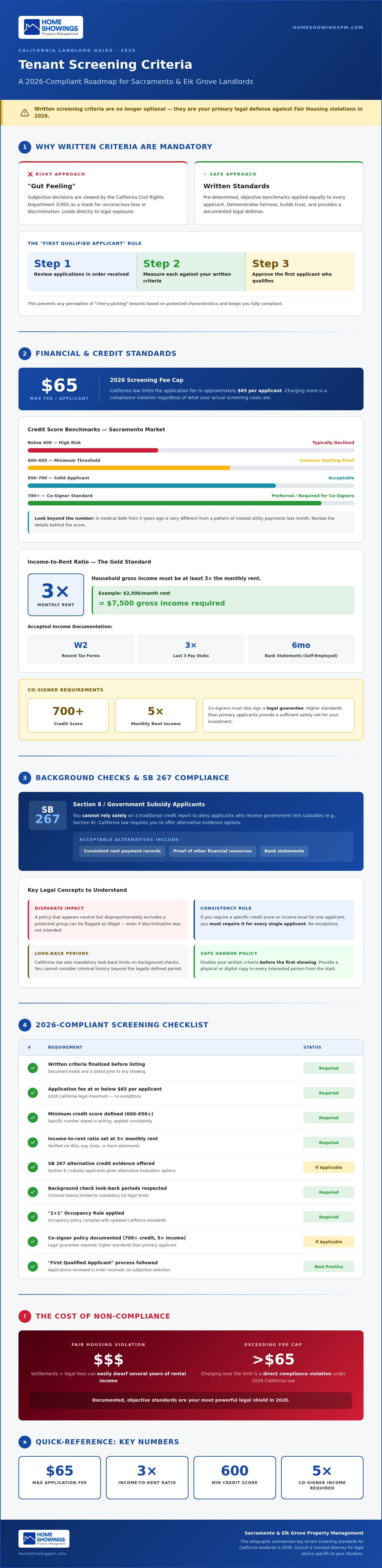
In the 2026 rental market, your tenant screening criteria california policy acts as a legal shield. It consists of a set of objective, pre-determined standards that every applicant must meet to qualify for your property. By defining these benchmarks before you even post a listing, you remove the guesswork and emotion from the process. Many landlords rely on a "gut feeling" when meeting prospective renters, but this approach is a direct path to legal exposure. The California Civil Rights Department (CRD) looks unfavorably on subjective decision-making; it often views "intuition" as a mask for unconscious bias or outright discrimination.
Adopting a "First Qualified Applicant" rule is a proactive way to stay compliant in Sacramento and the surrounding areas. This process involves reviewing applications in the order they're received and approving the first person who meets your written standards. It prevents the perception that you're "cherry-picking" tenants based on protected characteristics. Transparency doesn't just protect you legally; it builds immediate trust with high-quality applicants who appreciate knowing exactly what is required to secure the home.
The Legal Risks of Subjective Screening
Establishing your tenant screening criteria california standards requires a deep dive into an overview of the tenant screening process to ensure every base is covered. If a policy appears neutral but disproportionately excludes a protected group, it can be flagged as having a "disparate impact." In 2026, the financial consequences of a Fair Housing violation are severe. Settlements and legal fees can easily dwarf several years of rental income. Consistency is your best defense. If you require a specific credit score or income level for one applicant, you must require it for every single person who applies.
Establishing Your Safe Harbor Policy
To create a safe harbor for your investment, finalize your written criteria before the first showing occurs. This document should be readily available to every person who expresses interest. Providing a physical or digital copy ensures that everyone is playing by the same rules from the start. It's a simple step that demonstrates your commitment to professional standards. For a more detailed breakdown of the legal nuances involved, you can refer to our California Tenant Screening Laws Guide. This proactive documentation shows that you're a meticulous professional who values fairness and local compliance.
Financial and Credit Standards for Sacramento Rental Properties
Sacramento's rental market demands a precise approach to financial verification. Setting firm financial benchmarks is the cornerstone of effective tenant screening criteria california landlords use to minimize risk. In our local market, a minimum credit score between 600 and 650 is a common starting point. This range indicates a level of financial responsibility while acknowledging that life events happen. Beyond just looking at the final number, you should examine the details behind the score. A medical debt from five years ago is very different from a pattern of missed utility payments last month. When collecting these applications, remember that for 2026, the maximum screening fee you can charge in California is approximately $65 per applicant.
The gold standard for income remains the 3x rent-to-income ratio. If the monthly rent is $2,500, the household should ideally earn $7,500 gross per month. You should verify this through official documentation like recent W2s, the last three pay stubs, or six months of bank statements for self-employed individuals. If you decide to accept co-signers for applicants who don't quite meet these marks, ensure they sign a legal guarantee. We typically require co-signers to have a 700+ credit score and earn at least 5x the monthly rent to provide a sufficient safety net for your investment.
SB 267 and Credit Check Alternatives
Compliance with SB 267 is vital for any modern landlord. If you're screening an applicant with a government rent subsidy, like Section 8, you can't rely solely on a traditional credit report to deny them. California law requires you to offer these applicants the option to provide alternative evidence of their ability to pay. This could include records of consistent rent payments or proof of other financial resources. To stay fully aligned with the California Civil Rights Department Fair Housing Laws, your policy must be flexible enough to evaluate these alternatives without discriminating based on the source of income.
Verifying Financial Stability in a High-Cost Market
A credit score only tells part of the story. In a high-cost market like Sacramento, you should also analyze debt-to-income (DTI) ratios. If a tenant has a high credit score but is carries heavy car payments and student loans, their ability to pay rent might be compromised. For those with "thin" credit files or past bankruptcies, look for a steady employment history as a stabilizing factor. Establishing clear tenant screening criteria california standards helps you navigate these high-cost challenges with confidence. Once you've selected a qualified tenant, implementing online rent collection can help maintain that stability through automated reminders. If you're feeling overwhelmed by these technicalities, our team can help you set up professional tenant screening to ensure every box is checked correctly.
Evaluating Rental History and Background Checks Under CA Law
Establishing a clear picture of an applicant's past behavior is a vital part of your tenant screening criteria california strategy. Generally, a look-back period of 2 to 5 years provides a reliable window into their habits. When you contact previous landlords, focus on objective facts rather than personal opinions. Ask if they paid rent on time, if there were documented lease violations, and if they left the property in good condition. These questions help you move past hearsay and into data-driven decision-making. If an applicant has a history of property damage or multiple noise complaints, it's a clear signal that they may not be the right fit for your investment.
If you encounter applicants with no rental history, such as students or recent graduates, don't immediately discount them. While they lack a track record, you can mitigate risk by requiring a qualified co-signer or looking for a consistent employment history. Checking eviction records, or Unlawful Detainers, also requires a nuanced approach in California. Many records are masked or sealed, especially if the tenant won the case or reached a settlement. You should only consider evictions that resulted in a final judgment against the tenant within the last seven years to remain compliant with state reporting standards.
Criminal Background Check Restrictions
California’s "Fair Chance" ordinances and the state-level Fair Chance Act strictly prohibit blanket bans on applicants with criminal records. You can't have a policy that simply states "no felonies." Instead, you must perform an "individualized assessment" if a conviction is found. This involves considering the nature of the offense and how long ago it occurred. Specifically, California law limits the consideration of criminal convictions to the last 7 years, while non-violent misdemeanors are limited to a 3-year lookback period. If you intend to deny an applicant based on this history, you must provide them with a written notice and a chance to offer evidence of rehabilitation.
The Employment Verification Process
Confirming tenure is about ensuring the tenant has a stable source of funds to meet the 3x rent requirement. In the Sacramento region, we see a high volume of gig economy workers and self-employed professionals. For these applicants, look for steady deposits in bank statements rather than traditional pay stubs. Watch for red flags like inconsistent dates or employer names that don't match public records. If a document looks suspicious, a quick call to the HR department can provide the clarity you need. If you're unsure how to verify non-traditional income, our team at Home Showings Property Management can handle these technical verifications for you.
Building Your Legally Compliant Screening Checklist
Creating a safe harbor for your rental business means moving from theory to action. By formalizing your tenant screening criteria california, you build a consistent process that protects you from claims of favoritism or bias. If you have a clear, written checklist, you can easily demonstrate that every applicant was measured against the same yardstick. Use these five steps to finalize your standards before your next vacancy occurs.
Step 1: Define your minimum credit score and income requirements. As we discussed earlier, 3x the monthly rent is the standard benchmark for Sacramento.
Step 2: Set clear limits on the number of occupants. California generally follows the "2 plus 1" rule, which allows for two people per bedroom plus one additional person for the entire unit.
Step 3: Establish a pet policy. While you can restrict pets, you must remain in full compliance with ESA and Service Animal laws.
Step 4: Create a standard Adverse Action Notice template. If you deny an applicant based on a credit report, federal law requires this formal disclosure.
Step 5: Review your policy against the California Landlord-Tenant Law Update to ensure you haven't missed any 2026 legislative shifts.
Pet Policies vs. Service Animals
It's vital to understand the critical distinction between "pets" and "assistance animals" under California law. Assistance animals, which include both service animals and emotional support animals (ESAs), are not considered pets. This means you cannot charge a "pet deposit" or "pet rent" for a verified assistance animal, even if your building has a strict no-pet policy. For ESAs, you can request documentation from a licensed healthcare professional, but you cannot ask for specific details about the applicant's disability. Treating an assistance animal as a pet is one of the most common ways landlords accidentally trigger a discrimination claim.
The Proper Way to Deny an Applicant
If an applicant doesn't meet your tenant screening criteria california, you must handle the denial with care. Under the Fair Credit Reporting Act (FCRA), if you deny someone because of information in their credit report, you must provide them with an Adverse Action Notice. This document explains their right to see the report and dispute any inaccuracies. To avoid creating a liability trail, keep your communication brief and refer directly to your written standards. Maintaining a consistent set of records for at least two years is a smart way to defend against future claims. If you want to ensure your checklist is 100% compliant, our professional tenant screening services can take that weight off your shoulders.
Professional Tenant Screening: The Home Showings PM Advantage
Managing the complexities of tenant screening criteria california requires more than just a checklist; it demands a system that removes emotional bias and legal uncertainty. When you handle screening on your own, it's easy to let a compelling story cloud your judgment. Our approach at Home Showings Property Management balances professional authority with a neighborly touch. We act as your "Tech-Savvy Local Guide," using refined operational systems to identify high-quality tenants who will respect your property and pay on time.
Transparency is a core value of our partnership. Through our digital owner portals, you have 24/7 access to the status of your rental marketing and applicant processing. This level of oversight ensures you're never left wondering about the quality of the candidates we're evaluating. We believe that rigorous screening is the absolute first step in effective property maintenance and asset preservation. By placing the right person in the home from day one, we significantly reduce the risk of property damage and lease violations down the road.
Advanced Screening Technology
We leverage modern, automated systems to verify identity and financial data almost instantly. These tools allow us to go beyond local records, providing a comprehensive view of an applicant's history. Our technology suite includes:
Nationwide eviction and criminal database searches that go beyond basic local checks.
Instant identity and income verification to flag fraudulent documentation before it's too late.
Automated compliance checks that align with the latest 2026 California legislative updates.
This proactive oversight means we're always several steps ahead of potential legal issues. It gives you a worry-free experience while your asset remains protected by industry-leading data.
Beyond the Screening: Full-Service Management
A rigorous screening process is a proven way to lower vacancy rates and drive a higher ROI for your Sacramento investment. We provide "boots-on-the-ground" oversight in Elk Grove, Roseville, and surrounding areas to ensure your property remains in top condition. Our team handles the difficult conversations and technical details so you don't have to. If you're ready to trade the anxiety of DIY management for controlled stability, we're here to help. Schedule a consultation with Home Showings Property Management today to see how our systematic approach can preserve your investment for years to come.
Secure Your Rental Future with Confidence
Implementing a robust set of tenant screening criteria california landlords can trust is the foundation of a stress-free rental business. By moving from subjective intuition to objective, written standards, you protect both your property and your reputation. This guide has outlined the essential financial benchmarks, legal look-back periods, and mandatory checklists required to stay compliant in 2026. Whether you're managing a single home or a growing portfolio, consistency is your greatest legal shield against discrimination claims.
You don't have to navigate these complex regulations alone. As Sacramento and Elk Grove local experts, we provide a 100% Fair Housing Compliance Guarantee to keep your investment safe. Our transparent owner portals ensure you stay informed while we handle the technical details of background checks and income verification. We're dedicated to helping you find the high-quality tenants your property deserves while maintaining the highest professional standards.
Protect Your Investment with Professional Screening—Contact Home Showings PM
We look forward to helping you achieve total peace of mind with your rental property.
Frequently Asked Questions
Can I charge a tenant screening fee in California in 2026?
Yes, you can charge a fee, but it is strictly capped by state law. In 2026, the maximum allowable fee is approximately $65 per applicant, a figure that is adjusted annually based on the Consumer Price Index. You must provide a receipt to the applicant and return any unused portion of the fee if you don't run the background check. Including this limit in your tenant screening criteria california documentation ensures you stay fully compliant.
What is the maximum income-to-rent ratio I can require in California?
While there's no state law setting a specific cap, the industry standard in Sacramento and Elk Grove is requiring an income of 3x the monthly rent. You must apply this rule consistently to every applicant to avoid discrimination claims. For those with housing vouchers, you can only apply this ratio to the portion of the rent the tenant pays directly, rather than the total monthly rent amount for the property.
How do I legally screen a Section 8 applicant regarding their credit?
Under SB 267, you cannot use a traditional credit report as the sole reason to deny a subsidized applicant in California. You're required to offer them the option to provide alternative evidence of their ability to pay, such as proof of consistent utility payments or bank statements. This ensures your tenant screening criteria california process doesn't unfairly exclude voucher holders who may have thin credit files but a reliable payment history.
Can I deny a tenant for having a criminal record in California?
You cannot issue a blanket ban on all applicants with a criminal history. California's Fair Chance Act requires you to perform an individualized assessment that considers the nature of the crime and the time passed since the conviction. Generally, you can only look back seven years for most convictions. If you intend to deny an applicant, you must provide a written notice and allow them five days to respond with evidence of rehabilitation.
What are the protected classes under California Fair Housing laws?
California protects several characteristics beyond federal standards. These include race, color, religion, sex, gender identity, sexual orientation, marital status, national origin, ancestry, familial status, source of income, disability, genetic information, and age. It is vital to ensure your screening process doesn't inadvertently target any of these groups. Our team at Home Showings Property Management maintains a 100% Fair Housing Compliance Guarantee to protect our owners from these common and costly legal pitfalls.
Is a 600 credit score good enough for a rental in Sacramento?
A 600 credit score is a common minimum benchmark for many Sacramento rental properties, but its suitability depends on your specific risk tolerance. If a score is on the lower side, we often look for compensating factors like a long history of on-time rent payments or a higher income-to-rent ratio. Setting your threshold between 600 and 650 allows you to capture a wide pool of qualified applicants while filtering out those with high financial instability.
How long does the tenant screening process typically take?
A professional screening process typically takes between 24 and 72 hours to complete. This timeframe allows us to verify employment, contact previous landlords for references, and review credit and background reports thoroughly. While technology helps speed up the data collection, the human element of calling references ensures we get a complete picture of the applicant. Quick processing helps you secure high-quality tenants before they move on to another property in the competitive market.
Do I have to provide a reason for denying a rental application?
If your denial is based on information found in a credit report, federal law requires you to provide an Adverse Action Notice. This notice must explain why the application was rejected and provide the contact information for the credit bureau used. For other reasons, such as insufficient income or poor landlord references, it's best practice to provide a brief, factual explanation that refers directly to your pre-established written standards to ensure total transparency and fairness.



Comments