
Roseville Rental Property Tenant Eviction Process and Hearings

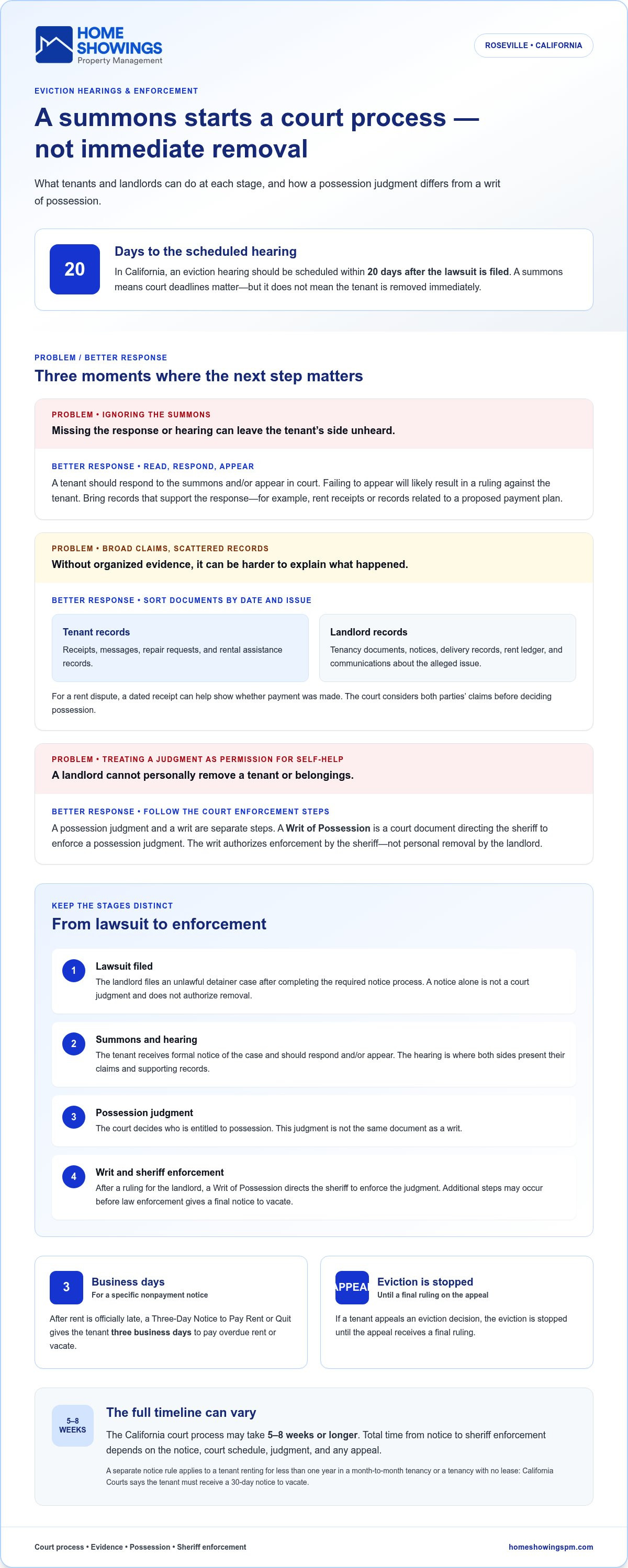
A Roseville rental property tenant eviction process moves from notice and court filing to a hearing, a possession judgment, and potentially a writ directing the sheriff to carry out the eviction. In California, an eviction hearing should be scheduled within 20 days after the lawsuit is filed, and a tenant who receives a summons should respond and/or appear in court.
For renters, a court summons is serious, but it does not mean immediate removal. The hearing, judgment, any appeal, and writ each shape what happens next. Landlords must follow the legal process and cannot remove tenants themselves.
This guide explains how eviction filings and summonses work in Roseville, what to expect at a hearing, and how possession judgments, appeals, and writs affect renters and property owners. It outlines the process and the points where each party’s next steps matter.
Table of Contents
Eviction court hearings and writs of execution
In a California unlawful detainer case, the court hearing moves the dispute toward a decision about possession. The summons, evidence, judgment, and writ each have a distinct role for renters and landlords.
Tenant Responses and Court Attendance
A tenant’s response and attendance provide an opportunity to address the landlord’s claims in court. The summons gives notice of the lawsuit and hearing, so ignoring it can have serious consequences.
A tenant who receives an eviction summons must respond and/or appear at the hearing. Failing to appear will likely result in a ruling against the tenant. For example, a renter disputing unpaid rent can bring receipts or records showing payments. A tenant seeking time to pay can present an emergency rental assistance application number or evidence supporting a proposed payment plan. The court considers both parties’ claims before deciding possession.
Evidence for Unlawful Detainer Hearings
Evidence is the material each side presents to support its position in an unlawful detainer hearing. Organizing records around the reason for the lawsuit helps the judge assess specific claims rather than broad statements.
A landlord can document the tenancy, notices, delivery records, rent ledger, and communications about the alleged problem. A tenant can organize receipts, messages, repair requests, or rental assistance records by date. If the dispute concerns unpaid rent, a dated receipt can help establish whether payment was made. Clear, relevant records help each side explain what happened.
Writs and Eviction Enforcement
A writ of possession is a court document directing the sheriff to enforce a judgment for possession. It comes at a later stage of the case, not with the initial eviction notice.
After a judge rules for the landlord in California, the judge issues a Writ of Possession directing the sheriff to evict the tenant. The process may involve additional steps before law enforcement gives a tenant a final notice to vacate. The writ authorizes enforcement by the sheriff, not personal removal of occupants or belongings by the landlord. After a court order, there may be limited ways to delay or challenge removal.
Applicable Rules and Tenant Protections
California eviction law governs Roseville rental cases, alongside applicable local rules. For nonpayment, a landlord may serve a Three-Day Notice to Pay Rent or Quit after rent is officially late; the tenant has three business days to pay overdue rent or vacate.
Roseville’s Tenant Notification Ordinance concerns certain rental properties affordable to lower-income households. It requires advance notice to the City before such a property becomes available for sale. Relocation benefits may apply when a new owner takes specified actions during the required three-month notification period, causing a tenant to move. These protections are separate from the eviction hearing.
California Courts says a tenant renting for less than one year must receive a 30-day notice to vacate when the tenancy is month-to-month or has no lease. The total time from notice to sheriff enforcement depends on the notice, court schedule, judgment, and any appeal; the California court process may take 5-8 weeks or longer. An appeal stops eviction until a final ruling.
Filing an eviction case and serving a summons
In Roseville, a landlord starts a court eviction by filing an unlawful detainer lawsuit after completing the required notice process. The filing asks the court to decide whether the landlord is entitled to possession. A notice alone does not create a court judgment or authorize the landlord to remove a renter. The lawsuit begins a separate legal process with formal documents and deadlines.
Court filing fees and total eviction costs in Roseville vary according to the case and the steps involved. Costs can include filing, serving court papers, legal representation, and later enforcement. There is no single total that applies to every landlord or renter. The number of filings, service method, and whether the case is contested can affect the overall expense.
Before filing, a landlord must identify the reason for seeking possession and use the notice that applies. A claim involving overdue rent, for example, differs from one involving a lease violation. A Three-Day Notice to Pay Rent or Quit gives a tenant three business days to pay overdue rent or vacate after rent is officially late. The lease, payment records, and notice details help clarify the basis of the case.
Once the notice period has expired without resolving the issue, the landlord can file the lawsuit. The court filing identifies the parties and rental property, and sets out the possession claim. The tenant then receives a summons with information about the case and the required response or appearance. California eviction hearings should be scheduled within 20 days after the lawsuit is filed, making timely filing and service important to the court calendar.
Serving the summons gives the renter formal notice that a case is underway. California service methods include hand delivery; leaving a copy with a household member when hand delivery fails, then mailing another copy; or posting the documents and mailing them. The method matters because service records help show how notice reached the renter. For example, a landlord can keep proof of delivery or mailing with the case documents.
For a renter, receiving a summons means reading the court papers promptly and noting the stated deadlines. A change in income or a promise to pay rent does not by itself end the lawsuit; the court considers the parties’ positions and supporting records. A renter disputing the amount claimed can organize payment receipts and compare them with the landlord’s account. A landlord can likewise prepare the lease, rent ledger, and notice records.
Accurate filing and documented service help both parties understand what the court will consider. A missing payment entry, unclear notice, or disputed delivery can matter to the possession claim. Keeping the lease, communications, and payment history together gives the parties a clearer record as the case moves from filing to hearing.
Forcible entry and detainer summons
For a Roseville rental, the court case seeking possession is an unlawful detainer action. A notice to vacate and a summons serve different purposes: the notice raises a rental issue, while the summons tells the renter a court case has begun. Knowing the difference helps renters identify which document needs prompt attention.
The summons connects the renter to a specific court case. It identifies the parties and provides information about the action, including where and when the renter must appear. The attached complaint explains why the landlord is seeking possession. For example, a claim based on unpaid rent should be read alongside the lease and the amounts listed in the complaint.
A renter who receives these papers should read every page and note the court details and deadlines. If the complaint alleges unpaid rent, compare its figures with receipts, bank records, or payment messages. If it describes a lease violation, locate the relevant lease terms and communications. These records help the renter understand what the landlord is asking the court to decide.
The summons is not a sheriff’s order to remove a renter or belongings. It begins the court stage, where the landlord must pursue the action through the legal process. If the renter does not respond and/or appear as required, the court will likely rule against them. Attending court gives the renter a chance to address the allegations and present relevant records.
Service delivers the summons and complaint to the renter. California methods include hand delivery; leaving a copy with a household member after hand delivery fails and mailing another copy; or posting the papers and mailing them. These methods create a record of delivery. A landlord should keep service records with the case file.
The court hearing follows the filed lawsuit; California hearings should be scheduled within 20 days after filing. The summons helps the renter connect the paperwork to that hearing, while the complaint explains the landlord’s requested outcome. A renter can prepare questions about disputed rent, notice details, or the alleged breach, then organize records that address those points.
For a landlord, a clear summons and documented service keep the court action focused on the possession claim. For a renter, the papers identify the case to answer, not an immediate instruction to leave. If a judge later rules for the landlord, enforcement proceeds through the court’s possession process and sheriff, not through self-help removal.
Judgment for possession and appeals
A judgment for possession decides whether the landlord may recover the rental unit. An appeal can affect when an eviction judgment proceeds to enforcement. Understanding these stages helps renters and landlords follow the court’s decision without confusing the ruling with the steps that follow.
Possession Judgment
A possession judgment is the court’s ruling on who has the right to occupy the rental property. Even after winning, a landlord must rely on the court process to enforce possession, not remove a renter personally.
The ruling follows the court’s review of the landlord’s claim and the tenant’s response. For example, a dispute over unpaid rent may turn on the lease, payment records, and notice documents presented. A judgment concerns possession and is separate from the notice period that preceded the lawsuit.
In the Roseville rental property tenant eviction process, a judge’s decision is a turning point, not permission for a self-help lockout. After a judge rules for the landlord in California, the judge issues a Writ of Possession directing the sheriff to evict the tenant. The landlord provides the judgment to local law enforcement, usually with a fee, before the tenant receives a final notice to vacate.
For a tenant, the judgment means the court has decided the possession claim, making the next court document and any appeal important. For a landlord, enforcement must still follow the court process. Neither party should treat the judgment as permission to remove belongings personally.
Appeals of Eviction Judgments
An appeal asks for review of an eviction decision and can change the timing of enforcement. If a tenant appeals an eviction decision, the eviction is stopped until a final ruling on the appeal.
This pause matters to both parties. A landlord cannot assume the sheriff’s removal can proceed immediately during an appeal. A tenant should understand that the appeal challenges the court’s decision. The judgment remains part of the case record while the appeal awaits a final ruling.
For landlords following the Roseville rental property tenant eviction process, an appeal means enforcement must wait for the final ruling. Tenants considering an appeal can review the judgment, court papers, and hearing record to identify the decision they want reviewed. Legal advice can clarify how the ruling and appeal apply to their circumstances.
An appeal differs from simply asking for more time to move out. Its outcome determines whether the case can proceed toward enforcement or the court’s decision changes. Both sides should keep court documents organized and follow the case status through the appeal.
Landlord considerations about eviction
A Roseville landlord must match the reason for ending a tenancy with the applicable notice and court process. The tenancy type, length, and conduct at issue shape the required steps.
Legal Grounds for Eviction
Legal grounds are the reasons a landlord may rely on to seek possession through court. Identifying the specific reason matters because it determines the notice and evidence relevant to the case.
California eviction grounds can include unpaid rent, a lease violation, or severe conduct such as illegal activity or repeated lease breaches. A landlord must use the notice that fits the alleged issue, then file an unlawful detainer action if the tenant does not resolve it or leave. The notice and court case are separate stages.
For a month-to-month tenancy or one without a lease, the notice period can depend on how long the tenant has lived there. According to California Courts, in California, a tenant renting for less than one year must receive a 30-Day notice to vacate when the tenancy is month-to-month or has no lease. According to California Courts, a tenant who has resided in a month-to-month rental for one year or more must receive a 60-Day notice to vacate.
Before serving notice, a landlord should compare the lease, rent ledger, and communications with the stated grounds. For example, a claim of unpaid rent should match the payment history and amount demanded. A landlord must not use self-help, such as changing locks, to remove a tenant. The lawful route is notice followed, when necessary, by a court action.
Just-Cause Eviction Rules
Just-cause rules concern whether a landlord has a legally recognized reason to end a tenancy. For a Roseville rental, the reason, tenancy terms, and applicable state or local requirements affect the process.
A landlord should distinguish an alleged tenant breach from ending a tenancy without claiming misconduct. Nonpayment and lease violations require records supporting the stated reason. A landlord should not label a dispute a violation without reviewing the lease and payment history. The notice must match the basis for seeking possession.
Roseville’s Tenant Notification Ordinance addresses a specific situation involving certain rental properties affordable to lower-income households. It requires advance notice to the City before such a property becomes available for sale. Relocation benefits may apply when a new owner takes specified actions during the required three-month notification period and a tenant must move as a result.
This local relocation provision does not replace eviction notice rules generally. Landlords should distinguish a sale-related notification issue from a court case based on nonpayment or lease violations. For example, documents supporting a rent claim differ from records about a property sale or changes to rental terms. Matching the facts to the applicable rule helps keep the notice and court filing consistent.
Home Showings Property Management: Property Management
Home Showings Property Management supports residential rental owners in Sacramento, Folsom, Roseville, Elk Grove, Rancho Cordova, Natomas, North Lake Sacramento, El Dorado Hills, Citrus Heights, and Carmichael. Its property management services help owners coordinate rental operations, from leasing and rent collection to maintenance and inspections.
Rental Marketing and Tenant Screening support the leasing process, while Rent Collection is handled online through the tenant portal. Maintenance is coordinated through online work orders with photos, using in-house teams and outside vendors. These services support rental operations but do not replace the court process or legal advice during an eviction case.
For help managing a rental property in the Sacramento region, contact Home Showings Property Management to discuss your needs.
Build a steadier plan for your rental property
Understanding the Roseville rental property tenant eviction process can help owners make more deliberate decisions before a dispute grows. Review how the rental is managed day to day: are lease records, rent payments, and tenant communications organized and easy to access? Consistent property practices make it easier to address concerns early and keep important information in order.
An eviction is a legal process, not a substitute for ongoing rental oversight. If managing the property is taking attention away from other responsibilities, structured support can help with routine operations. Home Showings Property Management works with rental owners on property management, rental marketing, and tenant screening, supporting leasing and the day-to-day responsibilities of a rental.
Take a practical next step by discussing your property management needs with Home Showings Property Management. Contact Home Showings Property Management to start the conversation and move forward with a clearer plan for your rental.
Frequently Asked Questions
What does it mean for renters?
For renters, an eviction case puts the right to remain in the home before a judge. A summons calls for action on the court papers, not immediate removal. For example, a renter disputing the balance claimed can organize payment records and identify incorrect entries. If the court rules for the landlord, an appeal stops eviction until a final ruling on that appeal.
When does the ordinance apply?
Roseville’s Tenant Notification Ordinance applies to licensed rental properties in buildings with five or more units. It requires advance notice to the City before a rental property affordable to lower-income households becomes available for sale, allowing the City to share the information with potential buyers interested in keeping rents affordable. Relocation benefits may apply if a new owner changes rental terms during a 90-day notice period and the tenant must move as a result.
How does a landlord obtain and schedule a Placer County sheriff eviction lockout?
The landlord first needs a court judgment for possession. After the judge rules for the landlord, the court issues a Writ of Possession directing the sheriff to evict the tenant. The landlord provides the judgment to local law enforcement, usually with a fee, before the tenant receives a final notice to vacate. The sheriff enforces the writ. A landlord cannot replace this process with a lock change or personal removal.
What are the court filing fees and typical eviction costs in Roseville?
Costs vary by case and may include filing, service of court papers, legal representation, and later enforcement. The number of filings, service method, and whether the case is contested can affect the total.



Comments