
Roseville Rental Property Capital Improvements and Tax Basis

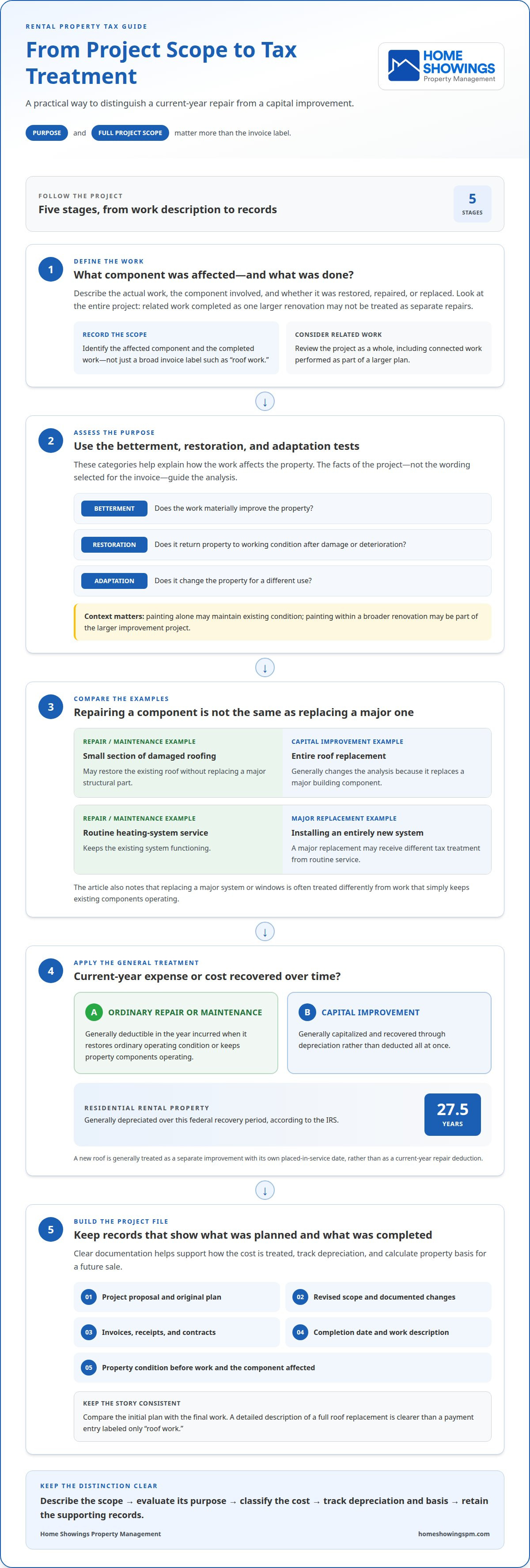
A new roof may look like a repair, but replacing a major part of a rental property is generally treated as a capital improvement, not an immediate deduction. Repairs that restore ordinary operating condition can generally be deducted in the year they’re incurred, while improvements are recovered over time. The IRS says residential rental property is generally depreciated over 27.5 years, and that distinction is central to Roseville rental property capital improvements.
It’s understandable to ask whether Roseville rental property capital improvements can reduce this year’s taxable rental income. The answer depends on the work’s purpose and scope, not simply its label or invoice. A repair that keeps equipment working may receive different tax treatment from replacing an entire system.
This article explains how the distinction applies to a new roof, HVAC equipment, and replacement windows, and how qualifying improvements affect your property’s cost basis. It also covers why clear project records matter when calculating depreciation and reporting a future sale.
Table of Contents
Can I Deduct A New Roof On My Rental Property?
A roof replacement is generally a capital improvement, while a repair that restores ordinary operating condition may be deductible in the year incurred. The deciding factors are the work’s purpose and scope, not the label on the invoice.
Repairs and Improvements
A repair restores a rental property or one of its components to ordinary working condition; an improvement betters, restores, or adapts the property. This distinction matters because a repair may reduce rental income in the year incurred, while an improvement is generally capitalized and recovered over time.
For example, repairing a small section of damaged roofing may restore the existing roof without replacing a major structural part. Replacing the entire roof generally changes the tax analysis because it replaces a major building component and is typically treated as an improvement. Consider the full project scope: related work performed as one larger renovation may not be treated as separate repairs.
Maintenance and Tax Treatment
Maintenance keeps property components operating, repairs restore them, and capital improvements add lasting value or extend useful life. The distinction affects when you claim tax benefits: ordinary repairs and maintenance are generally deductible in the year incurred, while capital costs are generally recovered through depreciation.
A routine service visit to keep an existing heating system functioning differs from installing an entirely new system. Likewise, a limited roof repair differs from replacing the roof. Keep invoices and work descriptions that identify what was done, which component was affected, and whether the work restored or replaced it. Clear records help support the treatment used on the rental tax return.
Do Roseville rental property improvements need landlord, tenant, or HOA approval? Tax classification alone does not answer that question. Approval depends on the property’s ownership documents, lease terms, and project requirements, not on whether the expense is deductible or capitalized.
What energy-efficiency rebates or incentives are available for Roseville rental property improvements? Tax classification does not establish rebate eligibility. Incentives depend on the program, the equipment or work, the property, and the program’s eligibility terms.
Depreciation Periods for Improvements
Depreciation spreads the cost of qualifying property improvements across a recovery period instead of deducting the full amount immediately. According to the Internal Revenue Service, residential rental property is generally depreciated over 27.5 years under federal tax law.
A new roof is generally treated as a separate improvement with its own placed-in-service date, rather than as a current-year repair deduction. The same distinction can apply to other major replacements. Record the completion date, invoices, and work description so you can track the improvement’s cost and depreciation separately from routine expenses.
For Roseville owners, document the property’s condition before work, the completed scope, and the component affected. An invoice describing a full roof replacement provides a clearer record than a payment entry labeled only “roof work.” These details help distinguish a repair from a capital project when reporting rental expenses and basis.
Betterments, improvements, restorations, and adaptations
The IRS groups improvement analysis into betterments, restorations, and adaptations. These categories help explain why a project’s effect on a rental property matters more than the invoice label.
Betterment, Restoration, and Adaptation Tests
A betterment materially improves property, a restoration returns it to working condition after damage or deterioration, and an adaptation changes its use. These distinctions matter because costs classified as improvements are generally capitalized rather than treated as ordinary operating expenses. The result depends on what the work changes, replaces, or restores.
Consider a property with an aging electrical system. Replacing a failed component to restore its prior function may point toward restoration. Reworking the system to support a substantially different use may point toward adaptation. An upgrade that materially improves the property may indicate betterment. The project’s facts, not the wording chosen for an invoice, guide the classification.
For Roseville rental property capital improvements, the plan and completed work should tell the same story. “Improve kitchen” is less informative than identifying the component changed and its resulting function. A landlord and accountant can use those details to assess whether the work bettered the property, restored it, or adapted it.
Painting illustrates why context matters. Painting alone may maintain a property’s existing condition, while painting included in a broader renovation may form part of an improvement project. The surrounding work and its purpose help show whether painting was a separate maintenance task or one element of a larger plan.
Project Plans and Documentation
A project plan records the intended scope before work begins, while supporting documents show what actually happened. Comparing them matters because the plan may reveal whether the project aimed to improve, restore, or adapt the property. Keep the proposal, revised scope, invoices, and completion records together in the project file.
For example, a proposal might describe replacing worn fixtures and updating room layouts. If the final invoice shows only fixture repairs, the completed work may differ from the initial plan. Record changes as they occur, including which components were removed, repaired, or added. This creates a clearer account for later tax preparation.
Photographs can also document a project’s condition before and after the work. Pair images with dated invoices and descriptions of the affected areas. A photo of a damaged wall, for example, gives useful context when matched with a repair invoice and notes describing the work.
Organized records help an accountant connect each cost to the work supporting its tax treatment. Keep separate entries for distinct parts of a larger project when invoices identify them. This detail makes it easier to review the project’s purpose and determine which costs should be depreciated.
Capitalizing renovation costs and adding them to cost basis
A rental property’s cost basis tracks investment in the real estate for tax purposes. Qualifying capital improvements add to the property’s original basis, while ordinary expenses such as repairs and routine maintenance generally reduce rental income without increasing basis. Keeping these categories distinct helps when calculating depreciation and gain on a later sale.
A property's original basis can include its purchase price, qualifying acquisition expenses, and capital-improvement costs. The roof cost is added because it qualifies as a capital improvement. By contrast, a repair cost incurred to restore an existing component is generally recorded as an expense rather than added to basis. Depreciation claimed over time reduces adjusted basis, so the original amount and later adjustments should both be tracked.
Initial renovation work can also affect basis when preparing a fixer-upper for rental use. Record the purchase and qualifying project costs separately, then retain invoices and descriptions showing which work belongs to the property’s capital investment. The repairs-versus-improvements distinction matters: a project’s scope and effect help determine which costs are capitalized. An accountant can use these records to connect renovation spending with depreciation and the property’s eventual sale.
Inherited property follows a different starting point in the provided example. A beneficiary’s new basis is generally $1,400,000, the property’s fair market value at the owner’s death. If $350,000 is allocated to land, the remaining $1,050,000 may be a starting point for building depreciation. Land and building are treated separately in that calculation because land is not the depreciable building portion. The deceased owner’s prior depreciation does not reduce the beneficiary’s new basis in this example.
What local permits are required for rental property renovations in Roseville, California? Permit requirements depend on the project’s scope and the building components involved. Changes to structural elements or building systems call for attention to local building review before work proceeds.
Can landlords pass capital improvement costs to tenants in Roseville? Capitalizing a project for tax purposes does not itself establish a right to charge tenants. Any tenant charge depends on the rental agreement and applicable rules governing the tenancy.
What are Roseville building permit fees for common rental property improvements? Fees depend on the project details used in the local fee calculation, including the work involved and its scope. Those factors, rather than tax basis treatment, determine the applicable permit fee.
What are typical costs for rental property improvements in Roseville, California? Costs depend on the property’s condition, materials selected, labor, and project scale. Repairing one damaged area, for example, involves a different amount of work from renovating an entire room.
How do capital improvements affect property taxes in Roseville, California? Improvements can affect assessed value, which may affect property taxes. The effect depends on how the work is treated for assessment and the property’s circumstances.
What risks and insurance issues should landlords consider before renovating a Roseville rental property? Work can create property damage, injury, or interruptions to occupancy. Before work begins, review how the project, contractor activity, and any vacancy may relate to the property’s insurance coverage.
Examples involving HVAC equipment and window replacements
Major replacements often involve separate assets rather than small repairs to existing components. The work’s scope helps distinguish a capital project from a repair, while the completion date helps establish when depreciation begins.
Replacing a furnace in a residential rental property is generally treated as a restoration and capital improvement because the furnace is a major component of the building’s HVAC system. Installing an entirely new HVAC system is also generally an improvement, with its cost recovered through depreciation rather than deducted as a current-year expense. Replacing an air-conditioning condenser is another capital improvement example.
These classifications depend on the project’s scope. A technician’s repair to restore a furnace’s operation differs from replacing the furnace itself. Similarly, replacing an air-conditioning condenser is different from routine service on existing equipment. The invoice should identify which components were repaired or replaced so the tax return reflects what actually happened.
Window projects also depend on their scope and effect. Replacing all outdated rental-property windows with new energy-efficient windows is a capital expense because the work prolongs the property’s usable lifespan. A limited repair to an existing window is different in scope. An invoice identifying the number and type of windows replaced helps preserve that distinction in your tax records.
A replacement that qualifies as a capital improvement is treated as a separate asset with a new placed-in-service date. Record the date the replacement asset is placed in service, along with receipts, contracts, and a description of the completed work. For a furnace installed after the old unit fails, for example, retain the installation record with the date and details of the new equipment. This keeps the asset’s depreciation record distinct from earlier equipment and routine repair entries.
Roof work follows the same scope-based approach. A new roof generally counts as an improvement, while work limited to restoring an existing roof may qualify as a repair. Replacing major residential building components, including roofs, windows, and doors, is generally depreciated over 27.5 years using the straight-line method and mid-month convention. This is a general recovery period for those replacement components, not an immediate deduction.
For a clear tax file, separate replacement costs from service calls and other repairs. Match each receipt to the affected component, project description, and placed-in-service date. If one invoice covers a new HVAC system and unrelated maintenance, itemized work details help distinguish the capital asset from routine work. Organized records support the depreciation entries for each replacement on the rental property’s tax return.
Deductible rental expenses versus capital improvements
A rental expense generally reduces taxable rental income, while a capital improvement is added to basis and recovered over time. The practical difference is timing: a qualifying expense may be deducted sooner, while an improvement is generally depreciated across its recovery period. Classify costs by the work performed, not merely by the account label or invoice description.
According to the Internal Revenue Service, residential rental property is generally depreciated over 27.5 years under federal tax law. This applies to the building, while qualifying improvements are generally capitalized and depreciated under the applicable rules. For example, a service call that maintains an existing furnace differs from replacing the furnace. Keep the receipt, work description, and asset records together so each amount is treated consistently on the tax return.
Safe harbors may allow certain costs to be expensed rather than capitalized, but eligibility depends on specific criteria. According to the Internal Revenue Service, a United States business may qualify for the small business building-improvement safe harbor if its average annual gross receipts are $10 million or less. The Internal Revenue Service also says the building’s unadjusted basis must be $1 million or less. Meeting these thresholds alone doesn’t establish that every project qualifies.
For this building-improvement safe harbor, the annual expense limit is the lesser of $10,000 or 2% of the property’s basis. That limit helps explain why the project’s total, the building basis, and the work’s scope matter. A qualifying expense under the safe harbor is treated differently from a major renovation that extends useful life or materially improves the property.
The de minimis safe harbor uses a separate test for tangible property. According to the Internal Revenue Service, a business with applicable financial statements may immediately deduct tangible property costing up to $5,000 per item or invoice. Without audited statements, the limit is $2,500 per item or invoice. The stated unit matters: one invoice covering several separate assets may require a different analysis from one asset treated as a single unit of property.
Keep routine maintenance separate from capital project records. For example, retain a plumbing service receipt with maintenance expenses and file a replacement-system invoice with improvement records. A clear description should identify the component, work completed, and amount. These details help explain why a cost reduced rental income immediately or was capitalized and depreciated.
Before applying a safe harbor, organize receipts, invoices, and property-basis records by project. The Internal Revenue Service criteria involve both the business and the property, so the cost’s amount alone does not determine its treatment. Accurate categories give your tax preparer a stronger basis for reviewing deductions and depreciation.
Home Showings Property Management: Rental Marketing
Home Showings Property Management helps rental owners connect property upkeep with the next stage of ownership through Rental Marketing and Property Management. After completing improvements, owners may need to prepare the home for prospective residents, coordinate leasing, and manage ongoing rental needs. Rental Marketing supports presenting the property to potential tenants, while Property Management brings the broader rental process together.
If renovation is part of a wider plan to maintain and rent your property, these services can help organize the transition. Contact Home Showings Property Management to discuss your rental property management and marketing needs.
Plan the Next Phase of Your Rental
Use the renovation process to align your property records and rental plans. A clear project file can support future tax preparation, while a thoughtful plan for the home’s next tenancy keeps the investment moving forward. For owners planning Roseville rental property capital improvements, consider how the completed work fits into the property’s ongoing rental operation.
Home Showings Property Management offers Property Management, Rental Marketing, and Tenant Screening to support owners as they prepare a property for tenants and manage its rental lifecycle. If you’re ready to discuss how those services could fit your plans, contact Home Showings Property Management. A well-planned next step can help you move forward with clarity and confidence.
Frequently Asked Questions
What Is An Improvement?
A rental-property improvement is work that materially betters the property, restores a major component, or adapts it to a new use. For example, converting an unused area into functional living space changes how the property serves tenants. A project’s purpose and completed scope matter more than an invoice label such as “upgrade.” Separate work descriptions can help explain why a project was treated as an improvement.
Can I Deduct A New HVAC System?
Usually, the cost of a complete new HVAC system is not deducted in full as a current-year rental expense. It is generally treated as a capital improvement and depreciated. A repair to an existing unit may receive different treatment if it restores operation without replacing a major component. Keep the installation date and an itemized invoice with equipment details so the new system’s tax records remain distinct from earlier service calls.
IRS Safe Harbors: Are There Ways to Deduct More Now?
Yes, certain safe harbors may allow eligible costs to be deducted sooner, but the requirements differ. According to the Internal Revenue Service, the de minimis safe harbor limit is $5,000 per item or invoice with applicable financial statements, and $2,500 per item or invoice without audited statements. The Internal Revenue Service also sets small-business building-improvement eligibility at average annual gross receipts of $10 million or less and an unadjusted building basis of $1 million or less.
What counts as a capital improvement for a rental property under IRS rules?
Work may count as a capital improvement if it betters the property, restores a major component, or adapts it to a different use. Replacing a building system differs from servicing one part of that system. The IRS analysis considers the affected property unit and the work’s overall scope. A project file describing the property’s condition before work and the result afterward helps show why the expenditure was capitalized.
How are rental property capital improvements depreciated versus repairs?
Repairs that keep a rental property operating may generally be deducted in the year incurred, while capital improvements are recovered through depreciation. The Internal Revenue Service generally uses a 27.5-year recovery period for residential rental property. For a separate replacement asset, record its placed-in-service date apart from the building’s original records. Depreciation reduces adjusted basis over time, so keep the asset schedule connected to the property’s tax records.
How should landlords document and report capital improvements on rental property taxes?
Keep the contract, itemized invoices, payment receipts, and a description of the completed work together. For a project involving several components, note which costs relate to each asset and when each was placed in service. Before filing, match those records to the depreciation schedule and rental-income records used for the tax return. Dated photographs can provide added context when they show the affected area before and after renovation.

Comments