
Rancho Cordova Rental Property Cash Flow Analysis: A 2026 Step-by-Step Guide

What if a property that looks profitable on paper starts losing cash once vacancy, taxes, maintenance, and financing are included? That’s the question a Rancho Cordova rental property cash flow analysis should answer before you invest. Headline rent is only a starting point. Property condition, neighborhood, and operating costs can quickly change the result.
Before committing your money, build a property-specific estimate that accounts for realistic rental income, operating expenses, and loan payments. This guide walks you through the process and shows how to compare conservative, expected, and optimistic scenarios. It also explains how to document assumptions for vacancy, insurance, property taxes, maintenance, and financing without treating estimates as guarantees.
You’ll learn how rental marketing, tenant screening, rent collection, and ongoing management fit into your forecast. Once the property is rented, compare actual income and expenses with your estimates. Organized records and regular reporting make it easier to identify what changed and update future assumptions.
Table of Contents
What Does Rental Property Cash Flow Mean in Rancho Cordova?
Rent collected, accounting profit, and cash flow describe different things. Rent collected is the money tenants actually pay. Accounting profit follows accounting rules and may include noncash items. Cash flow tracks money moving into and out of your account. For a rental property, the practical question is what remains after property expenses and loan payments are paid. The broader concept of tracking money in and out is outlined in What Does Rental Property Cash Flow Mean.
A positive estimate is useful, but it doesn’t promise future performance. A vacancy, unexpected repair, or change in financing can alter the result. A sound Rancho Cordova rental property cash flow analysis uses figures for the specific home and clearly stated assumptions, rather than treating advertised rent as income you’re certain to receive.
What is the basic rental cash flow formula?
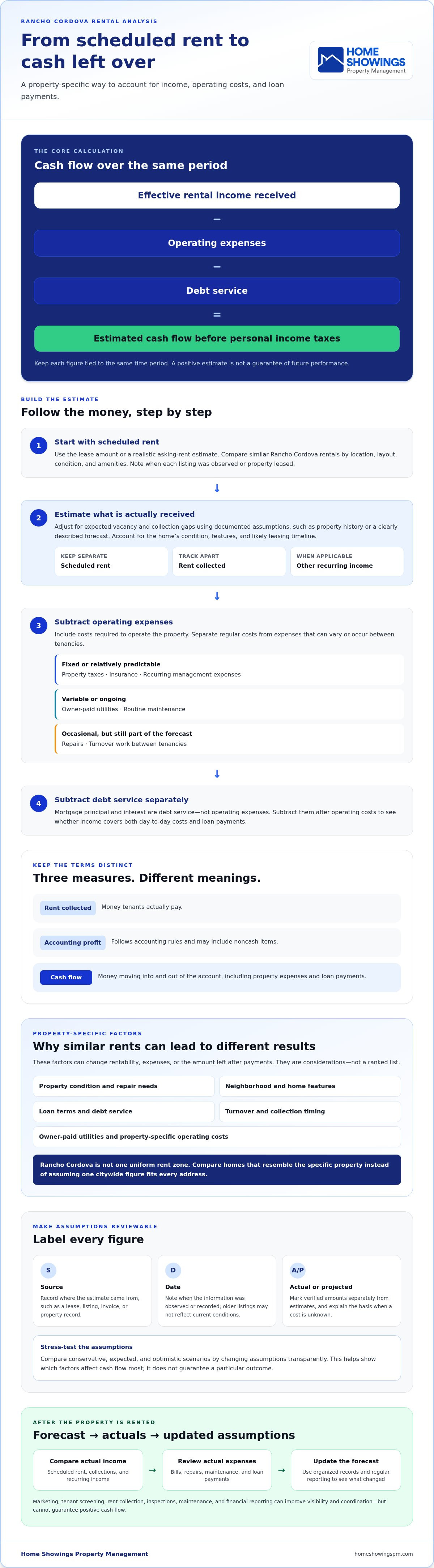
Rental property cash flow is effective rental income received minus operating expenses and debt service over the same period. Start with scheduled rent, then account for expected vacancy and collection gaps to estimate effective income. Include other recurring property income only when it applies.
Operating expenses can include taxes, insurance, owner-paid utilities, routine maintenance, repairs, and management. Keep these separate from mortgage principal and interest, which are debt service. Subtract debt service after operating expenses to estimate cash flow before personal income taxes. This distinction shows whether the property’s income covers both day-to-day costs and loan payments.
Why can Rancho Cordova properties have different cash flow outcomes?
Two Rancho Cordova rentals can have different results even when their scheduled rents look similar. Property condition affects repair needs. Location and features influence rentability, while loan terms determine debt service. Turnover, collection timing, and owner-paid utilities can also change the amount left over. Include these details in a property-level estimate instead of relying on a broad market average.
Rancho Cordova isn’t one uniform rent zone. Neighborhood, home type, condition, and tenant demand matter, so look for comparable properties that resemble the specific home rather than assuming one citywide figure fits every address. Rental marketing, tenant screening, rent collection, inspections, and coordinated maintenance help owners track forecast assumptions against actual operations. For broader context on rental operations across the region, see the Sacramento property management owner’s guide.
Which Income and Expenses Belong in a Rancho Cordova Cash Flow Estimate?
Start by separating advertised income from money the property is likely to receive. Then list the costs required to operate it. For every figure, record its source and date, and label it as actual or estimated. This gives you a clear basis for reviewing the forecast when leases, bills, or property conditions change.
How should landlords estimate effective rental income?
Begin with scheduled rent under the lease or a realistic asking-rent estimate. Compare similar Rancho Cordova listings and recent leasing evidence. Check that comparable properties match in location, layout, condition, and amenities. Record when each listing was observed or property leased, since an older listing may not reflect current conditions.
Adjust the estimate for the subject property’s condition, features, and likely leasing timeline. Apply a vacancy and collection allowance based on documented assumptions, such as the property’s history or a clearly described forecast. Keep scheduled rent, expected collections, and other recurring income in separate entries. That way, a missed payment or vacant period doesn’t disappear inside an optimistic total.
Which recurring costs can reduce rental cash flow?
Group expenses by how they behave. Fixed or relatively predictable costs may include property taxes, insurance, and recurring management expenses. Variable costs can include owner-paid utilities and routine maintenance. Occasional expenses, such as repairs and turnover work between tenancies, may not occur monthly, but still belong in a realistic annual forecast.
Use invoices and property records where available. If a cost is unknown, enter a clearly labeled estimate and explain its basis instead of presenting it as a verified amount. Regular inspections and maintenance records can help identify recurring needs and plan for property preservation. For more on organizing upkeep, read this Sacramento rental property maintenance guide.
Income: Scheduled rent, rent actually collected, and other recurring property income.
Operating costs: Taxes, insurance, owner-paid utilities, management, maintenance, repairs, vacancy, and turnover.
Separate items: Acquisition costs and major improvements from recurring operating expenses. They affect the investment budget, but shouldn’t be blended into an ordinary monthly operating-cost estimate.
The IRS explains how rental income and expenses may be treated for tax purposes. Tax reporting categories don’t automatically match a cash-flow forecast, so track cash movements separately and keep property-specific records. A property management and reporting overview also explains how organized records support ongoing performance tracking.
How Can You Stress-Test a Rancho Cordova Rental Property’s Cash Flow?
A useful forecast shows how changes to the assumptions affect the result, not just what happens if everything goes to plan. In a Rancho Cordova rental property cash flow analysis, keep the property, loan structure, and forecast period consistent across scenarios. Change uncertain inputs transparently and use documented estimates instead of invented market averages.
How do you compare conservative, expected, and optimistic scenarios?
Use the same rent, expense, and financing records as your starting point, then prepare three versions of the forecast. Label each assumption and note its source. For example, use a longer vacancy period in the conservative scenario, your best-supported leasing timeline in the expected scenario, and a shorter period only in the optimistic scenario. Apply the same approach to repair costs and rent collection assumptions.
Conservative: Lower collected income or higher operating costs based on plausible downside conditions.
Expected: The most supportable estimate based on current property records and comparable evidence.
Optimistic: A stronger but defensible outcome, not a best-case guess presented as certain.
Calculate cash flow for each scenario by month and year. If an expense occurs irregularly, include its annual estimate in the yearly view instead of implying it arrives evenly every month. Comparing the results shows how much your conclusion depends on uncertain inputs.
Which cash flow metrics should an owner review?
Start with net operating income (NOI): rental income after operating expenses, before mortgage principal and interest. Then subtract debt service to estimate cash flow after loan payments. These measures answer different questions. NOI shows property operations before financing, while post-debt-service cash flow also reflects the financing structure.
Stress-test one factor at a time to see its effect clearly. Model a vacancy period, then separately increase repair spending. Run another check for a financing change, such as a different payment assumption, while holding rent and expenses steady. After reviewing each factor individually, combine plausible downside assumptions to see whether the property remains manageable.
Return on investment compares a return with the capital invested. It isn’t the same as monthly cash flow, and its calculation depends on which costs and returns are included. The debt service coverage ratio (DSCR) compares income available for debt payments with debt obligations, but lenders may define and apply it differently. Verify the relevant lender’s definition and requirements before relying on it.
These scenarios are planning tools, not guarantees or personalized financial advice. They help identify fragile assumptions before you invest and show which inputs may need closer review.
How Do You Complete a Rental Property Cash Flow Analysis Step by Step?
A reliable forecast is a working record, not a one-time calculation. For a Rancho Cordova rental property cash flow analysis, organize the inputs so you can trace each estimate, update it when conditions change, and compare it with actual owner statements.
What information should you gather before calculating?
Collect records that describe the property and how you expect it to operate. Use this checklist to assemble the starting file:
Property and rent: Property details, lease terms, relevant Rancho Cordova rental comparisons, and recent leasing evidence. Record each comparable’s source and date, and note differences in condition, layout, and amenities.
Financing and ownership costs: Loan terms, property tax records, and insurance estimates. Use figures that apply to the specific property and financing arrangement.
Operating history: Maintenance and repair records, recurring bills, owner-paid utility responsibilities, and prior turnover costs.
Forecast assumptions: Expected rent, vacancy and collection assumptions, and expense estimates not supported by invoices or existing records.
Enter scheduled income and estimated collections separately, list operating costs, and calculate the result using the same monthly or annual period throughout. For every line, note the amount, source, date, and whether it’s actual or estimated. This audit trail helps you spot outdated comparable listings or replace an estimate with a bill or lease record.
How should you review the analysis after a tenant moves in?
Compare the forecast with actual collections and expenses each reporting period. Match rent received to expected income, then review bills, maintenance work, and other property costs against the budget. If the figures differ, record why. A vacancy, delayed payment, repair, or timing difference may call for a different adjustment.
Use the variance to improve the next forecast. Don’t change the original estimate without noting why. Inspections and maintenance records can reveal developing needs that may affect future costs. Owner portals with financial reporting and property updates help keep relevant records accessible for review.
For more practical context on tracking rent receipts and cash flow, see the online rent collection and cash flow guide. Home Showings Property Management provides rent collection and residential property management, including organized rental records and property activity. Explore residential property management and rent collection.
How Can Local Property Management Support More Reliable Cash Flow Tracking?
A Rancho Cordova rental property cash flow analysis depends on assumptions about leasing, rent collection, and property upkeep. Organized management makes those activities easier to track against your forecast, so you can see where actual operations differ from the plan. It supports oversight and coordination, but it can’t guarantee occupancy, income, or positive cash flow.
How do leasing and rent collection affect cash flow visibility?
Rental marketing and residential leasing help present the property to prospective tenants, while tenant screening is part of the leasing process. These activities relate to your vacancy and timing assumptions, but they can’t ensure a particular leasing timeline, tenant, or rent level.
Consistent rent collection records make it easier to compare expected income with payments received. When an amount is late or differs from the forecast, a clear record helps you identify the variance and account for it in your financial review.
What should owners expect from ongoing property oversight?
Regular inspections provide information about property condition, and coordinated maintenance helps document work and related expenses. These records can inform future repair and upkeep assumptions. They also give owners a clearer view of property activity, rather than leaving maintenance costs as a vague line in a spreadsheet.
Owner portals with financial reporting and property updates provide a place to review income and expenses alongside the forecast. Comparing those records over time can help identify whether differences stem from collections, vacancy, maintenance, or another operating factor. Use that information to refine future assumptions.
Home Showings Property Management provides residential property management for owners in Rancho Cordova and nearby communities, including Sacramento, Folsom, Roseville, Elk Grove, Natomas, North Lake Sacramento, El Dorado Hills, Citrus Heights, and Carmichael. Rental marketing, tenant screening, rent collection, inspections, maintenance coordination, and reporting bring key operating activities into a more organized process. This supports visibility and coordination, not a promised investment result. Explore residential property management support for your Rancho Cordova rental.
Make Your Next Investment Decision With Clearer Numbers
A dependable Rancho Cordova rental property cash flow analysis starts with property-specific income and expense assumptions, not headline rent. Separate operating costs from loan payments, compare conservative and expected scenarios, and record where each estimate came from. Once the property is rented, compare actual collections and expenses with your forecast so you can update assumptions based on real performance.
Local residential property management supports this process through rental marketing, rent collection, inspections, and coordinated maintenance. Owner portals provide access to financial reporting and property updates, helping you review activity and understand where your numbers differ from expectations. These services improve visibility and coordination, but they can’t guarantee positive cash flow.
If you’re considering help managing a Rancho Cordova rental, explore Home Showings Property Management. The company serves rental owners across Sacramento, Folsom, Roseville, Elk Grove, Rancho Cordova, Natomas, North Lake Sacramento, El Dorado Hills, Citrus Heights, and Carmichael. Get in touch to discuss managing your property.
Frequently Asked Questions
How do you calculate cash flow on a rental property in Rancho Cordova?
Subtract operating expenses and debt service from effective rental income to estimate rental cash flow. For a Rancho Cordova rental property cash flow analysis, start with scheduled rent, account for vacancy and collection gaps, then deduct costs such as taxes, insurance, maintenance, and owner-paid utilities. Subtract mortgage principal and interest separately as debt service. Use consistent monthly or annual figures, and label estimates so you can compare them with actual results.
What expenses should be included in a rental property cash flow analysis?
Include recurring operating costs such as property taxes, insurance, management, owner-paid utilities, and routine maintenance. Also account for vacancy, turnover, and repairs. These may occur irregularly but can still affect yearly performance. Keep mortgage payments separate from operating expenses, and distinguish recurring costs from one-time acquisition or improvement costs. Use property records where possible, and clearly mark estimates and their sources.
How do vacancy and repairs affect rental property cash flow?
Vacancy reduces rental income because the property may go without rent while it’s being marketed or prepared for a new tenant. Repairs increase expenses and can create a larger cash outflow in the month they occur. Include a documented vacancy assumption and use the property’s maintenance history to inform repair estimates. Stress-test these factors separately, then consider a combined downside scenario to see how much room the budget has.
Can a Rancho Cordova rental property have positive cash flow after mortgage payments?
Yes. A property can have positive cash flow when effective rental income exceeds operating expenses and mortgage debt service. The result depends on the property’s rentability and condition, its actual costs, and the loan terms. A positive forecast doesn’t guarantee future performance. Test different vacancy, repair, and financing assumptions, and compare the estimate with property-specific records before relying on it for an investment decision.
How much rent should I use in a Rancho Cordova cash flow estimate?
Use a rent estimate supported by relevant Rancho Cordova listings and recent leasing evidence, not the highest advertised figure you find. Compare properties with similar locations, layouts, condition, and amenities, and record each source and date. Adjust for your property’s features and likely leasing timeline. Then account for vacancy and collection gaps to estimate income you may actually receive, rather than assuming scheduled rent will always be collected in full.
What is the difference between net operating income and cash flow?
Net operating income, or NOI, is rental income minus operating expenses before mortgage payments. Cash flow after debt service subtracts loan payments from NOI, showing what remains before other owner-specific considerations. The two figures answer different questions: NOI reflects property operations, while cash flow also reflects financing. Keep their inputs consistent, and don’t treat NOI as cash available after paying a mortgage.
Does hiring a property manager affect rental property cash flow?
Yes. Management is an operating expense, so include the applicable cost in your forecast. A manager can also coordinate rental marketing, tenant screening, rent collection, inspections, and maintenance. Organized reporting helps you compare actual activity with estimates. Home Showings Property Management provides residential management in Rancho Cordova and nearby communities, including Sacramento, Folsom, Roseville, Elk Grove, Natomas, North Lake Sacramento, El Dorado Hills, Citrus Heights, and Carmichael. Management supports coordination, not guaranteed returns.



Comments