
Common Mistakes of DIY Landlords in Sacramento: Why Self-Management Costs More in 2026
- Steven Lunetta
- Jul 2
- 12 min read

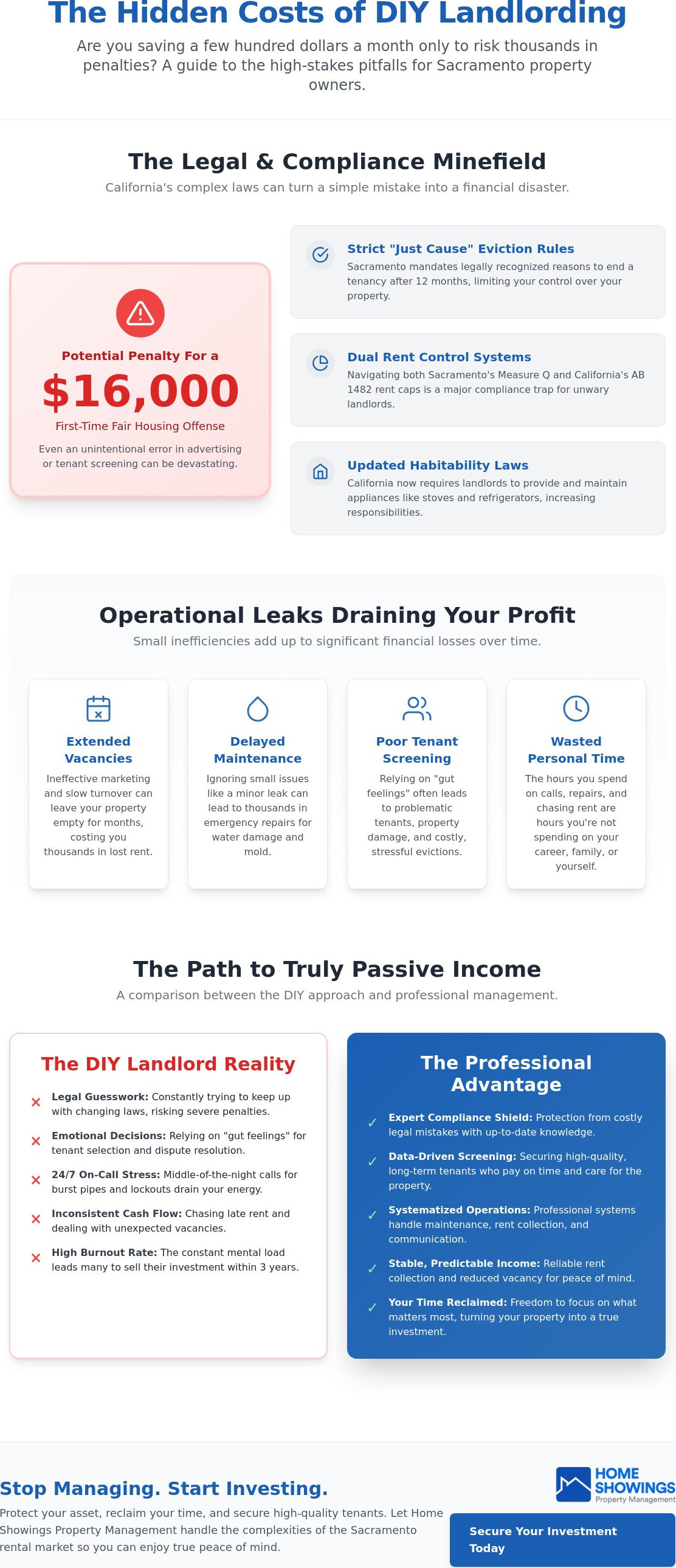
What if the few hundred dollars you are saving each month by managing your own rental is actually setting you up for a $16,000 legal penalty? For many property owners, the appeal of self-management is about maintaining control and protecting their bottom line. It is completely natural to feel that nobody will care for your investment quite like you do. However, as we move through 2026, the common mistakes of DIY landlords in Sacramento are becoming increasingly expensive due to a tightening web of local and state regulations.
Between the strict Measure Q rent caps and updated California habitability laws that now require provided appliances like stoves and refrigerators, the DIY approach carries significant financial risks. You deserve to earn passive income without the constant fear of a surprise lawsuit or the stress of middle-of-the-night maintenance calls. This guide will help you identify the high-stakes legal and financial pitfalls of managing property in today's market and show you how to safeguard your assets. We will explore the specific compliance traps currently catching local owners off guard and provide a clear strategy for securing high-quality, long-term tenants who stay for years.
Table of Contents
The Reality of DIY Landlording in Sacramento
Many property owners in the Sacramento suburbs start as "accidental landlords." Perhaps you inherited a family home in Elk Grove or moved to a new house in Folsom but decided to keep your old one as a rental. While this is a great way to build long-term wealth, the transition from homeowner to housing provider is often steeper than expected. In 2026, the local market has shifted away from casual "hobby" landlording toward a highly regulated environment that requires a professional touch.
If you are managing your own property, you are likely balancing a full-time career and family life alongside tenant demands. The common mistakes of DIY landlords in Sacramento often stem from treating the property like a side project rather than a business. This lack of systems can lead to an emotional toll that many owners don't anticipate. Being on call 24/7 for a burst pipe or a lockout isn't just a nuisance; it's a drain on your quality of life. The debate of property management vs self managing rental often comes down to one question: do you want a second job, or do you want an investment?
The Sacramento Rental Landscape in 2026
In areas like Roseville and Folsom, demand remains high, but so do tenant expectations. Today’s renters aren't just looking for four walls; they want responsive service and modern efficiency. With local inventory levels fluctuating, tenants have become more discerning. They know their rights regarding the implied warranty of habitability and expect every appliance to be in perfect working order. If you aren't prepared to meet these professional standards, you risk higher vacancy rates as quality tenants move toward professionally managed homes.
The "Time is Money" Fallacy
One of the most frequent common mistakes of DIY landlords in Sacramento is failing to value their own time. It's easy to look at a management fee as an expense, but you have to consider what your own hour is worth. If you spend your Saturdays chasing down late rent or coordinating repairs, you are essentially working a second job. Consider these points when evaluating your current workload:
Calculate your hourly rate at your primary job and see how much time you "lose" on property tasks.
Track every hour spent on rental marketing, tenant screening, and maintenance coordination.
Factor in the mental energy required to stay updated on shifting local laws.
Most self-managing owners find that they are actually paying themselves a very low wage to deal with high-stress situations. This burnout factor is real. Many DIY landlords end up selling their properties within three years simply because the constant mental load becomes unsustainable. Professional oversight isn't just about collecting rent; it's about protecting your time so you can focus on what matters most.
Legal and Compliance Pitfalls for California Landlords
California’s legal framework for rental housing is among the most complex in the nation. For a local owner, staying compliant means more than just being a "good person." It requires meticulous attention to detail and constant education. One of the most dangerous common mistakes of DIY landlords in Sacramento is assuming that a standard handshake or a generic lease downloaded from a national website will hold up in a local courtroom. These generic documents often lack the specific disclosures required by California law, which can lead to common landlord mistakes that result in heavy financial penalties.
Fair Housing Act violations represent another significant risk. A single misstep in your property advertisement or a poorly phrased question during a phone screening can trigger a discrimination claim. Even an unintentional error can be devastating; a first-time fair housing offense can cost a landlord $16,000 in penalties. In 2026, the Sacramento Tenant Protection Program mandates that landlords provide a legally recognized at-fault or no-fault "just cause" to end a tenancy once a resident has occupied the property for more than 12 months and one day. If you aren't prepared for these strict requirements, you may find yourself stuck with a difficult tenant and no legal path to reclaim your property.
Rent Control and AB 1482 Compliance
Understanding which laws apply to your specific property is vital. While the statewide AB 1482 limits rent increases to 5% plus the local CPI, properties within the City of Sacramento may fall under Measure Q. This local ordinance is even more restrictive, capping annual increases at 3% or 60% of the CPI, whichever is lower. DIY owners frequently make the mistake of serving rent increase notices that don't meet strict delivery requirements, effectively invalidating the increase. Missing a filing deadline for a local exemption can also lock your property into a lower rent tier for years. To avoid these traps, many owners choose to partner with a professional property management team to ensure every notice is served correctly and on time.
Security Deposit and Move-In/Move-Out Errors
The transition between tenants is the most common source of litigation for self-managing owners. California law is very clear about the 21-day rule; you must return the full security deposit or provide a detailed itemized statement of deductions within 21 days of the tenant moving out. Failing to meet this deadline can result in a judge ordering you to return the entire deposit regardless of the damage. Distinguishing between natural wear and tear and actual tenant damage is often a point of contention. For a deeper dive into these regulations, review our California Landlord Tenant Laws 2024 guide, which outlines the essential compliance steps you must take to protect your investment in 2026.
Operational Leaks: Where DIY Landlords Lose Revenue
Revenue loss in rental property management isn't always a sudden, catastrophic event like a lawsuit. Often, it's a series of silent leaks that drain your profit margin over months and years. One of the most frequent common mistakes of DIY landlords in Sacramento is underpricing their rental. If you set your rent just $200 below market value to "find a tenant fast," you aren't just losing $200 a month. You are losing $2,400 every year. Over a typical five-year tenancy, that is $12,000 of realized wealth that simply evaporated because you didn't have access to real-time, professional market data.
Beyond pricing, there is the predatory risk of "professional tenants." These are individuals who specifically target self-managed properties because they know DIY owners often lack rigorous, automated systems. They present themselves as the perfect applicants, knowing that a landlord relying on a "gut feeling" is less likely to uncover a history of strategic evictions or falsified documents. By the time you realize there is a problem, they have already stopped paying rent, leaving you to navigate a complex legal system while your mortgage payments continue to come due.
The Flaws in DIY Tenant Screening
Relying on a credit score alone is a major risk in 2026. A score is a lagging indicator; it tells you about the past, but it doesn't guarantee the future. Many self-managing owners skip the critical steps of verifying current income through digital bank connections or speaking with multiple previous landlords. These shortcuts are why tenant screening is so vital. To ensure you stay compliant with evolving state rules, you should review our guide on California Tenant Screening Laws. Avoiding the common mistakes of DIY landlords in Sacramento starts with a data-driven process that removes emotion from the equation.
Maintenance Coordination and Property Preservation
When a water heater fails on a Sunday night in Roseville or Elk Grove, a DIY landlord is at a distinct disadvantage. You'll likely spend hours searching for an available plumber and end up paying an "emergency call" premium that can double the cost of the repair. Professional managers maintain a vetted vendor network where contractors provide priority service and fair pricing because of the volume of work they receive.
Regular property inspections are your best defense against devaluation. Small issues, like a slow drip under a kitchen sink, can quickly turn into five-figure structural repairs if left unchecked for a year. A proactive approach to maintenance doesn't just save money on immediate fixes; it preserves the long-term value of your asset and keeps your tenants satisfied, reducing the high cost of turnover.
Property Management vs. Self-Managing Rental: A Direct Comparison
When you choose to manage your own property, you aren't just saving on a management fee; you are assuming the roles of marketer, accountant, and legal compliance officer. This comparison highlights why the common mistakes of DIY landlords in Sacramento often result in higher total costs than the professional fees they were trying to avoid. While self-management feels like a way to keep more cash, the lack of professional systems often leads to expensive inefficiencies.
Consider the lifecycle of a vacancy. A professional manager uses high-end photography and syndicates listings to dozens of platforms instantly. A DIY owner often relies on a few free sites and manual responses to inquiries. This delay isn't just a nuisance; every day a unit sits empty in 2026, you lose a portion of your annual revenue that can never be recovered. If professional rental marketing fills your unit just ten days faster than you could on your own, the service has already paid for a significant portion of its cost.
Rent collection is another area where systems beat manual effort. While a DIY landlord might spend days sending "just checking in" texts or waiting for checks in the mail, professional rent collection systems use automated reminders and secure portals. This creates a clear audit trail and ensures funds are deposited directly into your account without the awkwardness of personal confrontations. Furthermore, professional oversight includes indemnification and liability protection that a spreadsheet and a cell phone simply cannot provide.
Hidden Costs of Self-Management
Many owners forget to account for the tangible expenses of DIY work. You must factor in marketing subscription fees, travel time for property showings, and the cost of specialized software. If you find yourself spending hundreds of dollars on legal defense because of a minor disclosure error, that single event costs more than months of professional oversight. The "savings" of self-management are often an illusion when you look at the total annual spend including your own labor and the cost of vacancy.
When to Make the Switch
If you feel like your rental property has become a source of anxiety rather than a source of wealth, it is time to reassess your strategy. You should evaluate your ROI based on your net income after all expenses, including the value of your own time. Peace of mind is often the most valuable benefit of all, knowing that a professional is handling the midnight emergency or the complex lease renewal. If you are unsure if you have reached that point, check out our guide on 7 Critical Signs You Need a Property Manager to see where you stand on the 2026 landlord's checklist. Avoiding the common mistakes of DIY landlords in Sacramento starts with recognizing when your investment requires a more structured, professional approach.
Transitioning to Peace of Mind with Home Showings PM
Transitioning away from the common mistakes of DIY landlords in Sacramento doesn't have to be a stressful process. It's about closing the gap between your current workload and the passive income you originally envisioned. At Home Showings Property Management, we act as your steady hand, bridging the "compliance gap" that often leaves self-managing owners vulnerable to legal disputes. By implementing professional systems, we turn a high-stress second job back into a high-performing investment.
One of the most immediate benefits of our approach is the shift from manual communication to modern efficiency. Our dedicated Owner and Tenant Portals provide total transparency without the need for constant phone calls. Tenants can submit maintenance requests and pay rent online, while you can access real-time financial statements and inspection reports from anywhere. This tech-forward system replaces the fragmented trail of text messages and spreadsheets that lead to so many common mistakes of DIY landlords in Sacramento, ensuring that no detail is ever overlooked.
Meticulous Oversight and Property Preservation
We believe that a property's value is preserved through proactive attention rather than reactive repairs. Our systematic approach includes regular property inspections that identify potential issues before they become expensive emergencies. When repairs are needed, our coordinated property maintenance team prioritizes long-term value and tenant safety, using a vetted network of local contractors. At the end of the year, our transparent financial reporting makes tax season simple, providing you with organized, professional records of every dollar earned and spent.
Local Expertise in the Sacramento Region
There is no substitute for "boots-on-the-ground" knowledge in a market as nuanced as ours. While national corporate firms often use a one-size-fits-all approach, we understand the specific neighborhood dynamics of Sacramento, Elk Grove, and Rancho Cordova. We stay ahead of local market trends and specific municipal laws, such as Rancho Cordova's rental housing inspection programs or Sacramento's evolving rent control measures. This local expertise allows us to set optimal rental rates and navigate tenant relations with a neighborly yet professional touch.
If you are ready to reclaim your time and protect your asset from the risks of self-management, the next step is simple. We can help you evaluate your property’s potential and create a management plan that aligns with your financial goals. Protect your investment with Home Showings Property Management today.
Securing Your Investment in a Changing Market
The rental landscape in 2026 is no longer a place for trial and error. As we have explored, the financial consequences of the common mistakes of DIY landlords in Sacramento can far outweigh any perceived savings from self-management. From navigating the complexities of local rent caps to ensuring your property meets the latest habitability standards, the burden of compliance is heavier than ever. You don't have to carry that weight alone.
Our team brings expert local knowledge of the Sacramento and Elk Grove areas to every property we manage. We bridge the gap between your investment goals and the daily demands of landlording through dedicated digital owner portals and full-service compliance with California landlord-tenant laws. This structured approach ensures your asset is preserved while you enjoy the freedom of truly passive income. If you want to transition from a stressful second job to a high-performing investment, professional management provides the steady hand you need.
We are ready to help you optimize your portfolio and protect your bottom line. Get a Free Rental Analysis for Your Sacramento Property and discover how meticulous, tech-savvy oversight can transform your experience as an owner. Let's work together to build a stable, worry-free future for your investment.
Frequently Asked Questions
Is it worth it to manage your own rental property in California?
Self-management is only worth it if you have the time to treat it as a full-time business and the expertise to stay compliant with shifting laws. In 2026, the complexity of the California regulatory environment means that a single mistake can wipe out years of "saved" management fees. Most owners find that the peace of mind and legal protection of professional oversight provide a much better return on investment.
What is the biggest risk for DIY landlords in Sacramento?
The biggest risk for local owners is non-compliance with the dual-layered rent control and eviction laws. Navigating the common mistakes of DIY landlords in Sacramento often involves misunderstanding the differences between the city's Measure Q and the state's AB 1482. Violating these caps or failing to provide a valid "just cause" for eviction can lead to lawsuits and five-figure penalties.
How much does a property manager in Sacramento typically cost?
Industry standard fees in the Sacramento region generally range from 7% to 10% of the monthly collected rent. There is often a one-time leasing fee for finding a new tenant, which typically falls between 50% and 100% of the first month's rent. While these costs vary, they should be viewed as an insurance policy that protects your property's value and your legal standing.
Can I legally screen my own tenants in California?
Yes, you can legally screen your own tenants, but you must strictly follow state and federal Fair Housing guidelines and application fee limits. In 2026, the maximum you can charge for a screening fee is approximately $65 per applicant. You must also provide a receipt and a copy of the screening report if the tenant requests it, making a professional tenant screening process much safer for owners.
What happens if I don’t have a written lease agreement?
Operating without a written lease defaults your arrangement to a month-to-month tenancy under California law, which offers you very little protection. Without a written agreement, you cannot easily enforce specific rules regarding pets, smoking, or maintenance responsibilities. This lack of documentation is a major vulnerability if you ever need to resolve a dispute in court.
How do I handle maintenance requests if I live far from my rental?
Managing a rental from a distance requires a reliable network of local, vetted vendors who can respond to emergencies quickly. If you don't have a trusted plumber or electrician on call, you'll likely pay high emergency premiums for repairs. Most long-distance owners find that professional property maintenance coordination is the only way to ensure the home is preserved without constant travel.
What is the 21-day security deposit rule in California?
California law requires landlords to return a tenant's security deposit, or a detailed itemized statement of deductions, within 21 days of the tenant vacating the property. If you fail to meet this deadline, you may lose the right to keep any portion of the deposit, regardless of how much damage was left behind. Meticulous documentation during move-out property inspections is essential to defending your deductions.
How often should a landlord inspect a rental property?
We generally recommend conducting formal property inspections at least twice a year to ensure the home is being well-maintained. These visits allow you to catch small leaks or safety issues before they escalate into major structural repairs. Always remember that California law requires you to provide at least 24 hours' written notice before entering a tenant's home for a non-emergency inspection.


Comments