
California Security Deposit Law: The 2026 Guide for Landlords and Tenants

Missing the 21-day deadline for returning a security deposit by just one day could cost you twice the original amount in statutory damages. It's a high-stakes reality that many California property owners face during every move-out. You likely worry about whether your deductions for cleaning or repairs will hold up in court, or if you've unintentionally tripped over a new regulation. Staying current with the california security deposit law is no longer just a best practice; it's a critical shield for your rental investment.
We understand the anxiety that comes with shifting legislation like AB 12 and the new 2026 electronic return mandates. This guide provides the clarity you need to master these changes and ensure your move-out process is entirely dispute-free. We'll walk through the one-month deposit cap, the specific rules for small landlords, and how to document damages so your claims are indisputable. By the end of this article, you'll have a systematic approach to compliance that protects both your property and your peace of mind.
Table of Contents
California Security Deposit Limits: Navigating AB 12 in 2026
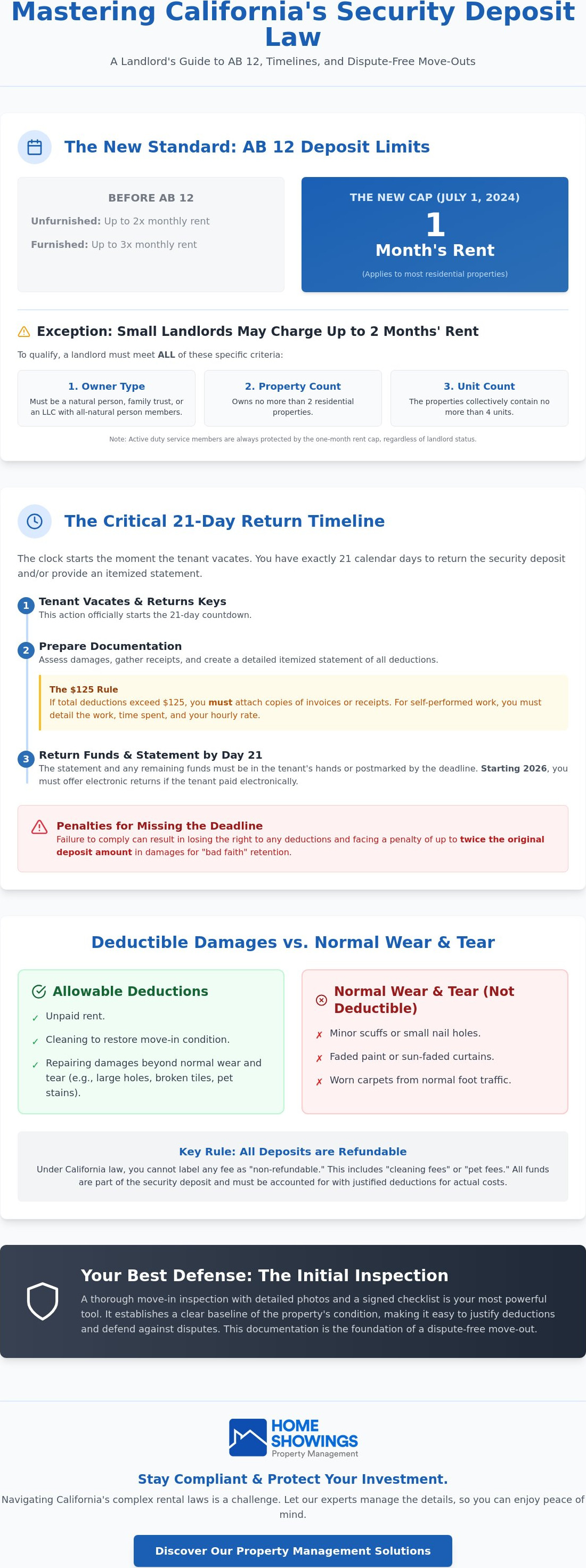
If you're managing property in 2026, you're likely still feeling the ripples of Assembly Bill 12. This landmark legislation fundamentally changed the california security deposit law by capping most residential deposits at a single month's rent. It doesn't matter if you're renting out a luxury furnished condo in Sacramento or a modest studio; the limit is now the same. While this law officially went into effect on July 1, 2024, it continues to dictate how lease renewals and new tenancies are handled today. If you've been holding a larger deposit from a long-term tenant, you don't necessarily have to refund the excess immediately, but any new agreement or significant lease modification in 2026 must comply with the one-month cap.
A Security deposit is designed to protect your investment, but collecting more than the legal limit can lead to severe penalties. Before AB 12, landlords could charge up to two months' rent for unfurnished units and three months for furnished ones. That flexibility has vanished for the vast majority of owners. You must also remember that active duty military members receive even stricter protections. Regardless of your landlord status or property size, you cannot charge a service member more than one month's rent as a deposit under any circumstances.
The Small Landlord Exception Explained
If you're a smaller operator, you might still qualify to charge up to two months' rent, but the criteria are specific. To meet this requirement under the california security deposit law, you must be a natural person, a family trust, or an LLC where all members are natural persons. Additionally, you cannot own more than two residential rental properties that collectively contain no more than four units. We've seen that maintaining this exception is becoming harder as the regulatory climate shifts toward broader tenant protections. If you're unsure if your business structure qualifies, it's safer to stick to the one-month limit to avoid potential "bad faith" claims in court.
Non-Refundable Deposits: Are They Legal?
Under California Civil Code 1950.5, every dollar you collect as a security deposit is technically refundable. Labeling a portion of the funds as a "non-refundable cleaning fee" or a "move-in fee" is a common mistake that can lead to legal trouble. If you want to account for the risk of a pet, you can still collect an additional deposit, but the total sum of all deposits combined cannot exceed the one-month cap. You're better off documenting the property's condition meticulously at move-in so you can justify legitimate deductions for cleaning or repairs later, rather than trying to rely on non-refundable labels that won't hold up in front of a judge.
The 21-Day Return Process: A Step-by-Step Compliance Timeline
The countdown begins the moment a tenant returns the keys or physically vacates the property. In the eyes of the california security deposit law, this is known as "possession." From this Day 1, you have exactly 21 calendar days to put a final accounting and any remaining funds into the tenant's hands. If you miss this window, even by a few hours, you risk losing your right to keep any portion of the deposit and could face "bad faith" penalties in small claims court.
Compliance involves more than just writing a check. You must provide a detailed itemized statement that explains exactly why any funds were withheld. Effective January 1, 2026, you must offer to return these funds electronically if the tenant originally paid their rent or deposit through a digital portal. For those still using paper checks, AB 414 requires you to issue a single check made payable to all adult tenants listed on the lease, unless you have a written agreement stating otherwise. To navigate these logistics smoothly, The 21-Day Return Process requires a methodical approach to documentation from the very first day of the vacancy.
One of the most critical thresholds to remember is the $125 rule. If your total deductions for repairs or cleaning exceed $125, you are legally required to attach copies of receipts or invoices to the itemized statement. If you or your employees performed the work yourselves, the statement must describe the work done, the time spent, and the hourly rate charged. If you find yourself racing against the clock to gather these documents, professional property management can streamline the accounting process to ensure you never miss a deadline.
What to Include in the Itemized Statement
Your statement should be a transparent roadmap of the move-out costs. It needs to include:
Labor and Materials: A clear breakdown of hours worked and the cost of specific parts used for repairs.
Cleaning Services: Documentation showing the costs required to return the unit to its original move-in condition, excluding normal wear and tear.
Financial Obligations: A final tally of any unpaid rent or outstanding utility bills that the tenant was responsible for under the lease.
Handling Missing Receipts and Third-Party Estimates
Sometimes, extensive repairs simply cannot be finished within the three-week window. If a contractor hasn't sent the final bill, you must provide a "good faith estimate" of the costs. A good faith estimate is a legal provision that allows landlords to provide a reasoned calculation of repair costs when final invoices aren't available within 21 days, provided they follow up with actual receipts within 14 days of the work's completion. This ensures the tenant receives their accounting on time while protecting your right to deduct for legitimate damages.
Legal Deductions vs. Normal Wear and Tear
When you walk through a vacated property in Sacramento or Elk Grove, the difference between a well-loved home and a damaged investment isn't always obvious. Determining what constitutes a legal deduction is often where the relationship between a landlord and tenant faces its greatest test. Under the california security deposit law, you have the right to withhold funds for four specific reasons: unpaid rent, cleaning costs, repair of damages beyond normal wear and tear, and, if the lease allows, the restoration of personal property in furnished units. Unpaid rent is typically the most objective deduction; if the ledger shows a balance on the move-out date, you can simply subtract that amount from the deposit.
Cleaning and repairs are where most disputes arise. The law allows you to charge for cleaning only to the extent necessary to return the unit to the same level of cleanliness it had at the beginning of the tenancy. If a tenant moves into a spotless home and leaves it with grime in the kitchen and hair in the bathrooms, a deduction is likely justified. However, you cannot use a tenant's deposit to "upgrade" the property's condition beyond its original state. For authoritative clarity on these distinctions, you can consult the California Attorney General's Guide to Security Deposits, which outlines consumer protections and landlord responsibilities.
Defining Normal Wear and Tear in 2026
In 2026, courts continue to look closely at the "useful life" of property components. Normal wear and tear is the unavoidable deterioration that happens from daily living. Faded paint from sunlight or minor scuffs on a baseboard are expected results of a multi-year tenancy. In contrast, large holes in the drywall from mounting a television or deep gouges in hardwood floors are considered damage. If you find yourself looking at worn carpet, you must consider its age. If a carpet has a 10-year useful life and it's already 12 years old, you generally cannot charge a tenant for its replacement, even if it's heavily soiled. For a deeper dive into these nuances, read our detailed breakdown of Normal Wear and Tear Meaning for California Rentals.
Common Deduction Pitfalls to Avoid
One of the most frequent mistakes we see is landlords charging for professional deep cleaning when a tenant has already left the unit "broom clean." If the tenant has performed a reasonable cleaning, you cannot legally deduct for a professional crew just to meet your personal preference for the next occupant. Another pitfall is attempting to charge the outgoing tenant for the full cost of replacing an appliance that was simply near the end of its life. To keep your move-out process dispute-free, always document deductions with photos and keep a steady hand on the "useful life" calculations. This meticulous approach ensures your accounting stands up in court and maintains your reputation as a fair, professional owner.
The Initial Inspection: A Landlord’s Best Defense
Many property owners view the move-out process as a reactive event, but the california security deposit law provides a proactive tool that serves as your strongest legal shield. This is the initial inspection, often called the pre-move-out inspection. While it's a right granted to the tenant under Civil Code 1950.5, savvy owners use it as a strategic opportunity to set expectations. By walking through the home before the tenant officially vacates, you can identify potential issues early and reduce the friction that often leads to small claims disputes. You're required to notify the tenant of their right to this inspection within a reasonable time after receiving or serving a notice to terminate the tenancy.
Timing is everything when it comes to this walk-through. The inspection must take place no earlier than two weeks before the lease ends. During this visit, you'll create a "Deficiency List" that outlines specific cleaning or repair items that would lead to deductions if left unaddressed. This gives the tenant a fair chance to fix these problems themselves before they hand over the keys. For owners in Elk Grove or Sacramento, capturing high-quality photo evidence during this stage is vital. It establishes a clear baseline of the property’s state just days before the final move-out, making your eventual itemized statement much harder to challenge.
Managing these specific timelines and the associated paperwork requires meticulous organization. If you'd rather focus on your next investment than tracking inspection windows, our team can handle every detail of your property inspections to keep you protected and compliant.
Conducting the Pre-Move-Out Inspection
Compliance begins with proper notice. You must provide at least a 48-hour written notice of entry before the inspection, unless you and the tenant agree to a different time in writing. We always recommend collaborative walk-throughs. When you and the tenant look at a stained carpet or a broken light fixture together, it removes the "us vs. them" mentality. The ultimate legal anchor in this process is your Move-In/Move-Out Checklist. This document, which should have been signed at the start of the lease, serves as the definitive record that proves whether a defect is new damage or a pre-existing condition.
Protecting the Investment via Regular Inspections
You shouldn't wait until the move-out notice to check on your property's condition. We've found that semi-annual inspections are the best way to prevent massive security deposit disputes at the end of a tenancy. These visits allow you to catch small maintenance issues before they spiral into expensive repairs. They also help you identify lease violations, such as unauthorized pets or occupants, well before the final move-out date. To ensure your visits are thorough and legally sound, you can use our Rental Property Inspection Checklist for California as a template for your next walk-through.
Professional Management: Ensuring Compliance in Sacramento
Managing the fine details of the california security deposit law can feel like a full-time job, especially with the strict 21-day accounting window and the nuances of AB 12. For many property owners in Sacramento, the fear of a small claims dispute often outweighs the rewards of the investment. This is where professional property management transforms a high-stress transition into a streamlined, automated process. By utilizing digital owner and tenant portals, we ensure that the move-out clock is tracked with precision. Our systems trigger alerts the moment a tenant vacates, ensuring that every itemized statement and refund check is issued well before the legal deadline.
Beyond simple timeline tracking, our expert vendor networks provide a critical layer of protection. When a deduction is necessary, you need more than just a handwritten note; you need documented, fair-market estimates that can stand up in a courtroom. We coordinate with licensed professionals who understand the difference between damage and wear and tear, providing the clear invoices required for deductions over $125. This systematic approach acts as a legal shield, positioning a professional buffer between you and the tenant during sensitive financial discussions. For owners in Elk Grove and Roseville, this means total oversight from the initial marketing phase all the way to the final security deposit return.
The Home Showings Systematic Approach
We believe that a smooth move-out starts with a high-quality move-in. Our process begins with professional rental marketing and rigorous tenant screening to find residents who will respect your property. Once the lease begins, we maintain the home's value through coordinated property maintenance and regular inspections. This proactive property preservation ensures that small issues don't become massive security deposit deductions later. Throughout the tenancy, both you and your residents have access to transparent reporting via our secure portals, so there are never any surprises when it's time to settle the final accounting.
Why Local Expertise Matters
Every rental market has its own rhythm, and Sacramento is no exception. Local court expectations and regional rental trends can influence how security deposit disputes are settled. Our team stays ahead of legislative shifts before they become liabilities, ensuring your business model adapts to new regulations like the 2026 electronic return mandates. We aren't just managing buildings; we're protecting your financial future with "boots-on-the-ground" knowledge of the local landscape. If you're ready to replace move-out anxiety with controlled stability, schedule a consultation with Home Showings Property Management today.
Mastering Compliance for a Worry-Free Investment
Staying compliant with the california security deposit law requires more than just a calendar; it demands a systematic approach to documentation and communication. We've explored how the one-month rent cap under AB 12 has redefined move-in costs and why the 21-day return window remains the most critical deadline for your bottom line. By mastering the distinction between damage and wear and tear, and utilizing the pre-move-out inspection, you can turn a stressful transition into a predictable, professional process.
If the administrative burden of these mandates feels overwhelming, we're here to provide a steady hand. Our team offers comprehensive property preservation through regular inspections and manages expert coordination of maintenance and repairs to ensure every deduction is indisputable. You'll have total transparency through our dedicated digital portals for financial reporting. Protect your rental investment with expert Sacramento property management today. With the right systems in place, your property remains a stable, worry-free asset for years to come.
Frequently Asked Questions
Can a California landlord charge 2 months’ rent for a security deposit in 2026?
No, most landlords can't charge more than one month's rent as a security deposit in 2026. This cap was established by AB 12 and applies to both furnished and unfurnished units. If you're a small landlord owning no more than two properties with a total of four units or fewer, you may still qualify to charge up to two months' rent. However, this exception never applies to active duty military tenants.
What happens if a landlord misses the 21-day deadline in California?
If you miss the 21-day deadline, you generally forfeit your right to retain any portion of the security deposit. The california security deposit law is strict about this timeline. Beyond returning the full amount, you could be sued in small claims court for bad faith retention. If a judge finds you acted in bad faith, you might have to pay the tenant up to twice the amount of the original deposit in statutory damages.
Is cleaning considered normal wear and tear in California?
Cleaning is not considered normal wear and tear; it is a separate category of allowable deductions. You can deduct costs to return the unit to the same level of cleanliness it had when the tenant first moved in. If the property was professionally cleaned at the start, you can charge to reach that same standard. However, you can't deduct for cleaning that goes beyond the original move-in condition or for standard "broom clean" departures.
Can a landlord keep the security deposit for breaking a lease?
Yes, you can use the security deposit to cover unpaid rent if a tenant breaks their lease early. California law allows deductions for any rent owed through the end of the lease term, provided you make a reasonable effort to re-rent the unit. You can also deduct for costs associated with property damage or cleaning. It's important to remember that the deposit can't be used as a penalty fee; it must cover actual financial losses.
Does a landlord have to provide receipts for security deposit deductions?
You must provide receipts or invoices if your total security deposit deductions exceed $125. This documentation must be attached to the itemized statement sent within the 21-day window. If you performed the work yourself, you must list the time spent and your hourly rate. If the work hasn't been completed yet, you can provide a good faith estimate and then send the final receipts within 14 days of the repair being finished.
What can a tenant do if the landlord does not return the deposit?
A tenant's first step should be sending a formal demand letter requesting the return of the funds. If you don't respond or provide a valid itemized statement, the tenant can file a claim in small claims court. Judges in these cases often look for proof of the property's condition at move-in and move-out. Tenants can seek the full deposit plus statutory damages if they can prove the landlord withheld the money in bad faith.
Are pet deposits separate from the one-month security deposit limit?
No, pet deposits are included in the total one-month rent limit under the california security deposit law. You can't charge one month's rent plus an additional pet deposit if you're subject to the AB 12 cap. All refundable fees, regardless of what they're called, count toward the legal maximum. If you want to mitigate pet risks, it's better to ensure your tenant screening process is thorough and your move-in documentation is meticulous.
Can I use the security deposit for the last month’s rent?
A tenant can't use the security deposit as the last month's rent unless you specifically agree to it in writing. The deposit is intended to cover damages, cleaning, and unexpected defaults, not to replace the final rent payment. If a tenant fails to pay the last month, you can deduct that unpaid amount from the deposit after they vacate. However, the tenant is still technically in breach of contract if they skip the payment without your consent.



Comments