
California Rental Security Deposit Laws: A 2026 Landlord’s Guide

Imagine walking to your mailbox only to find a small claims summons for a $3,500 security deposit, knowing a judge could order you to pay over $15,000 simply because of one missing receipt or a late letter. It's a scenario that keeps even the most experienced Sacramento property owners up at night. With the recent shift in california rental security deposit laws, the margin for error has never been thinner. You want to protect your investment and maintain your property, but the line between "normal wear and tear" and billable damage often feels like a moving target.
This guide will give you the clarity you need to master these 2026 regulations, from the strict AB 12 limits to the 21-day return window, ensuring your move-out process is both legal and stress-free. We'll break down the specific documentation you need, the small landlord exceptions, and the proactive steps that keep you out of court and your rentals in top shape. By the end, you'll have a clear checklist to handle every deposit with the confidence of a local expert who is always several steps ahead of potential issues.
Table of Contents
Understanding California’s New Security Deposit Limits under AB 12
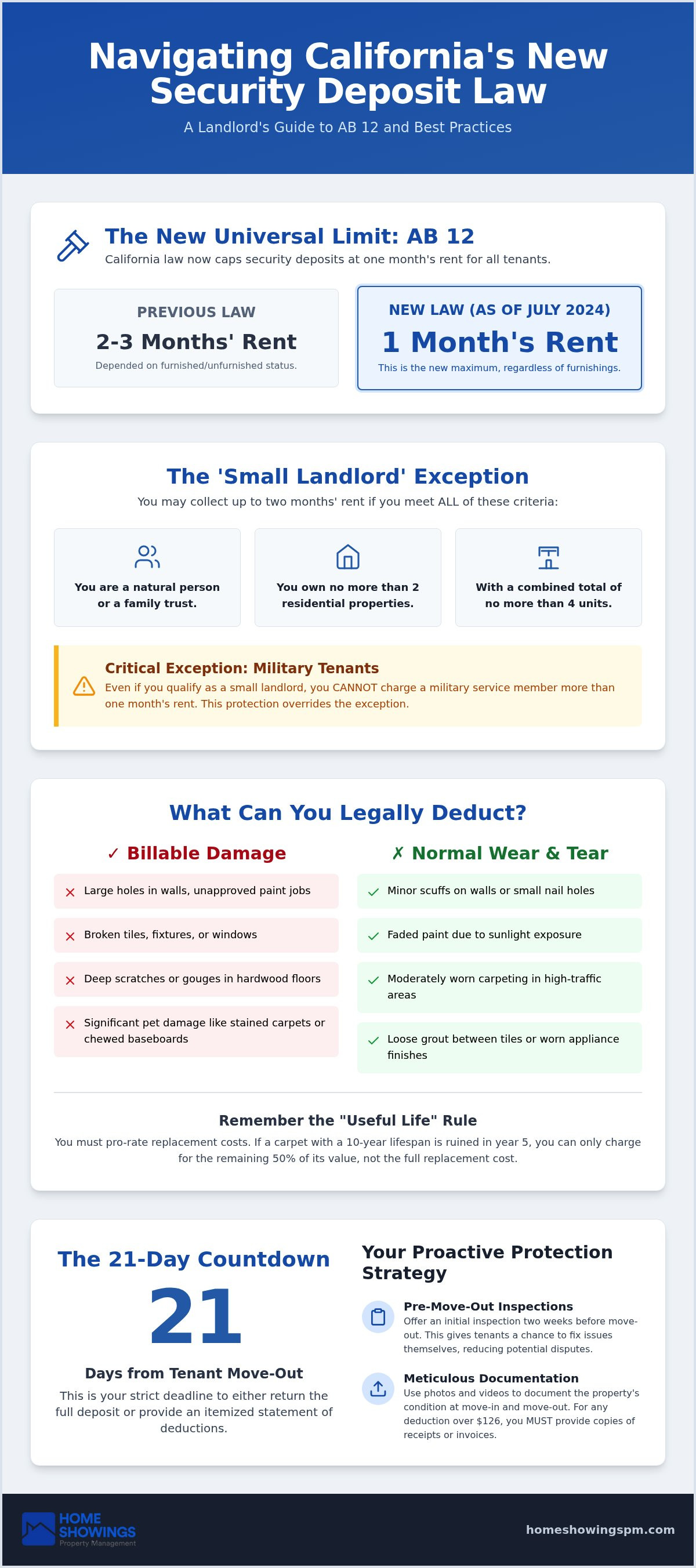
The landscape of california rental security deposit laws shifted significantly with the full implementation of Assembly Bill 12. This legislation amended California Civil Code Section 1950.5, fundamentally changing how much financial security you can request from a new tenant. Historically, landlords could charge up to two months' rent for unfurnished units and three months' for furnished ones. Since July 2024, that cap has dropped to a universal limit of just one month's rent. This rule applies regardless of whether the home is a bare studio or a fully furnished luxury rental.
State legislators pushed this change to lower the barrier to entry for renters across the state. While it makes housing more accessible for many families, it also means you have less of a financial cushion if a tenant leaves behind significant damage. Understanding what is a security deposit in this new legal context is vital for protecting your bottom line. It's no longer just a pot of money; it's a strictly regulated asset that requires meticulous oversight from day one.
The Small Landlord Exception: Do You Qualify?
If you're a smaller investor, you might still be able to charge up to two months' rent under specific conditions. To qualify for this exception, you must meet these criteria:
The landlord must be a natural person or a family trust.
You cannot own more than two residential rental properties.
Those properties combined cannot exceed a total of four dwelling units.
If you hold your properties in a corporate LLC or a large real estate investment trust, you won't meet these criteria. There's also a critical rule regarding military tenants. Even if you qualify as a small landlord, you can't charge a service member more than one month's rent as a deposit. This specific protection for the military overrides the small landlord exception every time.
Maximum Limits vs. Market Reality in Sacramento
Landlords in Sacramento and Elk Grove are adapting quickly to these tighter margins. Since you can't rely on a massive deposit to cover potential damages, your tenant screening and property management processes have to be airtight. We've seen a shift toward charging monthly "pet rent" instead of traditional pet deposits, which are now swallowed up by that one-month cap. It's about balancing competitive pricing with smart risk mitigation. You'll need to be more proactive with inspections and documentation to ensure your property remains a profitable asset through 2026.
What Can Landlords Legally Deduct? Defining Damages vs. Wear and Tear
One of the most common sources of friction between Sacramento landlords and tenants is deciding what qualifies as a legitimate deduction. Under california rental security deposit laws, you can only withhold funds for four specific reasons: unpaid rent, cleaning the unit to its original move-in condition, repairing damages beyond normal wear, and restoring or replacing personal property if your lease allows it. If you aren't meticulous during this phase, you risk a bad-faith claim in small claims court. Every dollar withheld must be justifiable and backed by evidence.
Cleaning requirements are a frequent point of contention. You have the right to charge a tenant to return the property to the level of cleanliness it had when they first arrived. This doesn't mean you can charge for upgrades or deep cleaning that exceeds the move-in standard. To stay compliant with California's Security Deposit Regulations, every deduction should be documented with photos and receipts, especially if the total exceeds $126.
Common Examples of Tenant Damage vs. Normal Aging
The distinction between damage and aging is often subtle but legally significant. Normal wear and tear refers to the natural deterioration that occurs when a tenant uses the home as intended. For instance, minor scuffs on a baseboard or slightly faded paint from sunlight are typical. However, large holes in the drywall, deep gouges in hardwood floors, or heavy pet stains are clear examples of damage that can be deducted.
California uses the "useful life" rule to ensure fairness for both parties. "Useful life" is a standard used to pro-rate the cost of repairs or replacements based on the age of the item compared to its expected lifespan. If a carpet has a ten-year life and the tenant ruins it in year five, you can only charge for the remaining five years of value rather than a brand-new replacement. Using property inspections to track the age and condition of these assets is a smart way to avoid disputes.
Handling Personal Property and Furniture Restoration
For those offering furnished rentals in Elk Grove, the rules for personal property are even more specific. You can only deduct for the restoration or replacement of furniture if your lease agreement explicitly contains this language. Without that specific clause, you may struggle to justify these costs in court. If they left behind a couch or bags of trash, you can also deduct for the actual cost of abandoned property removal. Maintaining a clear paper trail is the best way to prove these costs were necessary. Working with a professional property management team can help you navigate these nuances while ensuring your asset is preserved.
The 21-Day Countdown: Deadlines for Returning Deposits
The clock starts ticking the second your tenant hands over the keys or vacates the unit. Under california rental security deposit laws, you have exactly 21 calendar days to either return the full deposit or provide a detailed accounting of any withholdings. This is a strict calendar-day limit, meaning weekends and holidays count toward your total. If you're managing properties in Sacramento or Elk Grove, you know that three weeks can fly by when you're coordinating vendors and assessing damage. According to the California Attorney General's guide to landlord-tenant issues, this window is one of the most litigated aspects of the landlord-tenant relationship.
Your itemized statement is your primary defense against a small claims suit. If your deductions for cleaning or repairs total $126 or more, the law requires you to include copies of all receipts and invoices. When you or your own maintenance staff handle the repairs, you must document the hours worked, the specific tasks completed, and the hourly rate charged. This rate must be reasonable and consistent with local market standards. Transparency here is your best friend. It shows the tenant that you're being fair and meticulous, which often prevents a dispute from escalating before it reaches a courtroom.
Step-by-Step Itemization for California Landlords
Your itemized list needs to be specific. Instead of writing "cleaning," specify "kitchen cabinet and appliance degreasing" or "professional steam cleaning for living room carpets." This level of detail discourages tenants from questioning the charges. If a contractor can't finish the work within the 21-day window, you can provide a "good faith estimate." You must still send the final documentation and any remaining refund within 14 days of the work being completed. This ensures you stay within the bounds of california rental security deposit laws while managing complex repairs that require specialized vendors.
Penalties for Non-Compliance: Avoiding Treble Damages
The stakes for missing the deadline are high. If a judge determines you withheld a deposit in "bad faith," you could be liable for statutory damages up to twice the amount of the deposit. For a $3,500 deposit, that's a $7,000 penalty on top of returning the original funds. It's a financial hit that can be avoided with a structured system. Always send the deposit return via first-class mail or, if the tenant agreed in writing, through an electronic transfer. Using a professional residential leasing service ensures these deadlines are tracked and met automatically, keeping your investment safe from costly litigation.
Proactive Protection: Pre-Inspections and Documentation Strategy
Success in managing california rental security deposit laws begins long before a tenant hands over their keys. One of the most powerful tools in your arsenal is the "initial inspection," which you're legally required to offer in writing at least two weeks before the tenancy ends. While many landlords see this as a hurdle, it's actually your best chance to align expectations. By walking through the unit with the tenant, you can point out specific areas that need attention, giving them the chance to fix issues before they become deductions.
During this walkthrough, you'll want to use a detailed rental property inspection checklist to ensure nothing is overlooked. Documentation is your shield in 2026. High-resolution photos and videos taken at both move-in and move-out provide undeniable proof of a property's condition. If you can show a clear "before and after" of a hole in the wall or a stained carpet, a tenant is much less likely to dispute the repair cost in small claims court.
The Move-In/Move-Out Comparison Method
When you use side-by-side documentation, you eliminate the "he-said, she-said" dynamic that frustrates so many property owners. It's best practice to have the tenant sign off on a condition report the day they move in. We recommend leveraging digital portals to store these time-stamped files securely. If a dispute arises months or years later, you won't have to scramble for blurry photos on an old phone; instead, you'll have a systematic record ready to go.
Minimizing Disputes with Professional Communication
Clarity is the ultimate preventative measure. Providing your tenants with a cleaning checklist based on California standards helps them understand exactly what "move-in condition" means. If they know you'll be checking behind the stove and inside the dishwasher, they're more likely to handle those tasks themselves. Transparency about your process reduces the likelihood of defensive reactions and expensive court challenges. If you want to ensure your properties are managed with this level of meticulous care, our team at Home Showings Property Management can handle the entire inspection cycle for you.
Navigating Complex Deposit Laws with Professional Management
The pressure of managing california rental security deposit laws often hits hardest during the move-out transition. Between assessing damage and finding new tenants, the 21-day deadline arrives faster than most owners expect. At Home Showings Property Management, we've built operational systems to automate this compliance cycle. We use digital owner portals to store every receipt, photo, and itemized statement in real-time. This ensures that if a tenant ever questions a deduction, you have a cloud-based paper trail ready for immediate review.
Effective property maintenance management is another critical layer of protection. By performing regular inspections, we identify minor issues before they escalate into major repairs that might exceed a single month's rent. Our team maintains a network of vetted vendors in Sacramento and Elk Grove who understand the need for rapid, cost-effective work that meets California's strict itemization standards. This proactive oversight keeps your maintenance costs low and your legal compliance high.
Expert Oversight for Sacramento & Elk Grove Landlords
Local courts in the Sacramento area can be particularly strict about the technicalities of California Civil Code 1950.5. A small mistake in how an invoice is phrased or a one-day delay in mailing a statement can lead to the "bad faith" penalties discussed earlier. We act as your boots-on-the-ground experts, handling tenant communications with a professional, steady hand. This reduces your personal legal exposure while maintaining a neighborly tone that often de-escalates potential conflicts before they ever reach a judge.
The Peace of Mind Factor: Letting the Experts Handle Compliance
The best way to protect a security deposit is to ensure you have a reliable person living in the home. This is why professional tenant screening is your first and most important line of defense. We vet applicants thoroughly to find residents who treat your property with respect, which naturally leads to smoother move-outs and fewer deductions. Our streamlined processes are designed to protect your asset while keeping you fully compliant with the latest state regulations. If you're ready to trade the stress of legal deadlines for controlled stability, get a free rental analysis from Home Showings Property Management today.
Securing Your Rental Legacy in 2026
The shift in california rental security deposit laws represents a new era for Sacramento property owners, where meticulous detail is your strongest asset. By mastering the one-month cap under AB 12 and keeping a strict eye on the 21-day return window, you protect yourself from the heavy penalties of litigation. Success now depends on your ability to document every scuff and repair with high-resolution evidence and transparent receipts. If the thought of tracking these deadlines and vendor invoices feels overwhelming, you don't have to manage it alone.
Our team provides the steady hand you need to keep your investment profitable and compliant. We include regular property inspections to preserve your asset's value and offer transparent owner portals with real-time reporting for total peace of mind. With our deep expertise in AB 12 compliance, we ensure every move-out is handled correctly. Protect your Sacramento investment with professional property management. You've worked hard to build your portfolio. With the right systems in place, you can continue to grow with confidence and stability.
Frequently Asked Questions
Can a California landlord charge a non-refundable security deposit?
No, California law strictly prohibits any non-refundable security deposits. Regardless of what you call it, such as a move-in fee, a key deposit, or a cleaning fee, any money paid at the start of a lease is legally considered a security deposit. This means the funds must be handled according to california rental security deposit laws and returned within 21 days. You can't circumvent this rule with specific lease language or verbal agreements with the tenant.
What is the maximum security deposit for a pet in California in 2026?
The total security deposit, including any pet deposit, cannot exceed one month's rent under the current AB 12 regulations. You cannot charge a separate pet deposit on top of the standard one-month limit. To manage the risks associated with animals, many Sacramento owners now choose to charge a monthly pet rent instead. This allows you to stay compliant while still addressing the increased maintenance needs that pets often bring to a property.
How long does a landlord have to return a security deposit in California?
You have exactly 21 calendar days from the date the tenant vacates the property to return the funds. This timeline includes weekends and holidays, so it's vital to start your move-out inspection and vendor coordination immediately. If you miss this deadline, you lose the right to withhold any portion of the deposit and may face statutory damages in court. Efficient property management systems are essential for hitting this narrow window every time.
Can a landlord deduct for carpet cleaning in California?
You can deduct for carpet cleaning only if it's necessary to return the flooring to the exact level of cleanliness it had at the start of the tenancy. You cannot charge for cleaning that addresses normal wear and tear, such as minor traffic patterns or slight fading. If the carpet is professionally cleaned before the tenant moves in, you should keep that receipt as evidence to justify a similar cleaning deduction when they move out.
What happens if the landlord sells the property during the lease?
What happens if the landlord sells the property during the lease?
When a property is sold, the original landlord must either transfer the security deposit to the new owner or return it to the tenant, minus any legal deductions. The seller must provide the tenant with a written notice stating the amount of the deposit and the contact information for the new owner. For investors navigating these sales, Integrity Estates Realty offers the real estate and mortgage brokerage expertise to ensure every detail is handled correctly. Once the transfer is complete and the tenant is notified, the new owner becomes legally responsible for the eventual return of those funds.
Yes, california rental security deposit laws state that you cannot charge a service member more than one month's rent, even if you qualify as a small landlord. This specific protection applies to all active-duty military personnel and cannot be waived through a lease agreement. Ensuring you identify military status during the tenant screening process is a critical step in maintaining legal compliance and avoiding potential fair housing or military-specific legal challenges that could arise later.
Can a landlord use the security deposit for unpaid utilities?
You can use the security deposit to cover unpaid utility bills if the lease agreement clearly states that the tenant is responsible for those costs. If the tenant vacates with an outstanding balance on a city water or trash account, you can deduct that exact amount from the deposit. As with all deductions, you must include the final utility bill or a statement from the provider in your itemized move-out package to prove the cost.
What should I do if my former tenant sues me for their deposit?
If you receive a summons, your first step is to gather all move-in and move-out inspection reports, photos, and receipts. You'll need to prove that your deductions were reasonable and that you followed the 21-day notification rule. Most deposit disputes are heard in small claims court, where lawyers aren't typically allowed. Having a well-organized paper trail from a professional owner portal can often lead to a quick dismissal of the tenant's claims.


Comments