
California Fair Housing Compliance: The 2026 Landlord’s Guide to Risk Mitigation
- Steven Lunetta
- 5 days ago
- 13 min read

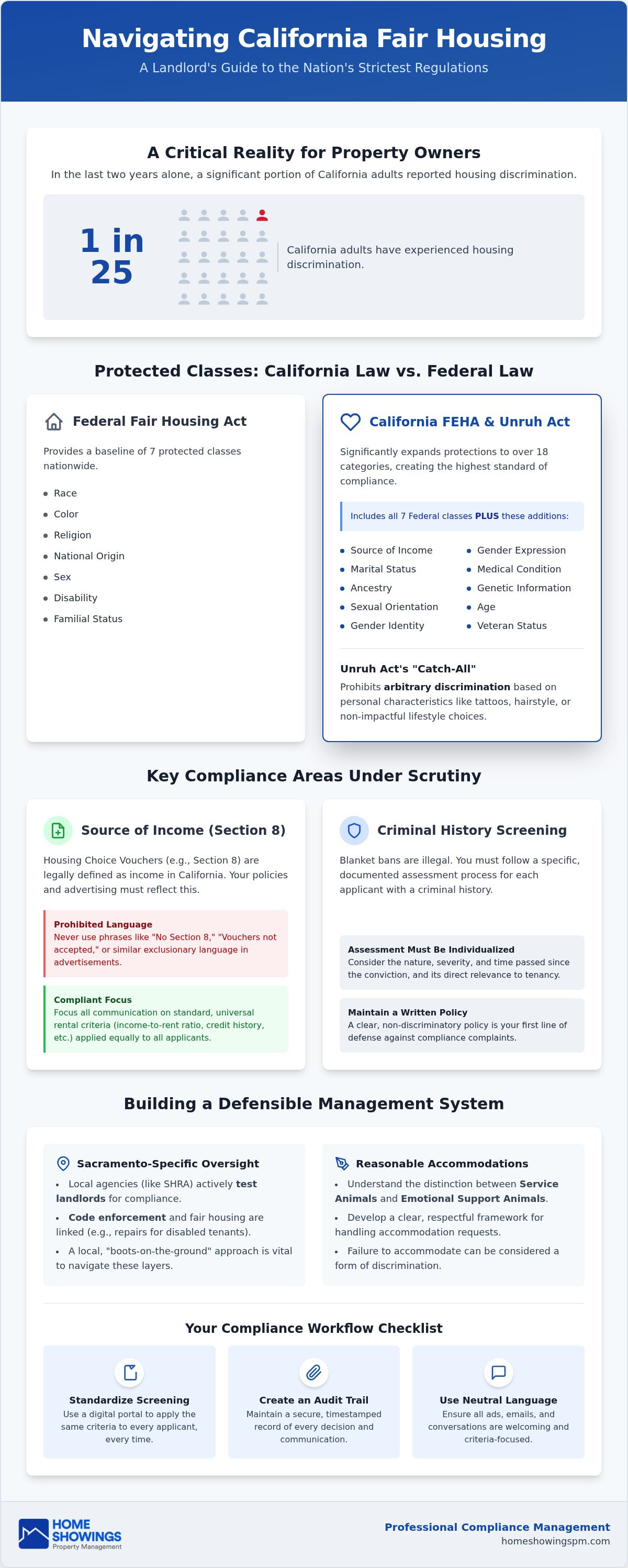
Did you know that roughly 1 in 25 California adults reported experiencing housing discrimination in just the last two years? For a property owner, that statistic isn't just a number. It's a signal that state regulators are watching closer than ever before. Maintaining california fair housing compliance has become a moving target, especially with 2026 bringing new mandates for electronic deposit returns and required kitchen appliances.
You've likely felt the weight of these shifting rules. It's natural to worry if a simple mistake in a tenant screening or a misunderstanding about an emotional support animal could trigger a costly investigation. You want to do the right thing, but the "Source of Income" rules and new criminal history assessment standards can feel like a legal minefield. It's exhausting to keep up when the goalposts seem to move every legislative session.
This guide will show you how to trade that anxiety for a proactive, system-based approach that protects your rental investment. We'll walk through a clear checklist for compliant screening, clarify the latest 2026 legal updates, and help you build a property management workflow that stands up to scrutiny. By the end, you'll have the tools to manage your properties with total confidence and a clear path forward.
Table of Contents
The Landscape of California Fair Housing in 2026
If you own rental property in the Golden State, you already know that the rules of the game are different here. While the federal Fair Housing Act (FHA) provides a baseline of protection across the country, it's merely the starting point for california fair housing compliance. In 2026, the state's legal framework has evolved into a multi-layered system where state statutes often override federal minimums. The primary engine of enforcement is the California Civil Rights Department, which actively monitors housing providers for even unintentional bias.
Understanding the hierarchy of these laws is essential for your peace of mind. Federal law serves as the floor, while state laws like the Fair Employment and Housing Act (FEHA) and the Unruh Act build a much higher ceiling of protection for tenants. This means a policy that might be legal in another state could lead to a devastating lawsuit here. It's not just about avoiding "bad" intentions; it's about following a rigid, documented process that proves your neutrality.
Federal vs. State: Why 'Protected Classes' are Broader in CA
Federal law protects seven core classes: race, color, religion, national origin, sex, disability, and familial status. California's FEHA expands this list significantly to include over 18 protected categories. This includes protections for marital status, ancestry, sexual orientation, gender identity, and source of income. By 2026, protections for gender expression and identity have become central to enforcement efforts. Landlords must be meticulous in their communication to ensure no applicant feels excluded based on these characteristics.
The Unruh Civil Rights Act adds a unique "catch-all" protection against what the courts call arbitrary discrimination. This means you can't deny a tenant based on personal characteristics that don't relate to their qualifications as a renter. If an owner denies someone because of their hairstyle, tattoos, or a specific lifestyle choice that doesn't impact the property, they're likely violating the Unruh Act. It's a broad standard. It requires a system-based approach to every single interaction with the public.
Sacramento-Specific Fair Housing Nuances
Owning property in Sacramento County adds another layer of oversight. Local municipalities like Elk Grove and Folsom often coordinate with the Sacramento Housing and Redevelopment Agency (SHRA) to ensure housing accessibility. In our local market, fair housing compliance often intersects with code enforcement. For example, failing to make a repair for a tenant with a disability isn't just a maintenance issue; it can be flagged as a failure to provide a reasonable accommodation.
Local agencies are proactive about testing landlords to ensure they're accepting housing vouchers and following strict screening protocols. We see this play out frequently in the Sacramento area. Using local resources and maintaining a transparent audit trail is the best way to prove your commitment to fair housing if a complaint ever arises. A "boots-on-the-ground" perspective is your best defense against these shifting local layers.
Critical Compliance Areas: Source of Income and Criminal History
The broad categories of the law set the stage, but the real test of california fair housing compliance happens in the details of your daily operations. Two areas currently draw the most attention from state regulators: how you handle housing vouchers and how you screen for criminal history. Missteps here aren't just administrative errors. They are viewed as systemic barriers to housing that can lead to significant state investigations.
California's SB 329 fundamentally changed the definition of income to include vouchers, making it illegal to exclude Section 8 holders from your applicant pool. To stay current on these evolving standards, the California Fair Housing Laws resource page provides a clear breakdown of these protected categories and the rights of applicants. Understanding these specifics is the first step toward building a resilient rental business.
Managing Housing Choice Vouchers (Section 8)
When you market your property, your language must be inclusive. Phrases like "No Section 8" or "Vouchers not accepted" are direct violations of state law. Instead, your ads should focus on your standard rental criteria. Once you receive an application from a voucher holder, the income calculation changes. You cannot require the applicant to earn three times the total monthly rent. You must only apply your income ratio to the portion of the rent the tenant will pay out of pocket. For example, if the rent is $2,500 and the voucher covers $2,000, the tenant only needs to prove income based on the remaining $500.
Source of income includes all lawful and verifiable income paid to a tenant or their representative, including public assistance and housing subsidies like Section 8 vouchers. If these calculations feel like a full-time job, professional property management can handle the math and the documentation for you.
The Fair Chance Act and Criminal Screenings
The 2026 landscape is particularly strict regarding criminal history. Following a landmark settlement with Greystar California in January 2026, the Civil Rights Department is actively pursuing landlords who use blanket bans. You cannot have a policy that automatically denies any applicant with a criminal record. Instead, the law requires an "individualized assessment."
This process involves looking at the nature of the offense and how much time has passed. You must determine if the specific conviction has a direct and demonstrable impact on the applicant's ability to fulfill the responsibilities of a tenant. If you decide to deny an applicant based on their history, you must provide a written explanation and allow them time to respond with evidence of rehabilitation. This level of documentation is your best defense against a discrimination claim.
Finally, remember that state law now emphasizes positive rent reporting. While it's a newer requirement for many, helping tenants build credit through on-time payments is becoming a standard part of a compliant, modern landlord-tenant relationship.
Designing a Defensible Tenant Screening Workflow
If a regulator from the California Civil Rights Department (CRD) asks why you chose one applicant over another, your memory isn't a valid defense. You need a paper trail that speaks for itself. Achieving true california fair housing compliance requires moving away from gut feelings and toward a rigid, documented workflow. This system ensures that every person who inquires about your Elk Grove or Sacramento property is treated with the exact same level of professional scrutiny. A defensible system doesn't just prevent bias; it proves your neutrality to anyone who asks.
Establishing Objective Rental Criteria
Before you even post a listing, you must have your "Rental Criteria" written down and finalized. This document should outline your specific thresholds for credit scores, verifiable income, and landlord references. It's not just about having the rules; it's about sharing them. Providing these criteria to every applicant before they pay a screening fee is a fundamental requirement of California Tenant Screening Laws: A 2026 Guide for Landlords. This transparency prevents misunderstandings and helps applicants decide if they are a good fit before they spend money on the process.
In the competitive Sacramento market, many landlords follow the "First-Qualified" rule. This means you offer the unit to the first applicant who meets every one of your written standards. This approach removes the temptation to "wait for someone better," which can inadvertently lead to discriminatory patterns. When your criteria are objective and applied in the order applications are received, you eliminate the subjective decision-making that often triggers legal red flags.
The Audit Trail: Proving Non-Discrimination
Paper applications are a significant liability in 2026. They are easily lost, difficult to timestamp, and nearly impossible to audit during a dispute. By using digital owner and tenant portals, you create an immutable record of every interaction. These systems track exactly when an application was submitted, when the screening was run, and the specific data points used for the decision. If an applicant is denied, your property management software should document the exact reason, linked directly to your pre-established criteria.
When a denial is necessary, you must issue an "Adverse Action" notice. This document must comply with both the Fair Credit Reporting Act (FCRA) and state fair housing standards, clearly explaining why the applicant didn't meet the requirements. Having a timestamped audit trail allows you to show that your process was consistent and fair. It turns a potential "he-said, she-said" situation into a data-driven defense. Consistency is your best friend, and a standardized system is what keeps your investment safe from litigation.
Reasonable Accommodations: Service Animals and Modifications
Managing requests for assistance animals or physical changes to a unit is often where landlords feel the most legal pressure. In 2026, the landscape has become even more nuanced. While federal HUD guidance shifted in May 2026 regarding untrained emotional support animals, a July 2026 legal alert from the California Civil Rights Department clarified that state protections under FEHA remain fully in effect. This means california fair housing compliance in our state still requires a high level of diligence when a tenant requests an accommodation. Ignoring these requests or handling them dismissively is a common trigger for a state investigation.
It helps to start with a clear distinction between service animals and emotional support animals (ESAs). Service animals are dogs or miniature horses individually trained to perform specific tasks for a person with a disability. ESAs, on the other hand, provide therapeutic support and do not require specific training. While the rules for each differ slightly, both are considered "assistance animals" rather than pets. Your "No Pet" policy simply does not apply to them. You cannot charge a pet deposit or monthly pet rent for these animals, as they are viewed as a necessity for the tenant's equal enjoyment of the home.
Navigating the ESA Verification Process
The rise of online "certificate mills" has created significant frustration for property owners. To protect yourself, you should look for valid documentation from a healthcare professional who has a genuine relationship with the tenant. A legitimate letter should confirm the disability and the disability-related need for the animal. You are legally allowed to verify the authenticity of the letter, but you absolutely cannot ask for a tenant's specific medical records or demand a demonstration of the animal's "tasks."
In Sacramento and Elk Grove, we often see questions regarding "restricted breeds" being used as ESAs. Under California law, you cannot deny an assistance animal based solely on its breed or size. A denial is only permissible if you can prove that the specific animal poses a direct threat to the safety of others or would cause substantial physical damage to the property. These determinations must be based on the individual animal's actual behavior, not on generalized assumptions about a breed.
Physical Modifications and Accessibility
A reasonable modification is a physical change to the property that allows a person with a disability to use the space effectively. Common requests include the installation of grab bars in bathrooms, entry ramps, or lowered light switches. In most private rental situations, the financial responsibility for these changes falls on the tenant. However, you must allow them to make these changes if they are reasonable and necessary.
As a landlord, you have the right to require that modifications are performed in a professional manner. You can also require the tenant to restore the interior of the unit to its original condition when they move out, provided the modification would interfere with the next tenant's use of the space. To ensure your property remains in top shape during these transitions, it is helpful to have a solid Property Maintenance Management in Sacramento: A Landlord’s Guide to follow. This keeps the asset preserved while staying fully compliant with accessibility laws.
Managing these requests requires a delicate balance of empathy and strict adherence to the law. If you want to ensure your property management workflow is legally sound and stress-free, consider partnering with Home Showings Property Management for professional oversight.
The Home Showings Advantage: Professional Compliance Management
Maintaining california fair housing compliance isn't a one-time project. It's a continuous operational requirement that demands constant attention. For most property owners, the sheer volume of new mandates in 2026 is enough to cause significant anxiety. You want to protect your investment, but you also want to treat your tenants fairly without falling into a legal trap. This is where professional property management becomes your most valuable asset. We act as a calculated buffer between you and the complex web of state and federal regulations.
Our "boots-on-the-ground" approach in Sacramento and Elk Grove ensures that your property isn't just a line item on a spreadsheet. We understand the local landscape, from specific county code enforcement to the nuances of the Sacramento Housing and Redevelopment Agency. By implementing standardized systems for tenant screening and rent collection, we remove the subjectivity that often leads to fair housing complaints. We handle the difficult conversations and the technical calculations so you don't have to.
Proactive Protection for Sacramento Owners
The legal environment in California moves fast. In 2026 alone, landlords must adapt to new rules regarding electronic security deposit returns under AB 414 and the requirement to provide working refrigerators and stoves under AB 628. We stay ahead of these legislative updates by integrating them directly into our property management workflow. When a law changes, our systems update immediately. This proactive stance ensures your property remains compliant without you having to spend hours researching the latest bill in the state legislature.
Standardized, tech-driven screening is the cornerstone of our risk mitigation strategy. By using objective criteria and digital portals, we create the defensible audit trail discussed earlier in this guide. If you want to dive deeper into how we optimize these processes, our Professional Property Management in Sacramento, CA: The Owner’s Guide provides a comprehensive look at our 2026 operational standards. We provide the stability you need to grow your portfolio with confidence.
Commitment to Transparent Communication
Fair housing disputes often stem from a breakdown in communication. If a tenant feels ignored or treated differently during a maintenance request, it can quickly escalate into a legal issue. We use dedicated Tenant Portals to ensure every interaction is professional, prompt, and, most importantly, documented. This transparency fosters a sense of trust and recognition, which is essential for long-term tenant retention and compliance.
Regular property inspections are another vital part of our oversight. These visits allow us to ensure the home meets habitability standards while identifying any need for reasonable modifications before they become a point of contention. Every inspection report and maintenance log is uploaded to your secure Owner Portal, giving you total visibility into the health of your investment. It's time to replace worry with a feeling of controlled stability. You can protect your investment with Home Showings Property Management and rest easy knowing every detail is being meticulously managed by local experts.
Securing Your Rental Investment for 2026 and Beyond
Maintaining california fair housing compliance in 2026 requires more than just good intentions. It demands a rigorous, system-based approach that replaces guesswork with data and documentation. The key to protecting your investment lies in establishing objective rental criteria, maintaining digital audit trails, and responding to accommodation requests with both empathy and legal precision. By moving away from subjective decision-making, you eliminate the red flags that often attract regulatory scrutiny.
If the complexity of shifting state and local laws feels overwhelming, you don't have to manage it alone. We offer expert knowledge of Sacramento and Elk Grove rental laws paired with a meticulous tenant screening process designed to keep you safe. Our digital portals provide the comprehensive audit trails necessary to prove your neutrality in any situation. You deserve the peace of mind that comes from knowing every detail of your property management is handled by a proactive local guide.
Ensure your rental is 100% compliant—Contact Home Showings Property Management Today
Owning rental property should be a source of stability, not stress. With the right systems in place, you can focus on growing your portfolio while we handle the complexities of the legal landscape. We're here to help you navigate every step of the journey with confidence.
Frequently Asked Questions
Can I refuse to rent to someone with a Section 8 voucher in California?
No, you cannot refuse to rent to someone solely because they use a Section 8 voucher. California law recognizes housing subsidies as a protected source of income. You must treat voucher holders like any other applicant and only apply your income requirements to the portion of the rent the tenant pays out of pocket. Refusing to participate in the voucher program is considered a discriminatory practice.
What are the protected classes under the California Fair Employment and Housing Act (FEHA)?
California's FEHA protects a broad range of characteristics that go far beyond federal standards. These include race, religion, sex, gender identity, gender expression, sexual orientation, and marital status. It also covers ancestry, national origin, familial status, source of income, disability, genetic information, age, primary language, and immigration status. Maintaining california fair housing compliance requires understanding all 18+ protected categories in the state.
Am I allowed to ask a tenant for proof of their disability for an ESA?
You can ask for verification of a disability-related need only if the disability is not readily apparent. You cannot demand specific medical records, ask for a diagnosis, or require a demonstration of the animal's support. A letter from a healthcare professional that confirms the individual has a disability and requires the animal for therapeutic support is generally all you are permitted to request under state law.
Does California fair housing law apply to single-family homes managed by the owner?
Yes, California fair housing laws apply to nearly all residential properties, including single-family homes managed directly by the owner. While federal law contains a limited exemption for some small landlords, the state's Fair Employment and Housing Act is much broader and more restrictive. It is best to assume that every rental unit in the state must follow these strict non-discrimination guidelines regardless of the property type.
Can I deny an applicant based on a past criminal conviction in Sacramento?
You can only deny an applicant based on a criminal conviction if you conduct an individualized assessment. Following the standards reinforced in January 2026, you must demonstrate that the specific conviction has a direct and demonstrable impact on the person's ability to fulfill tenant responsibilities. Blanket bans that automatically exclude anyone with a criminal record are illegal and are a primary focus for state enforcement agencies.
What is the difference between a 'Reasonable Accommodation' and a 'Reasonable Modification'?
A reasonable accommodation is a change in a rule or policy, while a reasonable modification is a physical change to the property. For example, allowing an emotional support animal in a building with a "no pets" policy is an accommodation. Installing grab bars in a bathroom or a ramp at the entry is a modification. Generally, tenants are responsible for the cost of physical modifications in private housing.
How do I handle a fair housing complaint if one is filed against me?
You should immediately organize all your documentation and contact a professional property manager or legal counsel. Do not ignore a notice from the Civil Rights Department. Your digital audit trails, timestamped applications, and written rental criteria will be your primary defense. Having a structured, documented process is the only way to prove that your decision-making was consistent and compliant with california fair housing compliance standards.
Are there local fair housing laws in Elk Grove or Roseville that differ from state law?
Elk Grove and Roseville generally follow the state's fair housing standards, but they may have specific local ordinances regarding code enforcement and rental inspections. Sacramento County also has local nuances regarding how housing subsidies are managed through the SHRA. Working with a "boots-on-the-ground" local expert ensures you stay ahead of these subtle geographic differences in how state laws are applied and enforced.


Comments